Event submissions
Published
This submission belongs to the session S7. Novel Preservation and Packaging Technologies of the event The 5th International Electronic Conference on Foods
Published date
28 Oct, 2024
Academic Editor
'%3e%3cpath%20d='M12.6657%2010.9104C12.4185%2010.325%2012.0599%209.79327%2011.6097%209.34482C11.1609%208.89508%2010.6293%208.5365%2010.0442%208.28888C10.0389%208.28626%2010.0337%208.28495%2010.0285%208.28233C10.8446%207.69279%2011.3752%206.73249%2011.3752%205.64904C11.3752%203.8542%209.92103%202.39999%208.1262%202.39999C6.33136%202.39999%204.87715%203.8542%204.87715%205.64904C4.87715%206.73249%205.40774%207.69279%206.22393%208.28364C6.21869%208.28626%206.21345%208.28757%206.20821%208.29019C5.62129%208.5378%205.09463%208.89284%204.64265%209.34613C4.1929%209.79493%203.83432%2010.3266%203.58671%2010.9117C3.34345%2011.4845%203.21226%2012.0987%203.20023%2012.7209C3.19988%2012.7349%203.20233%2012.7488%203.20744%2012.7619C3.21255%2012.7749%203.22022%2012.7867%203.22998%2012.7968C3.23975%2012.8068%203.25142%2012.8147%203.26431%2012.8202C3.2772%2012.8256%203.29105%2012.8284%203.30504%2012.8284H4.09109C4.14874%2012.8284%204.19459%2012.7825%204.1959%2012.7262C4.2221%2011.7148%204.62823%2010.7676%205.34617%2010.0497C6.08899%209.30683%207.0755%208.89808%208.1262%208.89808C9.17689%208.89808%2010.1634%209.30683%2010.9062%2010.0497C11.6242%2010.7676%2012.0303%2011.7148%2012.0565%2012.7262C12.0578%2012.7838%2012.1037%2012.8284%2012.1613%2012.8284H12.9474C12.9613%2012.8284%2012.9752%2012.8256%2012.9881%2012.8202C13.001%2012.8147%2013.0126%2012.8068%2013.0224%2012.7968C13.0322%2012.7867%2013.0398%2012.7749%2013.0449%2012.7619C13.0501%2012.7488%2013.0525%2012.7349%2013.0522%2012.7209C13.0391%2012.0947%2012.9094%2011.4855%2012.6657%2010.9104ZM8.1262%207.9024C7.52486%207.9024%206.9589%207.6679%206.53312%207.24211C6.10733%206.81633%205.87283%206.25037%205.87283%205.64904C5.87283%205.0477%206.10733%204.48174%206.53312%204.05596C6.9589%203.63018%207.52486%203.39567%208.1262%203.39567C8.72753%203.39567%209.29349%203.63018%209.71927%204.05596C10.1451%204.48174%2010.3796%205.0477%2010.3796%205.64904C10.3796%206.25037%2010.1451%206.81633%209.71927%207.24211C9.29349%207.6679%208.72753%207.9024%208.1262%207.9024Z'%20fill='%235D1EE1'/%3e%3c/g%3e%3c/svg%3e) SAROAT RAWDKUEN
SAROAT RAWDKUENCitation
Mohd Aaqib Sheikh, Fabrication of Composite Packaging Films Composed of Apricot (Prunus armeniaca) Kernel Protein, Corn Starch and Mint Oil: A Novel Approach, in Proceedings of The 5th International Electronic Conference on Foods, 28 October–30 October 2024, MDPI: Basel, Switzerland
Share
Email
Facebook
Twitter
LinkedIn
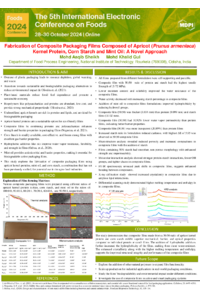
Fabrication of Composite Packaging Films Composed of Apricot (Prunus armeniaca) Kernel Protein, Corn Starch and Mint Oil: A Novel Approach

Mohd Aaqib Sheikh 1
1. Department of Food Process Engineering, National Institute of Technology, Rourkela (769008), Odisha, India
Abstract
In the present scenario, one of the most important ways to minimize waste and protect the ecological balance is to transform agricultural by-products into profitable commodities. A considerable quantity of apricot kernels produced from canning industries remains largely underutilized and undervalued. An initiative to advance sustainable development goals was undertaken by harnessing these apricot kernels. In this study, the impact of various film-forming matrices on the quality attributes of composite packaging films composed of apricot kernel protein isolate (AKPI), corn starch (CS) and mint oil (MO) at varied ratios of 100:0:0, 90:10:1, 80:20:1; 70:30:1, 60:40:1, and 50:50:1 was explored. The study outcomes revealed that each film-forming solution produced self-supporting and easily peelable packaging films. A composite film comprising 50% AKPI, 50% CS, and 10% MO (P50C50O1) was observed to have favorable properties among the explored formulations. The P50C50O1 film showed 1.96-fold superior thermal stability, 1.35-fold higher tensile strength, and a 1.65-fold reduction in water vapor permeability than the AKPI film, indicating a smaller presence of moisture and the enhanced tortuosity of the vapor diffusion pathway. Microstructure analysis exhibited smoother and more uniformly entrapped MO in P50C50O1 film, while X-ray diffraction patterns indicated a rise in crystallinity and improved interactions between molecules. Compared to AKPI film, P50C50O1 composite film showed the highest color difference of 6.19, suggesting a reduction in the purity of the dark greenish color. The study outcomes thus demonstrate a novel approach to fabricating composite packaging films by utilizing agro-food waste (apricot kernels), providing a sustainable solution for utilizing by-products from apricot processing industries.
Keywords
Waste utilization
Packaging films
Apricot kernel protein
Corn starch
Biodegradability
sustainability
Poster
Packaging poster.pdf
Use of electronic nose technology to predict acrylamide formation in roasted almonds
Exploratory survey of qPCR-HRM potential in differentiating Saccharomyces cerevisiae var. boulardii in probiotic-enriched matrices