Event submissions
Published
This submission belongs to the session S8. Food Quality and Safety of the event The 5th International Electronic Conference on Foods
Published date
28 Oct, 2024
Academic Editor
'%3e%3cpath%20d='M12.6657%2010.9104C12.4185%2010.325%2012.0599%209.79327%2011.6097%209.34482C11.1609%208.89508%2010.6293%208.5365%2010.0442%208.28888C10.0389%208.28626%2010.0337%208.28495%2010.0285%208.28233C10.8446%207.69279%2011.3752%206.73249%2011.3752%205.64904C11.3752%203.8542%209.92103%202.39999%208.1262%202.39999C6.33136%202.39999%204.87715%203.8542%204.87715%205.64904C4.87715%206.73249%205.40774%207.69279%206.22393%208.28364C6.21869%208.28626%206.21345%208.28757%206.20821%208.29019C5.62129%208.5378%205.09463%208.89284%204.64265%209.34613C4.1929%209.79493%203.83432%2010.3266%203.58671%2010.9117C3.34345%2011.4845%203.21226%2012.0987%203.20023%2012.7209C3.19988%2012.7349%203.20233%2012.7488%203.20744%2012.7619C3.21255%2012.7749%203.22022%2012.7867%203.22998%2012.7968C3.23975%2012.8068%203.25142%2012.8147%203.26431%2012.8202C3.2772%2012.8256%203.29105%2012.8284%203.30504%2012.8284H4.09109C4.14874%2012.8284%204.19459%2012.7825%204.1959%2012.7262C4.2221%2011.7148%204.62823%2010.7676%205.34617%2010.0497C6.08899%209.30683%207.0755%208.89808%208.1262%208.89808C9.17689%208.89808%2010.1634%209.30683%2010.9062%2010.0497C11.6242%2010.7676%2012.0303%2011.7148%2012.0565%2012.7262C12.0578%2012.7838%2012.1037%2012.8284%2012.1613%2012.8284H12.9474C12.9613%2012.8284%2012.9752%2012.8256%2012.9881%2012.8202C13.001%2012.8147%2013.0126%2012.8068%2013.0224%2012.7968C13.0322%2012.7867%2013.0398%2012.7749%2013.0449%2012.7619C13.0501%2012.7488%2013.0525%2012.7349%2013.0522%2012.7209C13.0391%2012.0947%2012.9094%2011.4855%2012.6657%2010.9104ZM8.1262%207.9024C7.52486%207.9024%206.9589%207.6679%206.53312%207.24211C6.10733%206.81633%205.87283%206.25037%205.87283%205.64904C5.87283%205.0477%206.10733%204.48174%206.53312%204.05596C6.9589%203.63018%207.52486%203.39567%208.1262%203.39567C8.72753%203.39567%209.29349%203.63018%209.71927%204.05596C10.1451%204.48174%2010.3796%205.0477%2010.3796%205.64904C10.3796%206.25037%2010.1451%206.81633%209.71927%207.24211C9.29349%207.6679%208.72753%207.9024%208.1262%207.9024Z'%20fill='%235D1EE1'/%3e%3c/g%3e%3c/svg%3e) Antonello Santini
Antonello SantiniCitation
Monika Borkowska, Michał Kułakowski, Exploratory survey of qPCR-HRM potential in differentiating Saccharomyces cerevisiae var. boulardii in probiotic-enriched matrices, in Proceedings of The 5th International Electronic Conference on Foods, 28 October–30 October 2024, MDPI: Basel, Switzerland
Share
Email
Facebook
Twitter
LinkedIn
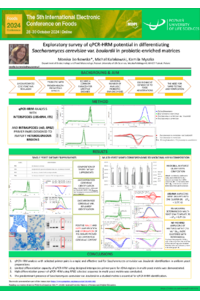
Exploratory survey of qPCR-HRM potential in differentiating Saccharomyces cerevisiae var. boulardii in probiotic-enriched matrices
'%3e%3cpath%20d='M12.6647%2010.9104C12.4176%2010.325%2012.0589%209.7933%2011.6088%209.34485C11.16%208.89511%2010.6283%208.53653%2010.0432%208.28891C10.038%208.28629%2010.0327%208.28498%2010.0275%208.28236C10.8437%207.69282%2011.3743%206.73252%2011.3743%205.64907C11.3743%203.85423%209.92005%202.40002%208.12522%202.40002C6.33038%202.40002%204.87618%203.85423%204.87618%205.64907C4.87618%206.73252%205.40677%207.69282%206.22296%208.28367C6.21772%208.28629%206.21248%208.2876%206.20724%208.29022C5.62031%208.53783%205.09365%208.89287%204.64167%209.34616C4.19192%209.79496%203.83334%2010.3266%203.58573%2010.9117C3.34247%2011.4846%203.21128%2012.0987%203.19925%2012.721C3.1989%2012.735%203.20135%2012.7489%203.20646%2012.7619C3.21157%2012.7749%203.21924%2012.7868%203.22901%2012.7968C3.23877%2012.8068%203.25045%2012.8148%203.26334%2012.8202C3.27623%2012.8256%203.29007%2012.8284%203.30406%2012.8284H4.09012C4.14776%2012.8284%204.19362%2012.7825%204.19493%2012.7262C4.22113%2011.7148%204.62726%2010.7676%205.34519%2010.0497C6.08802%209.30686%207.07452%208.89811%208.12522%208.89811C9.17592%208.89811%2010.1624%209.30686%2010.9052%2010.0497C11.6232%2010.7676%2012.0293%2011.7148%2012.0555%2012.7262C12.0568%2012.7839%2012.1027%2012.8284%2012.1603%2012.8284H12.9464C12.9604%2012.8284%2012.9742%2012.8256%2012.9871%2012.8202C13%2012.8148%2013.0117%2012.8068%2013.0214%2012.7968C13.0312%2012.7868%2013.0389%2012.7749%2013.044%2012.7619C13.0491%2012.7489%2013.0515%2012.735%2013.0512%2012.721C13.0381%2012.0947%2012.9084%2011.4856%2012.6647%2010.9104ZM8.12522%207.90243C7.52388%207.90243%206.95792%207.66793%206.53214%207.24215C6.10636%206.81636%205.87185%206.2504%205.87185%205.64907C5.87185%205.04773%206.10636%204.48177%206.53214%204.05599C6.95792%203.63021%207.52388%203.3957%208.12522%203.3957C8.72655%203.3957%209.29252%203.63021%209.7183%204.05599C10.1441%204.48177%2010.3786%205.04773%2010.3786%205.64907C10.3786%206.2504%2010.1441%206.81636%209.7183%207.24215C9.29252%207.66793%208.72655%207.90243%208.12522%207.90243Z'%20fill='%235D1EE1'/%3e%3c/g%3e%3c/svg%3e)
Monika Borkowska 1
Michał Kułakowski 1
1. Department of Biotechnology and Food Microbiology, Poznan University of Life Sciences, ul. Wojska Polskiego 48, 60-637 Poznań, Poland
Abstract
Introduction: Currently, the only probiotic yeast with clinically proven health-promoting effects for several gastrointestinal disorders in adults and children is Saccharomyces cerevisiae var. boulardii (Sb). The probiotic properties of this yeast have been proven to be strain-dependent. Of note, probiotics were taken in the past as a common panacea for lifestyle diseases. Therefore, probiotic preparations are accessible worldwide as preventive agents. Dietary supplements, including thosen that are Sb-fortified, are regulated as food is in the market. The current state of regulations and the growing supplement availability create an environment conducive to food adulteration, necessitating rapid testing for product verification.
Method: Due to the significant genetic similarity of Sb to Saccharomyces cerevisiae, qPCR-HRM analysis was was used for testing, which has a very high sensitivity for polymorphism detection and enables the simultaneous identification of the microorganism in the presence of a reference sample. The effectiveness of interspecies and intragenus primer pairs designed to amplify heterogeneous regions was examined.
Results: qPCR-HRM analysis using interspecies 18SrRNA and ITS sequences optimized in culture-dependent analysis identified Sb at the species level, while intraspecies HO and RPB2 sequences were identified at the variety level in single-yeast dietary supplements. The region amplification test of HXT9 and MAL11 verified additionally the physiological properties of the strains used in probiotic supplements. The low variability in sequences amplified by interspecies primer pairs in qPCR-HRM analysis prevented the differentiation of Sb in yeast mixtures. In contrast, identifying Sb with designed intragenus-specific primer pairs succeeded in establishing multi-yeast suspensions. The RPB2 sequence showed the highest intraspecies differentiation power. However, qPCR-HRM analysis identified Sb only with the prevalence of the variety quantity in the microbial matrix.
Conclusions:
- The predominant presence of probiotics in a matrix is essential for qPCR-HRM identification.
- There is limited differentiation capacity for qPCR-HRM using interspecies primer pairs for rDNA regions in a multi-yeast matrix.
- There is a high differentiation power of qPCR-HRM using the RPB2 selected sequence in a multi-yeast matrix.
Keywords
Saccharomyces cerevisiae var. boulardii
identification
qPCR-HRM analysis
probiotic
dietary supplement
probiotic-enriched food
Poster
Poster_Borkowska M.pdf
Fabrication of Composite Packaging Films Composed of Apricot (Prunus armeniaca) Kernel Protein, Corn Starch and Mint Oil: A Novel Approach
Measurement of the acoustic phase velocity of trade butters by means of the ultrasonic transmission technique