Event submissions
Published
This submission belongs to the session S3. Sustainable Food Security and Food System of the event The 5th International Electronic Conference on Foods
Published date
28 Oct, 2024
Academic Editor
'%3e%3cpath%20d='M12.6657%2010.9104C12.4185%2010.325%2012.0599%209.79327%2011.6097%209.34482C11.1609%208.89508%2010.6293%208.5365%2010.0442%208.28888C10.0389%208.28626%2010.0337%208.28495%2010.0285%208.28233C10.8446%207.69279%2011.3752%206.73249%2011.3752%205.64904C11.3752%203.8542%209.92103%202.39999%208.1262%202.39999C6.33136%202.39999%204.87715%203.8542%204.87715%205.64904C4.87715%206.73249%205.40774%207.69279%206.22393%208.28364C6.21869%208.28626%206.21345%208.28757%206.20821%208.29019C5.62129%208.5378%205.09463%208.89284%204.64265%209.34613C4.1929%209.79493%203.83432%2010.3266%203.58671%2010.9117C3.34345%2011.4845%203.21226%2012.0987%203.20023%2012.7209C3.19988%2012.7349%203.20233%2012.7488%203.20744%2012.7619C3.21255%2012.7749%203.22022%2012.7867%203.22998%2012.7968C3.23975%2012.8068%203.25142%2012.8147%203.26431%2012.8202C3.2772%2012.8256%203.29105%2012.8284%203.30504%2012.8284H4.09109C4.14874%2012.8284%204.19459%2012.7825%204.1959%2012.7262C4.2221%2011.7148%204.62823%2010.7676%205.34617%2010.0497C6.08899%209.30683%207.0755%208.89808%208.1262%208.89808C9.17689%208.89808%2010.1634%209.30683%2010.9062%2010.0497C11.6242%2010.7676%2012.0303%2011.7148%2012.0565%2012.7262C12.0578%2012.7838%2012.1037%2012.8284%2012.1613%2012.8284H12.9474C12.9613%2012.8284%2012.9752%2012.8256%2012.9881%2012.8202C13.001%2012.8147%2013.0126%2012.8068%2013.0224%2012.7968C13.0322%2012.7867%2013.0398%2012.7749%2013.0449%2012.7619C13.0501%2012.7488%2013.0525%2012.7349%2013.0522%2012.7209C13.0391%2012.0947%2012.9094%2011.4855%2012.6657%2010.9104ZM8.1262%207.9024C7.52486%207.9024%206.9589%207.6679%206.53312%207.24211C6.10733%206.81633%205.87283%206.25037%205.87283%205.64904C5.87283%205.0477%206.10733%204.48174%206.53312%204.05596C6.9589%203.63018%207.52486%203.39567%208.1262%203.39567C8.72753%203.39567%209.29349%203.63018%209.71927%204.05596C10.1451%204.48174%2010.3796%205.0477%2010.3796%205.64904C10.3796%206.25037%2010.1451%206.81633%209.71927%207.24211C9.29349%207.6679%208.72753%207.9024%208.1262%207.9024Z'%20fill='%235D1EE1'/%3e%3c/g%3e%3c/svg%3e) Theodoros Varzakas
Theodoros VarzakasCitation
Ouarda DJAOUDENE, Mostapha Bachir bey, Connie Schisano, Sabrina Djebari, Gian Carlo Tenore, Anabela Romano, Green approach to phenolic compound extraction from date fruit (Phoenix dactylifera L.), in Proceedings of The 5th International Electronic Conference on Foods, 28 October–30 October 2024, MDPI: Basel, Switzerland
Share
Email
Facebook
Twitter
LinkedIn
Green approach to phenolic compound extraction from date fruit (Phoenix dactylifera L.)
'%3e%3cpath%20d='M12.6647%2010.9104C12.4176%2010.325%2012.0589%209.7933%2011.6088%209.34485C11.16%208.89511%2010.6283%208.53653%2010.0432%208.28891C10.038%208.28629%2010.0327%208.28498%2010.0275%208.28236C10.8437%207.69282%2011.3743%206.73252%2011.3743%205.64907C11.3743%203.85423%209.92005%202.40002%208.12522%202.40002C6.33038%202.40002%204.87618%203.85423%204.87618%205.64907C4.87618%206.73252%205.40677%207.69282%206.22296%208.28367C6.21772%208.28629%206.21248%208.2876%206.20724%208.29022C5.62031%208.53783%205.09365%208.89287%204.64167%209.34616C4.19192%209.79496%203.83334%2010.3266%203.58573%2010.9117C3.34247%2011.4846%203.21128%2012.0987%203.19925%2012.721C3.1989%2012.735%203.20135%2012.7489%203.20646%2012.7619C3.21157%2012.7749%203.21924%2012.7868%203.22901%2012.7968C3.23877%2012.8068%203.25045%2012.8148%203.26334%2012.8202C3.27623%2012.8256%203.29007%2012.8284%203.30406%2012.8284H4.09012C4.14776%2012.8284%204.19362%2012.7825%204.19493%2012.7262C4.22113%2011.7148%204.62726%2010.7676%205.34519%2010.0497C6.08802%209.30686%207.07452%208.89811%208.12522%208.89811C9.17592%208.89811%2010.1624%209.30686%2010.9052%2010.0497C11.6232%2010.7676%2012.0293%2011.7148%2012.0555%2012.7262C12.0568%2012.7839%2012.1027%2012.8284%2012.1603%2012.8284H12.9464C12.9604%2012.8284%2012.9742%2012.8256%2012.9871%2012.8202C13%2012.8148%2013.0117%2012.8068%2013.0214%2012.7968C13.0312%2012.7868%2013.0389%2012.7749%2013.044%2012.7619C13.0491%2012.7489%2013.0515%2012.735%2013.0512%2012.721C13.0381%2012.0947%2012.9084%2011.4856%2012.6647%2010.9104ZM8.12522%207.90243C7.52388%207.90243%206.95792%207.66793%206.53214%207.24215C6.10636%206.81636%205.87185%206.2504%205.87185%205.64907C5.87185%205.04773%206.10636%204.48177%206.53214%204.05599C6.95792%203.63021%207.52388%203.3957%208.12522%203.3957C8.72655%203.3957%209.29252%203.63021%209.7183%204.05599C10.1441%204.48177%2010.3786%205.04773%2010.3786%205.64907C10.3786%206.2504%2010.1441%206.81636%209.7183%207.24215C9.29252%207.66793%208.72655%207.90243%208.12522%207.90243Z'%20fill='%235D1EE1'/%3e%3c/g%3e%3c/svg%3e)
Ouarda DJAOUDENE 1
Mostapha Bachir bey 2
Connie Schisano 3
Sabrina Djebari 4

Gian Carlo Tenore 3
Anabela Romano 5
1. Centre de Recherche en Technologies Agroalimentaires
2. Département des Sciences Alimentaires, Laboratoire de Biochimie Appliquée, Faculté des Sciences de la Nature et de la Vie, Université de Bejaia, 06000, Bejaia, Algérie
3. Department of Pharmacy, University of Naples Federico II, 80131 Napoli, Italy
4. Laboratoire de Biomathématiques, Biophysique, Biochimie et Scientométrie (L3BS), Faculté des Sciences de la Nature et de la Vie, Université de Bejaia, 06000, Bejaia, Algeria
5. MED – Mediterranean Institute for Agriculture, Environment and Development & CHANGE – Global Change and Sustainability Institute, Universidade do Algarve, Faculdade de Ciências e Tecnologia, Campus de Gambelas, Ed. 8, 8005‑139 Faro, Portugal
Abstract
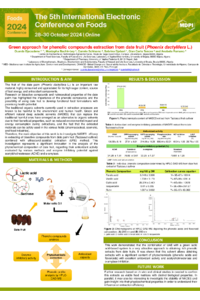
In recent times, green and efficient natural deep eutectic solvents (NADESs) that can replace harmful traditional ones have attracted considerable attention. The objective of the present study was to investigate a sustainable method for enhancing the extraction of phytochemicals from date palm fruit (Tazizaout cultivar), a valuable source of bioactive compounds. In this study, lactic acid/sucrose-based NADESs were employed as an alternative to conventional chemical solvents, in conjunction with the ultrasound-assisted extraction (UAE) method. Subsequently, the extracts were subjected to analysis in order to determine their bioactive compound contents, phenolic composition, antioxidant activity, and enzyme inhibitory potential. The results demonstrated that the Tazizaout extract contained considerable contents of total phenolics (570.8 mg GAE/100 g), total flavonoids (40.3 mg QE/100 g), proanthocyanidins (38.8 mg CE/100 g), and total triterpenoids (9.72 mg OAE/100 g). The cultivar displayed high antioxidant capacity against the ABTS•+ cation radical (214 mg TE/100 g) and ferric-reducing antioxidant potential (136 mg AAE/100 g). The extract exhibited moderate antioxidant activity when tested using the DPPH•, phosphomolybdenum, NO•, and linoleic acid lipid peroxidation assays. Furthermore, the extract exhibited notable inhibitory effects on α-amylase and acetylcholinesterase enzymes in vitro, with inhibition rates of 33% and 34%, respectively. High-performance liquid chromatography with diode array detection and mass spectrometry (HPLC-DAD-MS) identified a total of five compounds (three phenolic acids and two flavonoids) as the main phenolics present in the extract, with the predominant compound being gallic acid. The results indicated that the combination of UAE and NADESs represents a novel and useful alternative to chemical solvents for sustainable and green extraction. This approach could have implications for industries seeking eco-friendly alternatives for the extraction of phytochemicals, with potential applications in foods, pharmaceuticals, and other related sectors.
Keywords
Sustainable extraction
phenolic compounds
natural deep eutectic solvents
date fruit
ultrasound-assisted extraction
bioactivity
Poster
DJAOUDENE O. (green extraction).pdf
Microbial Spoilage Mitigation in Biodegradable Cheese Packaging via Protective Lactobacillus Coating
Potato Protein Concentrate: Enhancing Quality Through Sustainable Phenolic Reduction Method