Event submissions
Published
This submission belongs to the session S8. Food Quality and Safety of the event The 5th International Electronic Conference on Foods
Published date
28 Oct, 2024
Academic Editor
'%3e%3cpath%20d='M12.6657%2010.9104C12.4185%2010.325%2012.0599%209.79327%2011.6097%209.34482C11.1609%208.89508%2010.6293%208.5365%2010.0442%208.28888C10.0389%208.28626%2010.0337%208.28495%2010.0285%208.28233C10.8446%207.69279%2011.3752%206.73249%2011.3752%205.64904C11.3752%203.8542%209.92103%202.39999%208.1262%202.39999C6.33136%202.39999%204.87715%203.8542%204.87715%205.64904C4.87715%206.73249%205.40774%207.69279%206.22393%208.28364C6.21869%208.28626%206.21345%208.28757%206.20821%208.29019C5.62129%208.5378%205.09463%208.89284%204.64265%209.34613C4.1929%209.79493%203.83432%2010.3266%203.58671%2010.9117C3.34345%2011.4845%203.21226%2012.0987%203.20023%2012.7209C3.19988%2012.7349%203.20233%2012.7488%203.20744%2012.7619C3.21255%2012.7749%203.22022%2012.7867%203.22998%2012.7968C3.23975%2012.8068%203.25142%2012.8147%203.26431%2012.8202C3.2772%2012.8256%203.29105%2012.8284%203.30504%2012.8284H4.09109C4.14874%2012.8284%204.19459%2012.7825%204.1959%2012.7262C4.2221%2011.7148%204.62823%2010.7676%205.34617%2010.0497C6.08899%209.30683%207.0755%208.89808%208.1262%208.89808C9.17689%208.89808%2010.1634%209.30683%2010.9062%2010.0497C11.6242%2010.7676%2012.0303%2011.7148%2012.0565%2012.7262C12.0578%2012.7838%2012.1037%2012.8284%2012.1613%2012.8284H12.9474C12.9613%2012.8284%2012.9752%2012.8256%2012.9881%2012.8202C13.001%2012.8147%2013.0126%2012.8068%2013.0224%2012.7968C13.0322%2012.7867%2013.0398%2012.7749%2013.0449%2012.7619C13.0501%2012.7488%2013.0525%2012.7349%2013.0522%2012.7209C13.0391%2012.0947%2012.9094%2011.4855%2012.6657%2010.9104ZM8.1262%207.9024C7.52486%207.9024%206.9589%207.6679%206.53312%207.24211C6.10733%206.81633%205.87283%206.25037%205.87283%205.64904C5.87283%205.0477%206.10733%204.48174%206.53312%204.05596C6.9589%203.63018%207.52486%203.39567%208.1262%203.39567C8.72753%203.39567%209.29349%203.63018%209.71927%204.05596C10.1451%204.48174%2010.3796%205.0477%2010.3796%205.64904C10.3796%206.25037%2010.1451%206.81633%209.71927%207.24211C9.29349%207.6679%208.72753%207.9024%208.1262%207.9024Z'%20fill='%235D1EE1'/%3e%3c/g%3e%3c/svg%3e) Antonello Santini
Antonello SantiniCitation
RAGHU VISHWESWARAIAH, Shreya Saha, Pushpalatha K, Shreya Talan, Naresh Kumar, Rashmi Hogarehalli Mallappa, Paper-based strip sensor for monitoring of contaminants in milk, in Proceedings of The 5th International Electronic Conference on Foods, 28 October–30 October 2024, MDPI: Basel, Switzerland
Share
Email
Facebook
Twitter
LinkedIn
Paper-based strip sensor for monitoring of contaminants in milk

RAGHU VISHWESWARAIAH 1
'%3e%3cpath%20d='M12.6647%2010.9104C12.4176%2010.325%2012.0589%209.7933%2011.6088%209.34485C11.16%208.89511%2010.6283%208.53653%2010.0432%208.28891C10.038%208.28629%2010.0327%208.28498%2010.0275%208.28236C10.8437%207.69282%2011.3743%206.73252%2011.3743%205.64907C11.3743%203.85423%209.92005%202.40002%208.12522%202.40002C6.33038%202.40002%204.87618%203.85423%204.87618%205.64907C4.87618%206.73252%205.40677%207.69282%206.22296%208.28367C6.21772%208.28629%206.21248%208.2876%206.20724%208.29022C5.62031%208.53783%205.09365%208.89287%204.64167%209.34616C4.19192%209.79496%203.83334%2010.3266%203.58573%2010.9117C3.34247%2011.4846%203.21128%2012.0987%203.19925%2012.721C3.1989%2012.735%203.20135%2012.7489%203.20646%2012.7619C3.21157%2012.7749%203.21924%2012.7868%203.22901%2012.7968C3.23877%2012.8068%203.25045%2012.8148%203.26334%2012.8202C3.27623%2012.8256%203.29007%2012.8284%203.30406%2012.8284H4.09012C4.14776%2012.8284%204.19362%2012.7825%204.19493%2012.7262C4.22113%2011.7148%204.62726%2010.7676%205.34519%2010.0497C6.08802%209.30686%207.07452%208.89811%208.12522%208.89811C9.17592%208.89811%2010.1624%209.30686%2010.9052%2010.0497C11.6232%2010.7676%2012.0293%2011.7148%2012.0555%2012.7262C12.0568%2012.7839%2012.1027%2012.8284%2012.1603%2012.8284H12.9464C12.9604%2012.8284%2012.9742%2012.8256%2012.9871%2012.8202C13%2012.8148%2013.0117%2012.8068%2013.0214%2012.7968C13.0312%2012.7868%2013.0389%2012.7749%2013.044%2012.7619C13.0491%2012.7489%2013.0515%2012.735%2013.0512%2012.721C13.0381%2012.0947%2012.9084%2011.4856%2012.6647%2010.9104ZM8.12522%207.90243C7.52388%207.90243%206.95792%207.66793%206.53214%207.24215C6.10636%206.81636%205.87185%206.2504%205.87185%205.64907C5.87185%205.04773%206.10636%204.48177%206.53214%204.05599C6.95792%203.63021%207.52388%203.3957%208.12522%203.3957C8.72655%203.3957%209.29252%203.63021%209.7183%204.05599C10.1441%204.48177%2010.3786%205.04773%2010.3786%205.64907C10.3786%206.2504%2010.1441%206.81636%209.7183%207.24215C9.29252%207.66793%208.72655%207.90243%208.12522%207.90243Z'%20fill='%235D1EE1'/%3e%3c/g%3e%3c/svg%3e)
Shreya Saha 2
Pushpalatha K 2
Shreya Talan 2
Naresh Kumar 2
Rashmi Hogarehalli Mallappa 2
1. Dairy Microbiology Division, ICAR-National Dairy Research Institute, Karnal, 132001, India
2. ICAR-National dairy Research Institute
Abstract
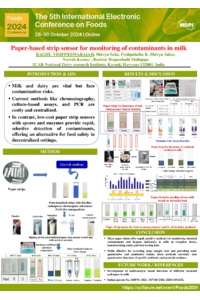
Introduction: Milk and dairy are vital but face contamination risks. Current methods like chromatography, culture-based assays, and PCR are costly and centralized. In contrast, low-cost paper strip sensors with spores and enzymes provide rapid, selective detection of contaminants, offering an alternative for food safety in decentralized settings.
Methods: Whatman filter papers were modified with Bacillus spores and chromogenic substrates to detect antibiotic and pesticide residues. Enzyme-specific chromogenic substrates targeted mastitis, hygiene, and safety indicator organisms. The PANI-PEC paper strip sensor utilized conducting polymer and selective medium. Samples (100-250 µl) underwent incubation with paper strips under optimized conditions: 1.5 h for antibiotic and pesticide residues, 6 minutes for mastitis, 20 min. for total plate count, and 6-10 h for hygiene and safety indicators. Developed sensors were evaluated using various milk ( pasteurized milk, dried milks, indigeneous dairy products, ice cream, butter) and food samples (cereals, fruits and vegetable, meat and egg) (n=1000), with results compared against established regulatory methods. Statistical analysis was conducted.
Results: Bacillus spores inhibited marker enzyme activity in milk samples containing antibiotic and pesticide residues, preventing blue color development on strips; residue-free samples exhibited enzymatic hydrolysis, resulting in blue coloration. Mastitis detection correlated marker enzyme activity with somatic cell counts in milk, with higher counts indicating mastitis. PANI-PEC strips detected hygiene indicators via pH and conductivity changes, altering strip color from blue to green. Specific marker enzymes targeted E. coli, Listeria monocytogenes, and Salmonella, inducing color changes on strips to yellow, blue, or bluish-green. Paper strips demonstrated 100% correlation with regulatory methods.
Conclusions: These paper strips offer a rapid, sensitive method for monitoring chemical contaminants and hygiene indicators in milk at reception docks, manufacturing units, and food testing labs. While effective for screening large sample sizes and providing semi-quantitative and qualitative results, these methods currently do not allow for quantitative detection of specific antibiotic and pesticide residues.
Keywords
paper
sensor
monitoring
chemical
hygiene
safety
indicator
contaminants
milk
Poster
Poster for Mdi food electronic conference.pdf
A case study about the perception of food safety in consumers of fresh produce from local and small farms in the North of Portugal
Human-related microsporidian spores in farm chickens from Makeni, Sierra Leone