Event submissions
Published
This submission belongs to the session S2. Food Nutrition and Functional Foods of the event The 5th International Electronic Conference on Foods
Published date
28 Oct, 2024
Academic Editor
'%3e%3cpath%20d='M12.6657%2010.9104C12.4185%2010.325%2012.0599%209.79327%2011.6097%209.34482C11.1609%208.89508%2010.6293%208.5365%2010.0442%208.28888C10.0389%208.28626%2010.0337%208.28495%2010.0285%208.28233C10.8446%207.69279%2011.3752%206.73249%2011.3752%205.64904C11.3752%203.8542%209.92103%202.39999%208.1262%202.39999C6.33136%202.39999%204.87715%203.8542%204.87715%205.64904C4.87715%206.73249%205.40774%207.69279%206.22393%208.28364C6.21869%208.28626%206.21345%208.28757%206.20821%208.29019C5.62129%208.5378%205.09463%208.89284%204.64265%209.34613C4.1929%209.79493%203.83432%2010.3266%203.58671%2010.9117C3.34345%2011.4845%203.21226%2012.0987%203.20023%2012.7209C3.19988%2012.7349%203.20233%2012.7488%203.20744%2012.7619C3.21255%2012.7749%203.22022%2012.7867%203.22998%2012.7968C3.23975%2012.8068%203.25142%2012.8147%203.26431%2012.8202C3.2772%2012.8256%203.29105%2012.8284%203.30504%2012.8284H4.09109C4.14874%2012.8284%204.19459%2012.7825%204.1959%2012.7262C4.2221%2011.7148%204.62823%2010.7676%205.34617%2010.0497C6.08899%209.30683%207.0755%208.89808%208.1262%208.89808C9.17689%208.89808%2010.1634%209.30683%2010.9062%2010.0497C11.6242%2010.7676%2012.0303%2011.7148%2012.0565%2012.7262C12.0578%2012.7838%2012.1037%2012.8284%2012.1613%2012.8284H12.9474C12.9613%2012.8284%2012.9752%2012.8256%2012.9881%2012.8202C13.001%2012.8147%2013.0126%2012.8068%2013.0224%2012.7968C13.0322%2012.7867%2013.0398%2012.7749%2013.0449%2012.7619C13.0501%2012.7488%2013.0525%2012.7349%2013.0522%2012.7209C13.0391%2012.0947%2012.9094%2011.4855%2012.6657%2010.9104ZM8.1262%207.9024C7.52486%207.9024%206.9589%207.6679%206.53312%207.24211C6.10733%206.81633%205.87283%206.25037%205.87283%205.64904C5.87283%205.0477%206.10733%204.48174%206.53312%204.05596C6.9589%203.63018%207.52486%203.39567%208.1262%203.39567C8.72753%203.39567%209.29349%203.63018%209.71927%204.05596C10.1451%204.48174%2010.3796%205.0477%2010.3796%205.64904C10.3796%206.25037%2010.1451%206.81633%209.71927%207.24211C9.29349%207.6679%208.72753%207.9024%208.1262%207.9024Z'%20fill='%235D1EE1'/%3e%3c/g%3e%3c/svg%3e) Manuel Viuda-Martos
Manuel Viuda-MartosCitation
Mauro Lombardo, MODULATION OF COAGULATION AND PLATELET FUNCTION WITH RED WINE: INSIGHTS FROM CLINICAL EVIDENCE, in Proceedings of The 5th International Electronic Conference on Foods, 28 October–30 October 2024, MDPI: Basel, Switzerland
Share
Email
Facebook
Twitter
LinkedIn
MODULATION OF COAGULATION AND PLATELET FUNCTION WITH RED WINE: INSIGHTS FROM CLINICAL EVIDENCE

Mauro Lombardo 1
1. Department of Human Sciences and Promotion of the Quality of Life - San Raffaele Roma Open University
Abstract
Background and Aims
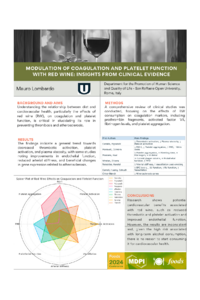
Understanding the relationship between diet and cardiovascular health, particularly the effects of red wine (RW), on coagulation and platelet function, is critical in elucidating its role in preventing thrombosis and atherosclerosis.
Methods
A comprehensive review of 20 clinical studies was conducted, focusing on the effects of RW consumption on coagulation markers such as prothrombin fragments (n=7), activated factor VII (n=5), fibrinogen levels (n=8), and platelet aggregation (n=10). The review included studies with sample sizes ranging from 30 to 200 participants and RW intake varying from 1 to 3 glasses per day over periods of 2 weeks to 6 months.
Results
The findings indicate a trend towards decreased thrombotic and platelet activation and reduced plasma viscosity. Studies showed reduced thrombotic and platelet activation, decreases in PAI-1 and platelet aggregation, and increased FMD and nitric oxide levels. Some reported no change in carotid plaque volume, endothelial function, fibrinogen, or D-dimer levels. Others observed increased arterial stiffness, improved vasodilation post-smoking, and beneficial changes in atherosclerosis-related gene expression. However, there were mixed results on bleeding time and left ventricular function.
Conclusions
While research indicates that RW consumption can lead to reduced thrombotic and platelet activation, decreased plasma viscosity, improved endothelial function, and reduced arterial stiffness, these potential cardiovascular benefits are overshadowed by the broader health risks associated with alcohol consumption. The evidence is not uniform, with some studies reporting no impact on variables such as bleeding time, carotid plaque volume, or fibrinogen levels. These findings underscore the complexity of RW's effects on health. Due to the significant health risks linked to alcohol intake, including addiction, liver disease, and increased cancer risk, the use of RW as a strategy for increasing cardiovascular health cannot be recommended.
Keywords
Red wine
cardiovascular health
coagulation
platelet function
thrombosis
atherosclerosis
endothelial function
arterial stiffness
gene expression
polyphenols
resveratrol
alcohol consumption
health risks
clinical studies
Poster
Poster di ricerca.pdf
Human-related microsporidian spores in farm chickens from Makeni, Sierra Leone
FATTY ACIDS AND IRON CONTENT IN A PUREE MADE FROM Sarda Chiliensis Chiliensis (BONITO) AND Ipomoea Batatas (YELLOW SWEET POTATO) FOR CHILDREN AGED 2 TO 3 YEARS IN LIMA, PERU