Event submissions
Published
This submission belongs to the session S2. Food Nutrition and Functional Foods of the event The 5th International Electronic Conference on Foods
Published date
28 Oct, 2024
Academic Editor
'%3e%3cpath%20d='M12.6657%2010.9104C12.4185%2010.325%2012.0599%209.79327%2011.6097%209.34482C11.1609%208.89508%2010.6293%208.5365%2010.0442%208.28888C10.0389%208.28626%2010.0337%208.28495%2010.0285%208.28233C10.8446%207.69279%2011.3752%206.73249%2011.3752%205.64904C11.3752%203.8542%209.92103%202.39999%208.1262%202.39999C6.33136%202.39999%204.87715%203.8542%204.87715%205.64904C4.87715%206.73249%205.40774%207.69279%206.22393%208.28364C6.21869%208.28626%206.21345%208.28757%206.20821%208.29019C5.62129%208.5378%205.09463%208.89284%204.64265%209.34613C4.1929%209.79493%203.83432%2010.3266%203.58671%2010.9117C3.34345%2011.4845%203.21226%2012.0987%203.20023%2012.7209C3.19988%2012.7349%203.20233%2012.7488%203.20744%2012.7619C3.21255%2012.7749%203.22022%2012.7867%203.22998%2012.7968C3.23975%2012.8068%203.25142%2012.8147%203.26431%2012.8202C3.2772%2012.8256%203.29105%2012.8284%203.30504%2012.8284H4.09109C4.14874%2012.8284%204.19459%2012.7825%204.1959%2012.7262C4.2221%2011.7148%204.62823%2010.7676%205.34617%2010.0497C6.08899%209.30683%207.0755%208.89808%208.1262%208.89808C9.17689%208.89808%2010.1634%209.30683%2010.9062%2010.0497C11.6242%2010.7676%2012.0303%2011.7148%2012.0565%2012.7262C12.0578%2012.7838%2012.1037%2012.8284%2012.1613%2012.8284H12.9474C12.9613%2012.8284%2012.9752%2012.8256%2012.9881%2012.8202C13.001%2012.8147%2013.0126%2012.8068%2013.0224%2012.7968C13.0322%2012.7867%2013.0398%2012.7749%2013.0449%2012.7619C13.0501%2012.7488%2013.0525%2012.7349%2013.0522%2012.7209C13.0391%2012.0947%2012.9094%2011.4855%2012.6657%2010.9104ZM8.1262%207.9024C7.52486%207.9024%206.9589%207.6679%206.53312%207.24211C6.10733%206.81633%205.87283%206.25037%205.87283%205.64904C5.87283%205.0477%206.10733%204.48174%206.53312%204.05596C6.9589%203.63018%207.52486%203.39567%208.1262%203.39567C8.72753%203.39567%209.29349%203.63018%209.71927%204.05596C10.1451%204.48174%2010.3796%205.0477%2010.3796%205.64904C10.3796%206.25037%2010.1451%206.81633%209.71927%207.24211C9.29349%207.6679%208.72753%207.9024%208.1262%207.9024Z'%20fill='%235D1EE1'/%3e%3c/g%3e%3c/svg%3e) Manuel Viuda-Martos
Manuel Viuda-MartosCitation
Alejandra Prieto, Paola Alexandra Meza, Mayra Lucía Anticona, Saby Inés Zegarra, FATTY ACIDS AND IRON CONTENT IN A PUREE MADE FROM Sarda Chiliensis Chiliensis (BONITO) AND Ipomoea Batatas (YELLOW SWEET POTATO) FOR CHILDREN AGED 2 TO 3 YEARS IN LIMA, PERU, in Proceedings of The 5th International Electronic Conference on Foods, 28 October–30 October 2024, MDPI: Basel, Switzerland
Share
Email
Facebook
Twitter
LinkedIn
FATTY ACIDS AND IRON CONTENT IN A PUREE MADE FROM Sarda Chiliensis Chiliensis (BONITO) AND Ipomoea Batatas (YELLOW SWEET POTATO) FOR CHILDREN AGED 2 TO 3 YEARS IN LIMA, PERU
'%3e%3cpath%20d='M12.6647%2010.9104C12.4176%2010.325%2012.0589%209.7933%2011.6088%209.34485C11.16%208.89511%2010.6283%208.53653%2010.0432%208.28891C10.038%208.28629%2010.0327%208.28498%2010.0275%208.28236C10.8437%207.69282%2011.3743%206.73252%2011.3743%205.64907C11.3743%203.85423%209.92005%202.40002%208.12522%202.40002C6.33038%202.40002%204.87618%203.85423%204.87618%205.64907C4.87618%206.73252%205.40677%207.69282%206.22296%208.28367C6.21772%208.28629%206.21248%208.2876%206.20724%208.29022C5.62031%208.53783%205.09365%208.89287%204.64167%209.34616C4.19192%209.79496%203.83334%2010.3266%203.58573%2010.9117C3.34247%2011.4846%203.21128%2012.0987%203.19925%2012.721C3.1989%2012.735%203.20135%2012.7489%203.20646%2012.7619C3.21157%2012.7749%203.21924%2012.7868%203.22901%2012.7968C3.23877%2012.8068%203.25045%2012.8148%203.26334%2012.8202C3.27623%2012.8256%203.29007%2012.8284%203.30406%2012.8284H4.09012C4.14776%2012.8284%204.19362%2012.7825%204.19493%2012.7262C4.22113%2011.7148%204.62726%2010.7676%205.34519%2010.0497C6.08802%209.30686%207.07452%208.89811%208.12522%208.89811C9.17592%208.89811%2010.1624%209.30686%2010.9052%2010.0497C11.6232%2010.7676%2012.0293%2011.7148%2012.0555%2012.7262C12.0568%2012.7839%2012.1027%2012.8284%2012.1603%2012.8284H12.9464C12.9604%2012.8284%2012.9742%2012.8256%2012.9871%2012.8202C13%2012.8148%2013.0117%2012.8068%2013.0214%2012.7968C13.0312%2012.7868%2013.0389%2012.7749%2013.044%2012.7619C13.0491%2012.7489%2013.0515%2012.735%2013.0512%2012.721C13.0381%2012.0947%2012.9084%2011.4856%2012.6647%2010.9104ZM8.12522%207.90243C7.52388%207.90243%206.95792%207.66793%206.53214%207.24215C6.10636%206.81636%205.87185%206.2504%205.87185%205.64907C5.87185%205.04773%206.10636%204.48177%206.53214%204.05599C6.95792%203.63021%207.52388%203.3957%208.12522%203.3957C8.72655%203.3957%209.29252%203.63021%209.7183%204.05599C10.1441%204.48177%2010.3786%205.04773%2010.3786%205.64907C10.3786%206.2504%2010.1441%206.81636%209.7183%207.24215C9.29252%207.66793%208.72655%207.90243%208.12522%207.90243Z'%20fill='%235D1EE1'/%3e%3c/g%3e%3c/svg%3e)
Alejandra Prieto 1
Paola Alexandra Meza 1

Mayra Lucía Anticona 1,2,3
Saby Inés Zegarra 1
1. Carrera de Nutrición y Dietética. Universidad Peruana de Ciencias Aplicadas, Facultad de Ciencias de la Salud, Av. Alameda San Marcos 370, 15067, Chorrillos, Lima, Perú.
2. Unidad de Investigación en Nutrición, Salud, Alimentos Funcionales y Nutracéuticos, Universidad San Ignacio de Loyola (UNUSAN-USIL), Av. La Fontana 550,15024, Lima, Perú.
3. Carrera de Nutrición y Dietética, Facultad de Ciencias de la Salud, Universidad San Ignacio de Loyola, Av. La Fontana 550,15024, Lima, Perú.
Abstract
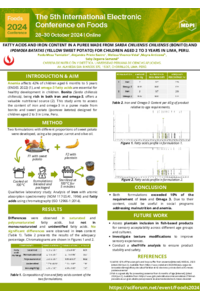
Introduction: Anemia and childhood malnutrition remain major public health problems in Peru, affecting mainly the child population. The effectiveness of current interventions remains limited, despite the efforts being made. It is in this context that the potential of the bonito fish as a food resource to address these problems is being investigated. The objective was to determine the fatty acid profile and iron content of a puree made from Sarda chiliensis chiliensis (bonito) and Ipomoea batatas (yellow sweet potato) for children aged 2 to 3 years in Lima, Peru. Methodology: A qualitative laboratory study was carried out to develop two puree formulations. Fatty acid analysis, including that of Omega-3, was performed using gas chromatography based on ISO 12966-1:2014. The iron content was measured through atomic absorption spectrometry following the NOM 117-SSA1 (1994) standard. Results: No significant difference in iron levels was found between the formulations. Significant differences (p<0.05) were observed in the levels of saturated and polyunsaturated fatty acids, but not in monounsaturated and unidentified fatty acids. Both formulations provided substantial amounts of Omega-3 fatty acids, including EPA and DHA. Conclusions: Both formulations prominently featured mono- and polyunsaturated fatty acids, successfully covering more than 10% of the daily requirements for Omega-3 fatty acids in children aged 2 to 3 years. Additionally, both formulations contained 5 mg/100 g, meeting over 10% of the daily iron requirements for this age group. Due to their Omega-3 and iron contents, these purees could be used in social programs aimed at addressing malnutrition and anemia in this age group.
Keywords
Fish products
Fatty Acids
Omega-3
Iron
Child Nutritional Requirements.
Poster
FATTY ACIDS AND IRON CONTENT IN A PUREE MADE FROM Sarda Chiliensis Chiliensis (BONITO) AND Ipomoea Batatas (YELLOW SWEET POTATO) FOR CHILDREN AGED 2 TO 3 YEARS IN LIMA, PERU..pdf
MODULATION OF COAGULATION AND PLATELET FUNCTION WITH RED WINE: INSIGHTS FROM CLINICAL EVIDENCE
Evaluation of GABA and GA Content in Cereals (Wheat, Spelt, Barley, Millet) Undergoing Germination