Event submissions
Published
This submission belongs to the session S2. Food Nutrition and Functional Foods of the event The 5th International Electronic Conference on Foods
Published date
28 Oct, 2024
Academic Editor
'%3e%3cpath%20d='M12.6657%2010.9104C12.4185%2010.325%2012.0599%209.79327%2011.6097%209.34482C11.1609%208.89508%2010.6293%208.5365%2010.0442%208.28888C10.0389%208.28626%2010.0337%208.28495%2010.0285%208.28233C10.8446%207.69279%2011.3752%206.73249%2011.3752%205.64904C11.3752%203.8542%209.92103%202.39999%208.1262%202.39999C6.33136%202.39999%204.87715%203.8542%204.87715%205.64904C4.87715%206.73249%205.40774%207.69279%206.22393%208.28364C6.21869%208.28626%206.21345%208.28757%206.20821%208.29019C5.62129%208.5378%205.09463%208.89284%204.64265%209.34613C4.1929%209.79493%203.83432%2010.3266%203.58671%2010.9117C3.34345%2011.4845%203.21226%2012.0987%203.20023%2012.7209C3.19988%2012.7349%203.20233%2012.7488%203.20744%2012.7619C3.21255%2012.7749%203.22022%2012.7867%203.22998%2012.7968C3.23975%2012.8068%203.25142%2012.8147%203.26431%2012.8202C3.2772%2012.8256%203.29105%2012.8284%203.30504%2012.8284H4.09109C4.14874%2012.8284%204.19459%2012.7825%204.1959%2012.7262C4.2221%2011.7148%204.62823%2010.7676%205.34617%2010.0497C6.08899%209.30683%207.0755%208.89808%208.1262%208.89808C9.17689%208.89808%2010.1634%209.30683%2010.9062%2010.0497C11.6242%2010.7676%2012.0303%2011.7148%2012.0565%2012.7262C12.0578%2012.7838%2012.1037%2012.8284%2012.1613%2012.8284H12.9474C12.9613%2012.8284%2012.9752%2012.8256%2012.9881%2012.8202C13.001%2012.8147%2013.0126%2012.8068%2013.0224%2012.7968C13.0322%2012.7867%2013.0398%2012.7749%2013.0449%2012.7619C13.0501%2012.7488%2013.0525%2012.7349%2013.0522%2012.7209C13.0391%2012.0947%2012.9094%2011.4855%2012.6657%2010.9104ZM8.1262%207.9024C7.52486%207.9024%206.9589%207.6679%206.53312%207.24211C6.10733%206.81633%205.87283%206.25037%205.87283%205.64904C5.87283%205.0477%206.10733%204.48174%206.53312%204.05596C6.9589%203.63018%207.52486%203.39567%208.1262%203.39567C8.72753%203.39567%209.29349%203.63018%209.71927%204.05596C10.1451%204.48174%2010.3796%205.0477%2010.3796%205.64904C10.3796%206.25037%2010.1451%206.81633%209.71927%207.24211C9.29349%207.6679%208.72753%207.9024%208.1262%207.9024Z'%20fill='%235D1EE1'/%3e%3c/g%3e%3c/svg%3e) Manuel Viuda-Martos
Manuel Viuda-MartosCitation
Desislava Teneva, Zornica Todorova, Daniela Pencheva, Mariya Pimpilova, Ani Petrova, Manol Ognyanov, Petko Denev, Evaluation of GABA and GA Content in Cereals (Wheat, Spelt, Barley, Millet) Undergoing Germination, in Proceedings of The 5th International Electronic Conference on Foods, 28 October–30 October 2024, MDPI: Basel, Switzerland
Share
Email
Facebook
Twitter
LinkedIn
Evaluation of GABA and GA Content in Cereals (Wheat, Spelt, Barley, Millet) Undergoing Germination
'%3e%3cpath%20d='M12.6647%2010.9104C12.4176%2010.325%2012.0589%209.7933%2011.6088%209.34485C11.16%208.89511%2010.6283%208.53653%2010.0432%208.28891C10.038%208.28629%2010.0327%208.28498%2010.0275%208.28236C10.8437%207.69282%2011.3743%206.73252%2011.3743%205.64907C11.3743%203.85423%209.92005%202.40002%208.12522%202.40002C6.33038%202.40002%204.87618%203.85423%204.87618%205.64907C4.87618%206.73252%205.40677%207.69282%206.22296%208.28367C6.21772%208.28629%206.21248%208.2876%206.20724%208.29022C5.62031%208.53783%205.09365%208.89287%204.64167%209.34616C4.19192%209.79496%203.83334%2010.3266%203.58573%2010.9117C3.34247%2011.4846%203.21128%2012.0987%203.19925%2012.721C3.1989%2012.735%203.20135%2012.7489%203.20646%2012.7619C3.21157%2012.7749%203.21924%2012.7868%203.22901%2012.7968C3.23877%2012.8068%203.25045%2012.8148%203.26334%2012.8202C3.27623%2012.8256%203.29007%2012.8284%203.30406%2012.8284H4.09012C4.14776%2012.8284%204.19362%2012.7825%204.19493%2012.7262C4.22113%2011.7148%204.62726%2010.7676%205.34519%2010.0497C6.08802%209.30686%207.07452%208.89811%208.12522%208.89811C9.17592%208.89811%2010.1624%209.30686%2010.9052%2010.0497C11.6232%2010.7676%2012.0293%2011.7148%2012.0555%2012.7262C12.0568%2012.7839%2012.1027%2012.8284%2012.1603%2012.8284H12.9464C12.9604%2012.8284%2012.9742%2012.8256%2012.9871%2012.8202C13%2012.8148%2013.0117%2012.8068%2013.0214%2012.7968C13.0312%2012.7868%2013.0389%2012.7749%2013.044%2012.7619C13.0491%2012.7489%2013.0515%2012.735%2013.0512%2012.721C13.0381%2012.0947%2012.9084%2011.4856%2012.6647%2010.9104ZM8.12522%207.90243C7.52388%207.90243%206.95792%207.66793%206.53214%207.24215C6.10636%206.81636%205.87185%206.2504%205.87185%205.64907C5.87185%205.04773%206.10636%204.48177%206.53214%204.05599C6.95792%203.63021%207.52388%203.3957%208.12522%203.3957C8.72655%203.3957%209.29252%203.63021%209.7183%204.05599C10.1441%204.48177%2010.3786%205.04773%2010.3786%205.64907C10.3786%206.2504%2010.1441%206.81636%209.7183%207.24215C9.29252%207.66793%208.72655%207.90243%208.12522%207.90243Z'%20fill='%235D1EE1'/%3e%3c/g%3e%3c/svg%3e)
Desislava Teneva 1
Zornica Todorova 1
Daniela Pencheva 1

Mariya Pimpilova 1
Ani Petrova 1
Manol Ognyanov 1

Petko Denev 1
1. Institute of Organic Chemistry with Centre of Phytochemistry, Bulgarian Academy of Sciences
Abstract
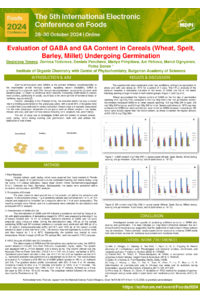
Introduction: Gamma-aminobutyric acid (GABA) serves as the primary inhibitory neurotransmitter in the mammalian central nervous system, regulating neuron excitability. GABA is synthesized from glutamic acid (GA) through decarboxylation, catalyzed by the enzyme glutamic acid decarboxylase. Consumption of GABA-enriched foods is related to numerous health benefits and augmenting GABA levels in foods and particularly in seeds is an interesting and challenging task. The aim of this study was to investigate GABA and GA content in cereals (wheat, spelt, barley, millet) during soaking and germination, both with and without the application of cold stress.
Methods: Cereals were purchased from a local market (Plovdiv, Bulgaria) and GABA and GA contents were determined by HPLC after derivatization with dansyl chloride. Germination was followed for 4 days without the application of cold stress or after stress at -18°C.
Results: Wheat accumulated the highest content of GABA on the third day of germination reaching 25.9mg/100g DW, compared to 8.6mg/100g DW in the non-germinated control. Germination increased GABA in all other cereals, reaching 13.9mg/100g DW in spelt, 8.8mg/100g DW in barley and 8.3mg/100g DW in millet. Severe cold stress at -18°C was less conducive to GABA formation and did not result in a further GABA increase. Interestingly, GA levels were notably higher than the GABA content, with wheat containing the highest amount: 130.3mg/100g DW of GA.
Conclusion: The investigated cereals are capable of producing sufficient amounts of GABA after soaking and germination. The data indicate an insignificant difference between the non-stressed and stressed groups, suggesting that the application of cold stress in these cultures may be redundant. These optimistic results inspire further research to enhance GABA yields from natural food sources for nutritional supplements and functional foods.
Acknowledgments: Financial support from the National Science Fund of Bulgaria, Grant № KП-06-Н71/4 from 15.12.2023, is gratefully acknowledged.
Keywords
gamma-aminobutyric acid
glutamic acid
HPLC
cereals
germination
cold stress
Poster
Foods2024 - poster_DT.pdf
FATTY ACIDS AND IRON CONTENT IN A PUREE MADE FROM Sarda Chiliensis Chiliensis (BONITO) AND Ipomoea Batatas (YELLOW SWEET POTATO) FOR CHILDREN AGED 2 TO 3 YEARS IN LIMA, PERU
Study on the effect of flavonoids on the formation of polycyclic aromatic hydrocarbons in barbecued food and its mechanism