Event submissions
Published
This submission belongs to the session S3. Sustainable Food Security and Food System of the event The 5th International Electronic Conference on Foods
Published date
28 Oct, 2024
Academic Editor
'%3e%3cpath%20d='M12.6657%2010.9104C12.4185%2010.325%2012.0599%209.79327%2011.6097%209.34482C11.1609%208.89508%2010.6293%208.5365%2010.0442%208.28888C10.0389%208.28626%2010.0337%208.28495%2010.0285%208.28233C10.8446%207.69279%2011.3752%206.73249%2011.3752%205.64904C11.3752%203.8542%209.92103%202.39999%208.1262%202.39999C6.33136%202.39999%204.87715%203.8542%204.87715%205.64904C4.87715%206.73249%205.40774%207.69279%206.22393%208.28364C6.21869%208.28626%206.21345%208.28757%206.20821%208.29019C5.62129%208.5378%205.09463%208.89284%204.64265%209.34613C4.1929%209.79493%203.83432%2010.3266%203.58671%2010.9117C3.34345%2011.4845%203.21226%2012.0987%203.20023%2012.7209C3.19988%2012.7349%203.20233%2012.7488%203.20744%2012.7619C3.21255%2012.7749%203.22022%2012.7867%203.22998%2012.7968C3.23975%2012.8068%203.25142%2012.8147%203.26431%2012.8202C3.2772%2012.8256%203.29105%2012.8284%203.30504%2012.8284H4.09109C4.14874%2012.8284%204.19459%2012.7825%204.1959%2012.7262C4.2221%2011.7148%204.62823%2010.7676%205.34617%2010.0497C6.08899%209.30683%207.0755%208.89808%208.1262%208.89808C9.17689%208.89808%2010.1634%209.30683%2010.9062%2010.0497C11.6242%2010.7676%2012.0303%2011.7148%2012.0565%2012.7262C12.0578%2012.7838%2012.1037%2012.8284%2012.1613%2012.8284H12.9474C12.9613%2012.8284%2012.9752%2012.8256%2012.9881%2012.8202C13.001%2012.8147%2013.0126%2012.8068%2013.0224%2012.7968C13.0322%2012.7867%2013.0398%2012.7749%2013.0449%2012.7619C13.0501%2012.7488%2013.0525%2012.7349%2013.0522%2012.7209C13.0391%2012.0947%2012.9094%2011.4855%2012.6657%2010.9104ZM8.1262%207.9024C7.52486%207.9024%206.9589%207.6679%206.53312%207.24211C6.10733%206.81633%205.87283%206.25037%205.87283%205.64904C5.87283%205.0477%206.10733%204.48174%206.53312%204.05596C6.9589%203.63018%207.52486%203.39567%208.1262%203.39567C8.72753%203.39567%209.29349%203.63018%209.71927%204.05596C10.1451%204.48174%2010.3796%205.0477%2010.3796%205.64904C10.3796%206.25037%2010.1451%206.81633%209.71927%207.24211C9.29349%207.6679%208.72753%207.9024%208.1262%207.9024Z'%20fill='%235D1EE1'/%3e%3c/g%3e%3c/svg%3e) Theodoros Varzakas
Theodoros VarzakasCitation
Denise A Grimaut, Mariana S Lingua, Jesica E Blajman, Roxana B Paez, Daniel A Wunderlin, M Verónica Baroni, Sweet potato industry waste is an interesting by-product from which to obtain polyphenols with antioxidant properties, in Proceedings of The 5th International Electronic Conference on Foods, 28 October–30 October 2024, MDPI: Basel, Switzerland
Share
Email
Facebook
Twitter
LinkedIn
Sweet potato industry waste is an interesting by-product from which to obtain polyphenols with antioxidant properties
'%3e%3cpath%20d='M12.6647%2010.9104C12.4176%2010.325%2012.0589%209.7933%2011.6088%209.34485C11.16%208.89511%2010.6283%208.53653%2010.0432%208.28891C10.038%208.28629%2010.0327%208.28498%2010.0275%208.28236C10.8437%207.69282%2011.3743%206.73252%2011.3743%205.64907C11.3743%203.85423%209.92005%202.40002%208.12522%202.40002C6.33038%202.40002%204.87618%203.85423%204.87618%205.64907C4.87618%206.73252%205.40677%207.69282%206.22296%208.28367C6.21772%208.28629%206.21248%208.2876%206.20724%208.29022C5.62031%208.53783%205.09365%208.89287%204.64167%209.34616C4.19192%209.79496%203.83334%2010.3266%203.58573%2010.9117C3.34247%2011.4846%203.21128%2012.0987%203.19925%2012.721C3.1989%2012.735%203.20135%2012.7489%203.20646%2012.7619C3.21157%2012.7749%203.21924%2012.7868%203.22901%2012.7968C3.23877%2012.8068%203.25045%2012.8148%203.26334%2012.8202C3.27623%2012.8256%203.29007%2012.8284%203.30406%2012.8284H4.09012C4.14776%2012.8284%204.19362%2012.7825%204.19493%2012.7262C4.22113%2011.7148%204.62726%2010.7676%205.34519%2010.0497C6.08802%209.30686%207.07452%208.89811%208.12522%208.89811C9.17592%208.89811%2010.1624%209.30686%2010.9052%2010.0497C11.6232%2010.7676%2012.0293%2011.7148%2012.0555%2012.7262C12.0568%2012.7839%2012.1027%2012.8284%2012.1603%2012.8284H12.9464C12.9604%2012.8284%2012.9742%2012.8256%2012.9871%2012.8202C13%2012.8148%2013.0117%2012.8068%2013.0214%2012.7968C13.0312%2012.7868%2013.0389%2012.7749%2013.044%2012.7619C13.0491%2012.7489%2013.0515%2012.735%2013.0512%2012.721C13.0381%2012.0947%2012.9084%2011.4856%2012.6647%2010.9104ZM8.12522%207.90243C7.52388%207.90243%206.95792%207.66793%206.53214%207.24215C6.10636%206.81636%205.87185%206.2504%205.87185%205.64907C5.87185%205.04773%206.10636%204.48177%206.53214%204.05599C6.95792%203.63021%207.52388%203.3957%208.12522%203.3957C8.72655%203.3957%209.29252%203.63021%209.7183%204.05599C10.1441%204.48177%2010.3786%205.04773%2010.3786%205.64907C10.3786%206.2504%2010.1441%206.81636%209.7183%207.24215C9.29252%207.66793%208.72655%207.90243%208.12522%207.90243Z'%20fill='%235D1EE1'/%3e%3c/g%3e%3c/svg%3e)
Denise A Grimaut 1
Mariana S Lingua 1
Jesica E Blajman 1
Roxana B Paez 1
Daniel A Wunderlin 2,3
M Verónica Baroni 2,3
1. Instituto de Investigación de la Cadena Láctea (IDICAL)- INTA/ CONICET, Ruta Nacional 34 Km 227, Rafaela, Santa Fe, Argentina
2. Instituto de Ciencia y Tecnología de Alimentos Córdoba (ICYTAC)- UNC/ CONICET, Juan Filloy S/N, Ciudad Universitaria, Córdoba, Argentina.
3. Dpto. Química Orgánica, Facultad de Ciencias Químicas, Universidad Nacional de Córdoba, Medina Allende y Haya de la Torre, Ciudad Universitaria, Córdoba, Argentina.
Abstract
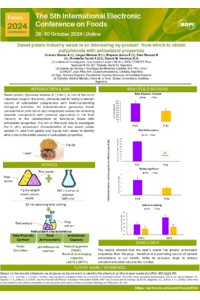
Sweet potato (Ipomoea batatas (L.) Lam.) is one of the most important crops in the world, characterized for being a relevant source of antioxidant polyphenols with health-promoting biological activities. Its industrialization generates waste considered an alternative and inexpensive source for obtaining phenolic compounds, with potential applications in the food industry for the development of functional foods with antioxidant properties. In this work, we investigated the in vitro antioxidant characteristics of two sweet potato wastes (1—the peel from a peeler and 2—the pulp from a sieve) to identify which one is the better source of antioxidant properties. Both wastes were lyophilized and grounded using liquid nitrogen. The phenolic extracts were obtained with a 50% v/v ethanol solution (7 g of dry weight, DW, with 100 mL of solvent; extraction repeated three times). The content of total polyphenols (by Folin–Ciocalteu) and total anthocyanins (by a pH differential method) was studied. The antioxidant capacity was investigated by FRAP (reducing power), ABTS, and DPPH (both methods of radical-scavenging capacity). The peel waste presented 8 mg/g (DW) of polyphenols and 0.8 mg/ g (DW) of anthocyanins. Instead, the pulp waste presented 50 % fewer polyphenols without evidence for the content of anthocyanins. The higher content of antioxidant compounds in the peel waste impacted its higher reducing power and radical-scavenging capacity. The results showed that the peel waste coming out of the sweet potato industry is a promising source of natural antioxidants to our health, while its recovery helps to reduce pollution and adds value to the residue.
Keywords
Ipomoea batatas - Antioxidant activity- Bioactive compounds- Functional properties
Poster
Template poster Grimaut Denise 2024.pdf
Design and development of a temperature-controlled chamber for e-nose in honey adulteration detection
High-throughput FIA-MS/MS and LC-MS/MS Polyphenolics for the Authentication of Teas adulterated with Chicory