Event submissions
Published
This submission belongs to the session S6. Emerging Methods of Food Analysis of the event The 5th International Electronic Conference on Foods
Published date
28 Oct, 2024
Academic Editor
'%3e%3cpath%20d='M12.6657%2010.9104C12.4185%2010.325%2012.0599%209.79327%2011.6097%209.34482C11.1609%208.89508%2010.6293%208.5365%2010.0442%208.28888C10.0389%208.28626%2010.0337%208.28495%2010.0285%208.28233C10.8446%207.69279%2011.3752%206.73249%2011.3752%205.64904C11.3752%203.8542%209.92103%202.39999%208.1262%202.39999C6.33136%202.39999%204.87715%203.8542%204.87715%205.64904C4.87715%206.73249%205.40774%207.69279%206.22393%208.28364C6.21869%208.28626%206.21345%208.28757%206.20821%208.29019C5.62129%208.5378%205.09463%208.89284%204.64265%209.34613C4.1929%209.79493%203.83432%2010.3266%203.58671%2010.9117C3.34345%2011.4845%203.21226%2012.0987%203.20023%2012.7209C3.19988%2012.7349%203.20233%2012.7488%203.20744%2012.7619C3.21255%2012.7749%203.22022%2012.7867%203.22998%2012.7968C3.23975%2012.8068%203.25142%2012.8147%203.26431%2012.8202C3.2772%2012.8256%203.29105%2012.8284%203.30504%2012.8284H4.09109C4.14874%2012.8284%204.19459%2012.7825%204.1959%2012.7262C4.2221%2011.7148%204.62823%2010.7676%205.34617%2010.0497C6.08899%209.30683%207.0755%208.89808%208.1262%208.89808C9.17689%208.89808%2010.1634%209.30683%2010.9062%2010.0497C11.6242%2010.7676%2012.0303%2011.7148%2012.0565%2012.7262C12.0578%2012.7838%2012.1037%2012.8284%2012.1613%2012.8284H12.9474C12.9613%2012.8284%2012.9752%2012.8256%2012.9881%2012.8202C13.001%2012.8147%2013.0126%2012.8068%2013.0224%2012.7968C13.0322%2012.7867%2013.0398%2012.7749%2013.0449%2012.7619C13.0501%2012.7488%2013.0525%2012.7349%2013.0522%2012.7209C13.0391%2012.0947%2012.9094%2011.4855%2012.6657%2010.9104ZM8.1262%207.9024C7.52486%207.9024%206.9589%207.6679%206.53312%207.24211C6.10733%206.81633%205.87283%206.25037%205.87283%205.64904C5.87283%205.0477%206.10733%204.48174%206.53312%204.05596C6.9589%203.63018%207.52486%203.39567%208.1262%203.39567C8.72753%203.39567%209.29349%203.63018%209.71927%204.05596C10.1451%204.48174%2010.3796%205.0477%2010.3796%205.64904C10.3796%206.25037%2010.1451%206.81633%209.71927%207.24211C9.29349%207.6679%208.72753%207.9024%208.1262%207.9024Z'%20fill='%235D1EE1'/%3e%3c/g%3e%3c/svg%3e) Susana Casal
Susana CasalCitation
Thom Romers, Sònia Sentellas, Javier Saurina, Oscar Nuñez, High-throughput FIA-MS/MS and LC-MS/MS Polyphenolics for the Authentication of Teas adulterated with Chicory, in Proceedings of The 5th International Electronic Conference on Foods, 28 October–30 October 2024, MDPI: Basel, Switzerland
Share
Email
Facebook
Twitter
LinkedIn
High-throughput FIA-MS/MS and LC-MS/MS Polyphenolics for the Authentication of Teas adulterated with Chicory
'%3e%3cpath%20d='M12.6647%2010.9104C12.4176%2010.325%2012.0589%209.7933%2011.6088%209.34485C11.16%208.89511%2010.6283%208.53653%2010.0432%208.28891C10.038%208.28629%2010.0327%208.28498%2010.0275%208.28236C10.8437%207.69282%2011.3743%206.73252%2011.3743%205.64907C11.3743%203.85423%209.92005%202.40002%208.12522%202.40002C6.33038%202.40002%204.87618%203.85423%204.87618%205.64907C4.87618%206.73252%205.40677%207.69282%206.22296%208.28367C6.21772%208.28629%206.21248%208.2876%206.20724%208.29022C5.62031%208.53783%205.09365%208.89287%204.64167%209.34616C4.19192%209.79496%203.83334%2010.3266%203.58573%2010.9117C3.34247%2011.4846%203.21128%2012.0987%203.19925%2012.721C3.1989%2012.735%203.20135%2012.7489%203.20646%2012.7619C3.21157%2012.7749%203.21924%2012.7868%203.22901%2012.7968C3.23877%2012.8068%203.25045%2012.8148%203.26334%2012.8202C3.27623%2012.8256%203.29007%2012.8284%203.30406%2012.8284H4.09012C4.14776%2012.8284%204.19362%2012.7825%204.19493%2012.7262C4.22113%2011.7148%204.62726%2010.7676%205.34519%2010.0497C6.08802%209.30686%207.07452%208.89811%208.12522%208.89811C9.17592%208.89811%2010.1624%209.30686%2010.9052%2010.0497C11.6232%2010.7676%2012.0293%2011.7148%2012.0555%2012.7262C12.0568%2012.7839%2012.1027%2012.8284%2012.1603%2012.8284H12.9464C12.9604%2012.8284%2012.9742%2012.8256%2012.9871%2012.8202C13%2012.8148%2013.0117%2012.8068%2013.0214%2012.7968C13.0312%2012.7868%2013.0389%2012.7749%2013.044%2012.7619C13.0491%2012.7489%2013.0515%2012.735%2013.0512%2012.721C13.0381%2012.0947%2012.9084%2011.4856%2012.6647%2010.9104ZM8.12522%207.90243C7.52388%207.90243%206.95792%207.66793%206.53214%207.24215C6.10636%206.81636%205.87185%206.2504%205.87185%205.64907C5.87185%205.04773%206.10636%204.48177%206.53214%204.05599C6.95792%203.63021%207.52388%203.3957%208.12522%203.3957C8.72655%203.3957%209.29252%203.63021%209.7183%204.05599C10.1441%204.48177%2010.3786%205.04773%2010.3786%205.64907C10.3786%206.2504%2010.1441%206.81636%209.7183%207.24215C9.29252%207.66793%208.72655%207.90243%208.12522%207.90243Z'%20fill='%235D1EE1'/%3e%3c/g%3e%3c/svg%3e)
Thom Romers 1

Sònia Sentellas 1,2,3

Javier Saurina 1,2

Oscar Nuñez 1,2,4
1. Department of Chemical Engineering and Analytical Chemistry, University of Barcelona, Martí i Franquès 1-11, E08028 Barcelona, Spain.
2. Research Institute in Food Nutrition and Food Safety, University of Barcelona, Av. Prat de la Riba 171, Edifici Recerca (Gaudí), E08921 Santa Coloma de Gramenet, Spain.
3. Serra Húnter Lecturer, Generalitat de Catalunya, 08007 Barcelona, Spain
4. Serra Húnter Felow Program, Generalitat de Catalunya, Via Laietana 2, E08003, Barcelona, Spain
Abstract
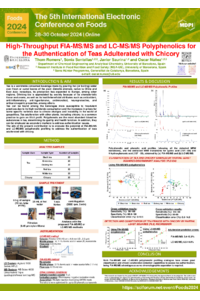
Tea is one of the beverages that is more susceptible to fraudulent practices due to its high worldwide consumption and because of the increase in prices for some specific varieties due to climate change and instability in the world of geopolitics. Tea adulteration with other plants, including chicory, is a common practice that is carried out to gain an illicit profit. Polyphenols are the most abundant bioactive substances in tea, determining its quality and health function. In addition, they can be employed as secondary markers to address authentication issues. The present contribution evaluated the potential of polyphenolic profiling using high-throughput FIA-MS/MS and LC-MS/MS methodologies to assess tea authenticity. A total of 100 tea samples belonging to different varieties (green, black, red, oolong, and white teas), as well as 20 chicory samples, were analyzed with both methodologies after a simple tea brewing process, obtaining the corresponding polyphenolic profiles by monitoring 55 polyphenols belonging to different families. The corresponding profiles were then employed as sample chemical descriptors to address tea classification and authentication using partial least squares discriminant analysis (PLS-DA). An excellent classification performance was accomplished using PLS-DA, with sensitivity and specificity values being higher than 90% and 88.9%, respectively, for FIA-MS/MS, and higher than 85% and 86%, respectively, for LC-MS/MS. A good accuracy was also attained, with calibration errors below 10.5 and 14.5% for FIA-MS/MS and LC-MS/MS, respectively. Overall, FIA-MS/MS showed a better performance than LC-MS/MS, with the advantage of requiring a lower analysis time due to the fact that no chromatographic separation was necessary. The capability of the obtained polyphenolic profiles to detect and quantify tea adulterations with chicory was also assessed using partial least squares (PLS) regression, showing excellent adulterant level determination, with prediction errors below 10.9 and 14.8% for FIA-MS/MS and LC-MS/MS, respectively. Thus, both methodologies demonstrated feasibility in assessing tea authentication issues when adulterations with chicory are involved.
Keywords
Tea authenticacion
Chicory
FIA-MS/MS
LC-MS/MS
Polyphenols
Chemometrics
Poster
Poster Foods2024_Tea_ONuñez.pdf
Sweet potato industry waste is an interesting by-product from which to obtain polyphenols with antioxidant properties
The Development of highly stable tapioca-starch-based coating formulations functionalized with essential oils and ultrasonication: An application in the postharvest management of Khasi mandarin (Citrus rediculata)