Event submissions
Published
This submission belongs to the session S2. Food Nutrition and Functional Foods of the event The 5th International Electronic Conference on Foods
Published date
28 Oct, 2024
Academic Editor
'%3e%3cpath%20d='M12.6657%2010.9104C12.4185%2010.325%2012.0599%209.79327%2011.6097%209.34482C11.1609%208.89508%2010.6293%208.5365%2010.0442%208.28888C10.0389%208.28626%2010.0337%208.28495%2010.0285%208.28233C10.8446%207.69279%2011.3752%206.73249%2011.3752%205.64904C11.3752%203.8542%209.92103%202.39999%208.1262%202.39999C6.33136%202.39999%204.87715%203.8542%204.87715%205.64904C4.87715%206.73249%205.40774%207.69279%206.22393%208.28364C6.21869%208.28626%206.21345%208.28757%206.20821%208.29019C5.62129%208.5378%205.09463%208.89284%204.64265%209.34613C4.1929%209.79493%203.83432%2010.3266%203.58671%2010.9117C3.34345%2011.4845%203.21226%2012.0987%203.20023%2012.7209C3.19988%2012.7349%203.20233%2012.7488%203.20744%2012.7619C3.21255%2012.7749%203.22022%2012.7867%203.22998%2012.7968C3.23975%2012.8068%203.25142%2012.8147%203.26431%2012.8202C3.2772%2012.8256%203.29105%2012.8284%203.30504%2012.8284H4.09109C4.14874%2012.8284%204.19459%2012.7825%204.1959%2012.7262C4.2221%2011.7148%204.62823%2010.7676%205.34617%2010.0497C6.08899%209.30683%207.0755%208.89808%208.1262%208.89808C9.17689%208.89808%2010.1634%209.30683%2010.9062%2010.0497C11.6242%2010.7676%2012.0303%2011.7148%2012.0565%2012.7262C12.0578%2012.7838%2012.1037%2012.8284%2012.1613%2012.8284H12.9474C12.9613%2012.8284%2012.9752%2012.8256%2012.9881%2012.8202C13.001%2012.8147%2013.0126%2012.8068%2013.0224%2012.7968C13.0322%2012.7867%2013.0398%2012.7749%2013.0449%2012.7619C13.0501%2012.7488%2013.0525%2012.7349%2013.0522%2012.7209C13.0391%2012.0947%2012.9094%2011.4855%2012.6657%2010.9104ZM8.1262%207.9024C7.52486%207.9024%206.9589%207.6679%206.53312%207.24211C6.10733%206.81633%205.87283%206.25037%205.87283%205.64904C5.87283%205.0477%206.10733%204.48174%206.53312%204.05596C6.9589%203.63018%207.52486%203.39567%208.1262%203.39567C8.72753%203.39567%209.29349%203.63018%209.71927%204.05596C10.1451%204.48174%2010.3796%205.0477%2010.3796%205.64904C10.3796%206.25037%2010.1451%206.81633%209.71927%207.24211C9.29349%207.6679%208.72753%207.9024%208.1262%207.9024Z'%20fill='%235D1EE1'/%3e%3c/g%3e%3c/svg%3e) Manuel Viuda-Martos
Manuel Viuda-MartosCitation
Ines Tarchi, Mohamed Bouaziz, Abderrahmane Aït-Kaddour, The Potential of Olive Leaf Extract as a Functional Ingredient in Yogurts: Physicochemical, Texture, and Antioxidant Effects, in Proceedings of The 5th International Electronic Conference on Foods, 28 October–30 October 2024, MDPI: Basel, Switzerland
Share
Email
Facebook
Twitter
LinkedIn
The Potential of Olive Leaf Extract as a Functional Ingredient in Yogurts: Physicochemical, Texture, and Antioxidant Effects
'%3e%3cpath%20d='M12.6647%2010.9104C12.4176%2010.325%2012.0589%209.7933%2011.6088%209.34485C11.16%208.89511%2010.6283%208.53653%2010.0432%208.28891C10.038%208.28629%2010.0327%208.28498%2010.0275%208.28236C10.8437%207.69282%2011.3743%206.73252%2011.3743%205.64907C11.3743%203.85423%209.92005%202.40002%208.12522%202.40002C6.33038%202.40002%204.87618%203.85423%204.87618%205.64907C4.87618%206.73252%205.40677%207.69282%206.22296%208.28367C6.21772%208.28629%206.21248%208.2876%206.20724%208.29022C5.62031%208.53783%205.09365%208.89287%204.64167%209.34616C4.19192%209.79496%203.83334%2010.3266%203.58573%2010.9117C3.34247%2011.4846%203.21128%2012.0987%203.19925%2012.721C3.1989%2012.735%203.20135%2012.7489%203.20646%2012.7619C3.21157%2012.7749%203.21924%2012.7868%203.22901%2012.7968C3.23877%2012.8068%203.25045%2012.8148%203.26334%2012.8202C3.27623%2012.8256%203.29007%2012.8284%203.30406%2012.8284H4.09012C4.14776%2012.8284%204.19362%2012.7825%204.19493%2012.7262C4.22113%2011.7148%204.62726%2010.7676%205.34519%2010.0497C6.08802%209.30686%207.07452%208.89811%208.12522%208.89811C9.17592%208.89811%2010.1624%209.30686%2010.9052%2010.0497C11.6232%2010.7676%2012.0293%2011.7148%2012.0555%2012.7262C12.0568%2012.7839%2012.1027%2012.8284%2012.1603%2012.8284H12.9464C12.9604%2012.8284%2012.9742%2012.8256%2012.9871%2012.8202C13%2012.8148%2013.0117%2012.8068%2013.0214%2012.7968C13.0312%2012.7868%2013.0389%2012.7749%2013.044%2012.7619C13.0491%2012.7489%2013.0515%2012.735%2013.0512%2012.721C13.0381%2012.0947%2012.9084%2011.4856%2012.6647%2010.9104ZM8.12522%207.90243C7.52388%207.90243%206.95792%207.66793%206.53214%207.24215C6.10636%206.81636%205.87185%206.2504%205.87185%205.64907C5.87185%205.04773%206.10636%204.48177%206.53214%204.05599C6.95792%203.63021%207.52388%203.3957%208.12522%203.3957C8.72655%203.3957%209.29252%203.63021%209.7183%204.05599C10.1441%204.48177%2010.3786%205.04773%2010.3786%205.64907C10.3786%206.2504%2010.1441%206.81636%209.7183%207.24215C9.29252%207.66793%208.72655%207.90243%208.12522%207.90243Z'%20fill='%235D1EE1'/%3e%3c/g%3e%3c/svg%3e)
Ines Tarchi 1,2

Mohamed Bouaziz 1,3
Abderrahmane Aït-Kaddour 2,4
1. Laboratory of Electrochemistry and Environment, National School of Engineers of Sfax (ENIS), University of Sfax, BP 1175, 3038 Sfax, Tunisia
2. Université Clermont-Auvergne, INRAE, VetAgro Sup, Unité Mixte de Recherche sur le Fromage UMRF, 89 Avenue de l’Europe, France
3. Institut supérieur de Biotechnologie de Sfax, Université de Sfax, BP1175, 3038 Sfax, Tunisia
4. Departement of Food Technology, Faculty of Agroindustrial Technology, University of Padjadjaran, Sumedang 45363, Jawa Barat, Indonesia
Abstract
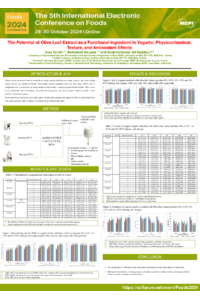
Yogurt is widely appreciated for its high nutritional value and health benefits. The recent addition of plant extracts rich in phenolic compounds and bioflavonoids has attracted considerable interest, particularly as milk and dairy products contain a low amount of these beneficial elements. Olive leaf extract (OLE) has been studied as a potential source of bioactive compounds. This study assessed the impact of incorporating OLE on the physicochemical properties, total phenol content, antioxidant activity (assessed by DPPH and ABTS methods), rheological characteristics and color of yogurts made from cow's, sheep’s, and goat's milk. The milk was enriched with OLE at concentrations of 0.5%, 1%, 1.5% and 2% (v/v) and analyzed after complete coagulation.
The results showed a decrease in pH and an increase in acidity during storage, with the buffering effect of OLE attenuating these variations. OLE-enriched yogurts had a higher total phenol content and increased antioxidant activity. In addition, the water holding capacity (WHC) of the yogurts increased with the addition of OLE, probably due to interactions between yogurt proteins and polyphenols, resulting in a reduction in syneresis. Color analysis revealed that OLE reduced brightness (L* values) and shifted in hue towards red (positive a* values) and yellow (positive b* values). The texture profile showed that higher levels of supplementation increased the firmness of cow's milk while reducing it for other types of milk. These results highlight the potential of OLE as a functional ingredient to improve the nutritional and health benefits of dairy products. Considering all the results and previous work, the addition of 1.5% OLE proved to be optimal. To confirm this conclusion, sensory analyses should be carried out.
Keywords
olive leaf extract
polyphenols
yogurt
antioxidant activity
physicochemical properties
rheological properties
Poster
Poster Ines Tarchi 2024-1.pdf
AMINO ACIDS, PHENOLIC, AND FLAVONOID CONTENTS IN TWO DIVERSE EXRACTS OF Spinacia oleracea L.: EVALUATION OF IN VITRO ANTIOXIDANT AND ENZYME INHIBITORY ACTIVITY
Innovative and sustainable plant-based solutions for geriatric health: Fermented plum surplus products to combat dysphagia, hydration, and strengthen the gut microbiota