Event submissions
Published
This submission belongs to the session S1. Innovation in Food Technology and Engineering of the event The 5th International Electronic Conference on Foods
Published date
28 Oct, 2024
Academic Editor
'%3e%3cpath%20d='M12.6657%2010.9104C12.4185%2010.325%2012.0599%209.79327%2011.6097%209.34482C11.1609%208.89508%2010.6293%208.5365%2010.0442%208.28888C10.0389%208.28626%2010.0337%208.28495%2010.0285%208.28233C10.8446%207.69279%2011.3752%206.73249%2011.3752%205.64904C11.3752%203.8542%209.92103%202.39999%208.1262%202.39999C6.33136%202.39999%204.87715%203.8542%204.87715%205.64904C4.87715%206.73249%205.40774%207.69279%206.22393%208.28364C6.21869%208.28626%206.21345%208.28757%206.20821%208.29019C5.62129%208.5378%205.09463%208.89284%204.64265%209.34613C4.1929%209.79493%203.83432%2010.3266%203.58671%2010.9117C3.34345%2011.4845%203.21226%2012.0987%203.20023%2012.7209C3.19988%2012.7349%203.20233%2012.7488%203.20744%2012.7619C3.21255%2012.7749%203.22022%2012.7867%203.22998%2012.7968C3.23975%2012.8068%203.25142%2012.8147%203.26431%2012.8202C3.2772%2012.8256%203.29105%2012.8284%203.30504%2012.8284H4.09109C4.14874%2012.8284%204.19459%2012.7825%204.1959%2012.7262C4.2221%2011.7148%204.62823%2010.7676%205.34617%2010.0497C6.08899%209.30683%207.0755%208.89808%208.1262%208.89808C9.17689%208.89808%2010.1634%209.30683%2010.9062%2010.0497C11.6242%2010.7676%2012.0303%2011.7148%2012.0565%2012.7262C12.0578%2012.7838%2012.1037%2012.8284%2012.1613%2012.8284H12.9474C12.9613%2012.8284%2012.9752%2012.8256%2012.9881%2012.8202C13.001%2012.8147%2013.0126%2012.8068%2013.0224%2012.7968C13.0322%2012.7867%2013.0398%2012.7749%2013.0449%2012.7619C13.0501%2012.7488%2013.0525%2012.7349%2013.0522%2012.7209C13.0391%2012.0947%2012.9094%2011.4855%2012.6657%2010.9104ZM8.1262%207.9024C7.52486%207.9024%206.9589%207.6679%206.53312%207.24211C6.10733%206.81633%205.87283%206.25037%205.87283%205.64904C5.87283%205.0477%206.10733%204.48174%206.53312%204.05596C6.9589%203.63018%207.52486%203.39567%208.1262%203.39567C8.72753%203.39567%209.29349%203.63018%209.71927%204.05596C10.1451%204.48174%2010.3796%205.0477%2010.3796%205.64904C10.3796%206.25037%2010.1451%206.81633%209.71927%207.24211C9.29349%207.6679%208.72753%207.9024%208.1262%207.9024Z'%20fill='%235D1EE1'/%3e%3c/g%3e%3c/svg%3e) Moktar Hamdi
Moktar HamdiCitation
Beatriz Z.R. Araujo, Manuela E. Pintado, Rui M.S.C Morais, Alcina M.M. Bernardo, MICROWAVE DRYING VERSUS HOT-AIR DRYING OF MIXED APPLE AND GINGER POMACE, in Proceedings of The 5th International Electronic Conference on Foods, 28 October–30 October 2024, MDPI: Basel, Switzerland
Share
Email
Facebook
Twitter
LinkedIn
MICROWAVE DRYING VERSUS HOT-AIR DRYING OF MIXED APPLE AND GINGER POMACE
'%3e%3cpath%20d='M12.6647%2010.9104C12.4176%2010.325%2012.0589%209.7933%2011.6088%209.34485C11.16%208.89511%2010.6283%208.53653%2010.0432%208.28891C10.038%208.28629%2010.0327%208.28498%2010.0275%208.28236C10.8437%207.69282%2011.3743%206.73252%2011.3743%205.64907C11.3743%203.85423%209.92005%202.40002%208.12522%202.40002C6.33038%202.40002%204.87618%203.85423%204.87618%205.64907C4.87618%206.73252%205.40677%207.69282%206.22296%208.28367C6.21772%208.28629%206.21248%208.2876%206.20724%208.29022C5.62031%208.53783%205.09365%208.89287%204.64167%209.34616C4.19192%209.79496%203.83334%2010.3266%203.58573%2010.9117C3.34247%2011.4846%203.21128%2012.0987%203.19925%2012.721C3.1989%2012.735%203.20135%2012.7489%203.20646%2012.7619C3.21157%2012.7749%203.21924%2012.7868%203.22901%2012.7968C3.23877%2012.8068%203.25045%2012.8148%203.26334%2012.8202C3.27623%2012.8256%203.29007%2012.8284%203.30406%2012.8284H4.09012C4.14776%2012.8284%204.19362%2012.7825%204.19493%2012.7262C4.22113%2011.7148%204.62726%2010.7676%205.34519%2010.0497C6.08802%209.30686%207.07452%208.89811%208.12522%208.89811C9.17592%208.89811%2010.1624%209.30686%2010.9052%2010.0497C11.6232%2010.7676%2012.0293%2011.7148%2012.0555%2012.7262C12.0568%2012.7839%2012.1027%2012.8284%2012.1603%2012.8284H12.9464C12.9604%2012.8284%2012.9742%2012.8256%2012.9871%2012.8202C13%2012.8148%2013.0117%2012.8068%2013.0214%2012.7968C13.0312%2012.7868%2013.0389%2012.7749%2013.044%2012.7619C13.0491%2012.7489%2013.0515%2012.735%2013.0512%2012.721C13.0381%2012.0947%2012.9084%2011.4856%2012.6647%2010.9104ZM8.12522%207.90243C7.52388%207.90243%206.95792%207.66793%206.53214%207.24215C6.10636%206.81636%205.87185%206.2504%205.87185%205.64907C5.87185%205.04773%206.10636%204.48177%206.53214%204.05599C6.95792%203.63021%207.52388%203.3957%208.12522%203.3957C8.72655%203.3957%209.29252%203.63021%209.7183%204.05599C10.1441%204.48177%2010.3786%205.04773%2010.3786%205.64907C10.3786%206.2504%2010.1441%206.81636%209.7183%207.24215C9.29252%207.66793%208.72655%207.90243%208.12522%207.90243Z'%20fill='%235D1EE1'/%3e%3c/g%3e%3c/svg%3e)
Beatriz Z.R. Araujo 1

Manuela E. Pintado 1

Rui M.S.C Morais 1

Alcina M.M. Bernardo 1
1. Universidade Católica Portuguesa, CBQF - Centro de Biotecnologia e Química Fina — Laboratório Associado, Escola Superior de Biotecnologia, Rua Diogo Botelho, 1327, 4169-005 Porto, Portugal.
Abstract
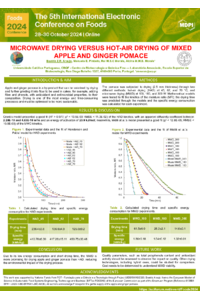
Apple and ginger pomace is a by-product that can be valorised by drying and further grinding it into flour to be used in cakes, for example, adding fibre and phenols, with antioxidant and antimicrobial properties, to their composition. Drying is one of the most energy- and time-consuming processes and must be optimised to be more sustainable. The pomace was subjected to drying through two different methods: hot-air drying (HAD; Excalibur, model 4900, U.S.A.) and microwave drying (MWD; Samsung, MS23K3513AW, Ireland). HAD was performed at 45, 62, and 70 °C, whereas MWD was carried out at 100, 180, and 300 W. Mathematical models were tested to fit the kinetics of the moisture ratio (MR); the drying time was predicted through the models and the specific energy consumption was calculated for each experiment. Crank’s model presented a good fit (R2 > 0.977; χ2 < 13.5E-03 RMSE < 11.0E-02) of the HAD kinetics, with an apparent diffusivity coefficient between 2.28E-10 and 4.83E-10 m2/s and an energy of activation of 23.9 kJ/mol; meanwhile, Midili’s model presented a good fit (χ2 < 9.5E-05; RMSE < 9.1E-03) of the MWD kinetics. The drying time was calculated to achieve 12 % moisture content using these models with the parameters determined for each experiment. It resulted in being between 125 and 236 min for HAD and between 14 and 61 min for MWD, being 4 to 9 times lower in MWD. The specific energy required was 410.78–453.75 kWh/kg for HAD, whereas it was 1.32 – 2.26 kWh/kg for MWD. Due to its low energy consumption and short drying time, the MWD is more promising for drying apple and ginger pomace than HAD, reducing the environmental impact of the drying process.
Keywords
Apple and ginger pomace
microwave drying
hot-air drying
mathematical models
specific energy consumption
Poster
ICF_Beatriz_Araujo_22-10-24_.pdf
Influence of different extraction conditions on the bioactivity and polyphenol profile of propolis extracts
Evaluation of the effect of grinding type and enzyme-assisted extraction on okara protein concentrate properties.