Event submissions
Published
This submission belongs to the session S2. Food Nutrition and Functional Foods of the event The 5th International Electronic Conference on Foods
Published date
28 Oct, 2024
Academic Editor
'%3e%3cpath%20d='M12.6657%2010.9104C12.4185%2010.325%2012.0599%209.79327%2011.6097%209.34482C11.1609%208.89508%2010.6293%208.5365%2010.0442%208.28888C10.0389%208.28626%2010.0337%208.28495%2010.0285%208.28233C10.8446%207.69279%2011.3752%206.73249%2011.3752%205.64904C11.3752%203.8542%209.92103%202.39999%208.1262%202.39999C6.33136%202.39999%204.87715%203.8542%204.87715%205.64904C4.87715%206.73249%205.40774%207.69279%206.22393%208.28364C6.21869%208.28626%206.21345%208.28757%206.20821%208.29019C5.62129%208.5378%205.09463%208.89284%204.64265%209.34613C4.1929%209.79493%203.83432%2010.3266%203.58671%2010.9117C3.34345%2011.4845%203.21226%2012.0987%203.20023%2012.7209C3.19988%2012.7349%203.20233%2012.7488%203.20744%2012.7619C3.21255%2012.7749%203.22022%2012.7867%203.22998%2012.7968C3.23975%2012.8068%203.25142%2012.8147%203.26431%2012.8202C3.2772%2012.8256%203.29105%2012.8284%203.30504%2012.8284H4.09109C4.14874%2012.8284%204.19459%2012.7825%204.1959%2012.7262C4.2221%2011.7148%204.62823%2010.7676%205.34617%2010.0497C6.08899%209.30683%207.0755%208.89808%208.1262%208.89808C9.17689%208.89808%2010.1634%209.30683%2010.9062%2010.0497C11.6242%2010.7676%2012.0303%2011.7148%2012.0565%2012.7262C12.0578%2012.7838%2012.1037%2012.8284%2012.1613%2012.8284H12.9474C12.9613%2012.8284%2012.9752%2012.8256%2012.9881%2012.8202C13.001%2012.8147%2013.0126%2012.8068%2013.0224%2012.7968C13.0322%2012.7867%2013.0398%2012.7749%2013.0449%2012.7619C13.0501%2012.7488%2013.0525%2012.7349%2013.0522%2012.7209C13.0391%2012.0947%2012.9094%2011.4855%2012.6657%2010.9104ZM8.1262%207.9024C7.52486%207.9024%206.9589%207.6679%206.53312%207.24211C6.10733%206.81633%205.87283%206.25037%205.87283%205.64904C5.87283%205.0477%206.10733%204.48174%206.53312%204.05596C6.9589%203.63018%207.52486%203.39567%208.1262%203.39567C8.72753%203.39567%209.29349%203.63018%209.71927%204.05596C10.1451%204.48174%2010.3796%205.0477%2010.3796%205.64904C10.3796%206.25037%2010.1451%206.81633%209.71927%207.24211C9.29349%207.6679%208.72753%207.9024%208.1262%207.9024Z'%20fill='%235D1EE1'/%3e%3c/g%3e%3c/svg%3e) Manuel Viuda-Martos
Manuel Viuda-MartosCitation
Rodrigo Alonso Escalante Moreno, Jean Pierre Batanero Armstrong, Melissa Alejandra Vivanco Vidal, Mayra Lucia Anticona Barreto, Saby Inés Zegarra Samamé de Castro, Nutritional characterization and caffeine content of a food bar made with Paullinia cupana (guarana) powder, in Proceedings of The 5th International Electronic Conference on Foods, 28 October–30 October 2024, MDPI: Basel, Switzerland
Share
Email
Facebook
Twitter
LinkedIn
Nutritional characterization and caffeine content of a food bar made with Paullinia cupana (guarana) powder
'%3e%3cpath%20d='M12.6647%2010.9104C12.4176%2010.325%2012.0589%209.7933%2011.6088%209.34485C11.16%208.89511%2010.6283%208.53653%2010.0432%208.28891C10.038%208.28629%2010.0327%208.28498%2010.0275%208.28236C10.8437%207.69282%2011.3743%206.73252%2011.3743%205.64907C11.3743%203.85423%209.92005%202.40002%208.12522%202.40002C6.33038%202.40002%204.87618%203.85423%204.87618%205.64907C4.87618%206.73252%205.40677%207.69282%206.22296%208.28367C6.21772%208.28629%206.21248%208.2876%206.20724%208.29022C5.62031%208.53783%205.09365%208.89287%204.64167%209.34616C4.19192%209.79496%203.83334%2010.3266%203.58573%2010.9117C3.34247%2011.4846%203.21128%2012.0987%203.19925%2012.721C3.1989%2012.735%203.20135%2012.7489%203.20646%2012.7619C3.21157%2012.7749%203.21924%2012.7868%203.22901%2012.7968C3.23877%2012.8068%203.25045%2012.8148%203.26334%2012.8202C3.27623%2012.8256%203.29007%2012.8284%203.30406%2012.8284H4.09012C4.14776%2012.8284%204.19362%2012.7825%204.19493%2012.7262C4.22113%2011.7148%204.62726%2010.7676%205.34519%2010.0497C6.08802%209.30686%207.07452%208.89811%208.12522%208.89811C9.17592%208.89811%2010.1624%209.30686%2010.9052%2010.0497C11.6232%2010.7676%2012.0293%2011.7148%2012.0555%2012.7262C12.0568%2012.7839%2012.1027%2012.8284%2012.1603%2012.8284H12.9464C12.9604%2012.8284%2012.9742%2012.8256%2012.9871%2012.8202C13%2012.8148%2013.0117%2012.8068%2013.0214%2012.7968C13.0312%2012.7868%2013.0389%2012.7749%2013.044%2012.7619C13.0491%2012.7489%2013.0515%2012.735%2013.0512%2012.721C13.0381%2012.0947%2012.9084%2011.4856%2012.6647%2010.9104ZM8.12522%207.90243C7.52388%207.90243%206.95792%207.66793%206.53214%207.24215C6.10636%206.81636%205.87185%206.2504%205.87185%205.64907C5.87185%205.04773%206.10636%204.48177%206.53214%204.05599C6.95792%203.63021%207.52388%203.3957%208.12522%203.3957C8.72655%203.3957%209.29252%203.63021%209.7183%204.05599C10.1441%204.48177%2010.3786%205.04773%2010.3786%205.64907C10.3786%206.2504%2010.1441%206.81636%209.7183%207.24215C9.29252%207.66793%208.72655%207.90243%208.12522%207.90243Z'%20fill='%235D1EE1'/%3e%3c/g%3e%3c/svg%3e)
Rodrigo Alonso Escalante Moreno 1
Jean Pierre Batanero Armstrong 1
Melissa Alejandra Vivanco Vidal 1

Mayra Lucia Anticona Barreto 2
Saby Inés Zegarra Samamé de Castro 1
1. Carrera de Nutrición y Dietética, Universidad Peruana de Ciencias Aplicadas, Av. Alameda San
Marcos 370, 15067, Chorrillos, Lima, Perú.
2. Unidad de Investigación en Nutrición, Salud, Alimentos Funcionales y Nutracéuticos, Universidad San Ignacio de Loyola (UNUSAN-USIL), av. La Fontana 550, 15024, Lima, Perú.
Carrera de Nutrición y Dietética, Facultad de Ciencias de la Salud, Universidad S
Abstract
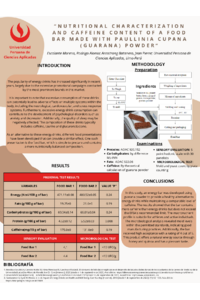
Introduction: The excessive consumption of energy drinks can cause many problems in the consumer's health due to the ingredients contained. A population that tends to consume this type of products more frequently are athletes and university students, that is why a product was developed with a similar function to an energy drink but with ingredients from natural sources. It should be noted that it is a food bar that presents simple carbohydrates and caffeine that provide immediate energy and a stimulating effect, respectively, not as a food rich in protein; which is why it is compared to energy drinks.
Methodology: Two different food bars (FB1 and FB2) were made with quinoa, honey, sunflower oil, peanut butter, cocoa powder, bitter chocolate and guarana powder. In which the guarana content varied from 28 and 21% per 70 g serving of each food bar, respectively. Proximal, microbiological and caffeine content per serving was determined in each sample.
Results: The proximate composition for a 70 g serving of FB1 was 329.8 kcal, 36.8% fat, 59.4% carbohydrate, 0.3% fiber, 3.8% protein, 5.2% moisture, 1.07% ash and 0.25% caffeine. For FB2 it was 336.4 kcal, 40.5% fat, 54.9% carbohydrate,0.4% fiber, 4.6% protein,5.45% moisture, 1.41% ash and 0.187% caffeine. Among these, there was only a significant difference in protein and ash content. The caffeine content in FB1 and FB2 was 175 mg and 131 mg/70 g, respectively. Microbiological analysis (molds) gave a result of <10 CFU/g for both samples, thus demonstrating their safety.
Conclusions: The food bars elaborated contain an adequate nutritional composition and an ideal amount of caffeine according to the nature of the product and complied with microbiological standards. These bars could provide the energy and stimulation in the form of a single food for training or day-to-day use
Keywords
food bar
caffeine
carbohydrate
energy
natural product
Poster
Nutritional characterization and caffeine content of a food bar made with Paullinia cupana (guarana) powder.pdf
Effect of the carotene fortification of a cucumber juice on shelf life with extracts from tomato by-products
Evaluating growth-inhibitory effects of plant volatile compounds against food pathogenic microorganisms in vapor phase using new microplate disk volatilization method