Event submissions
Published
This submission belongs to the session S7. Novel Preservation and Packaging Technologies of the event The 5th International Electronic Conference on Foods
Published date
28 Oct, 2024
Academic Editor
'%3e%3cpath%20d='M12.6657%2010.9104C12.4185%2010.325%2012.0599%209.79327%2011.6097%209.34482C11.1609%208.89508%2010.6293%208.5365%2010.0442%208.28888C10.0389%208.28626%2010.0337%208.28495%2010.0285%208.28233C10.8446%207.69279%2011.3752%206.73249%2011.3752%205.64904C11.3752%203.8542%209.92103%202.39999%208.1262%202.39999C6.33136%202.39999%204.87715%203.8542%204.87715%205.64904C4.87715%206.73249%205.40774%207.69279%206.22393%208.28364C6.21869%208.28626%206.21345%208.28757%206.20821%208.29019C5.62129%208.5378%205.09463%208.89284%204.64265%209.34613C4.1929%209.79493%203.83432%2010.3266%203.58671%2010.9117C3.34345%2011.4845%203.21226%2012.0987%203.20023%2012.7209C3.19988%2012.7349%203.20233%2012.7488%203.20744%2012.7619C3.21255%2012.7749%203.22022%2012.7867%203.22998%2012.7968C3.23975%2012.8068%203.25142%2012.8147%203.26431%2012.8202C3.2772%2012.8256%203.29105%2012.8284%203.30504%2012.8284H4.09109C4.14874%2012.8284%204.19459%2012.7825%204.1959%2012.7262C4.2221%2011.7148%204.62823%2010.7676%205.34617%2010.0497C6.08899%209.30683%207.0755%208.89808%208.1262%208.89808C9.17689%208.89808%2010.1634%209.30683%2010.9062%2010.0497C11.6242%2010.7676%2012.0303%2011.7148%2012.0565%2012.7262C12.0578%2012.7838%2012.1037%2012.8284%2012.1613%2012.8284H12.9474C12.9613%2012.8284%2012.9752%2012.8256%2012.9881%2012.8202C13.001%2012.8147%2013.0126%2012.8068%2013.0224%2012.7968C13.0322%2012.7867%2013.0398%2012.7749%2013.0449%2012.7619C13.0501%2012.7488%2013.0525%2012.7349%2013.0522%2012.7209C13.0391%2012.0947%2012.9094%2011.4855%2012.6657%2010.9104ZM8.1262%207.9024C7.52486%207.9024%206.9589%207.6679%206.53312%207.24211C6.10733%206.81633%205.87283%206.25037%205.87283%205.64904C5.87283%205.0477%206.10733%204.48174%206.53312%204.05596C6.9589%203.63018%207.52486%203.39567%208.1262%203.39567C8.72753%203.39567%209.29349%203.63018%209.71927%204.05596C10.1451%204.48174%2010.3796%205.0477%2010.3796%205.64904C10.3796%206.25037%2010.1451%206.81633%209.71927%207.24211C9.29349%207.6679%208.72753%207.9024%208.1262%207.9024Z'%20fill='%235D1EE1'/%3e%3c/g%3e%3c/svg%3e) Saji George
Saji GeorgeCitation
Adrish Dutta, Marketa Houdkova, Ladislav Kokoska, Evaluating growth-inhibitory effects of plant volatile compounds against food pathogenic microorganisms in vapor phase using new microplate disk volatilization method, in Proceedings of The 5th International Electronic Conference on Foods, 28 October–30 October 2024, MDPI: Basel, Switzerland
Share
Email
Facebook
Twitter
LinkedIn
Evaluating growth-inhibitory effects of plant volatile compounds against food pathogenic microorganisms in vapor phase using new microplate disk volatilization method
'%3e%3cpath%20d='M12.6647%2010.9104C12.4176%2010.325%2012.0589%209.7933%2011.6088%209.34485C11.16%208.89511%2010.6283%208.53653%2010.0432%208.28891C10.038%208.28629%2010.0327%208.28498%2010.0275%208.28236C10.8437%207.69282%2011.3743%206.73252%2011.3743%205.64907C11.3743%203.85423%209.92005%202.40002%208.12522%202.40002C6.33038%202.40002%204.87618%203.85423%204.87618%205.64907C4.87618%206.73252%205.40677%207.69282%206.22296%208.28367C6.21772%208.28629%206.21248%208.2876%206.20724%208.29022C5.62031%208.53783%205.09365%208.89287%204.64167%209.34616C4.19192%209.79496%203.83334%2010.3266%203.58573%2010.9117C3.34247%2011.4846%203.21128%2012.0987%203.19925%2012.721C3.1989%2012.735%203.20135%2012.7489%203.20646%2012.7619C3.21157%2012.7749%203.21924%2012.7868%203.22901%2012.7968C3.23877%2012.8068%203.25045%2012.8148%203.26334%2012.8202C3.27623%2012.8256%203.29007%2012.8284%203.30406%2012.8284H4.09012C4.14776%2012.8284%204.19362%2012.7825%204.19493%2012.7262C4.22113%2011.7148%204.62726%2010.7676%205.34519%2010.0497C6.08802%209.30686%207.07452%208.89811%208.12522%208.89811C9.17592%208.89811%2010.1624%209.30686%2010.9052%2010.0497C11.6232%2010.7676%2012.0293%2011.7148%2012.0555%2012.7262C12.0568%2012.7839%2012.1027%2012.8284%2012.1603%2012.8284H12.9464C12.9604%2012.8284%2012.9742%2012.8256%2012.9871%2012.8202C13%2012.8148%2013.0117%2012.8068%2013.0214%2012.7968C13.0312%2012.7868%2013.0389%2012.7749%2013.044%2012.7619C13.0491%2012.7489%2013.0515%2012.735%2013.0512%2012.721C13.0381%2012.0947%2012.9084%2011.4856%2012.6647%2010.9104ZM8.12522%207.90243C7.52388%207.90243%206.95792%207.66793%206.53214%207.24215C6.10636%206.81636%205.87185%206.2504%205.87185%205.64907C5.87185%205.04773%206.10636%204.48177%206.53214%204.05599C6.95792%203.63021%207.52388%203.3957%208.12522%203.3957C8.72655%203.3957%209.29252%203.63021%209.7183%204.05599C10.1441%204.48177%2010.3786%205.04773%2010.3786%205.64907C10.3786%206.2504%2010.1441%206.81636%209.7183%207.24215C9.29252%207.66793%208.72655%207.90243%208.12522%207.90243Z'%20fill='%235D1EE1'/%3e%3c/g%3e%3c/svg%3e)
Adrish Dutta 1

Marketa Houdkova 1

Ladislav Kokoska 1
1. Department of Crop Sciences and Agroforestry, Faculty of Tropical AgriSciences, Czech University of Life Sciences Prague, Kamycka 129, Prague, 165 21, Czech Republic
Abstract
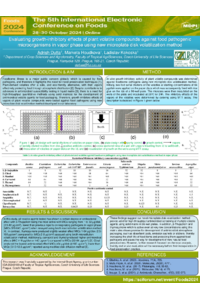
Foodborne illnesses, caused by food pathogens, highlight the need for novel preservation techniques [1]. Plant-derived volatiles offer a safe and eco-friendly alternative, as their vapors effectively protect food through atmospheric distribution [2]. Despite contributions to advances in antimicrobial susceptibility testing in liquid matrices [3], there is also a need for high-throughput quantitative methods using solid matrices for the development of antimicrobial volatile agents for food packaging. Therefore, the growth-inhibitory effects of the vapors of plant volatile compounds, namely thujaplicin, carvacrol, citral, menthol, thymol, and thymoquinone, were tested against food pathogens like Aspergillus niger, Bacillus cereus, Clostridium perfringens, Enterococcus faecalis, Escherichia coli, Listeria monocytogenes, Salmonella enterica Typhimurium, Shigella flexneri, Vibrio parahaemolyticus, and Yersinia enterocolitica using a new microplate disk volatilization method developed in our laboratory. This method allows for multiple screening of volatiles using paper discs on lids of microplates inhibiting microbial growth in the wells. β-Thujaplicin was the most active compound, with MICs ranging from 1 to 32 µg/disk (2.5-80 µg/cm3), lower than previous reports on respiratory pathogens in vapor phase (MICs 320-640 µg/cm3) assayed using the broth macrodilution volatilization method [4]. Thymoquinone produced a slightly weaker effect, with MICs in the range of 1-64 µg/disk (2.5-160 µg/cm3), compared to MICs of 2-8 µg/cm3 achieved using the broth microdilution volatilization method. Carvacrol and thymol produced higher antimicrobial effects (MIC ≥16 µg/disk or ≥40 µg/cm3) compared to previously observed MICs (32-64 µg/cm3) [3]. Citral produced MICs of ≥64 µg/disk (≥160 µg/cm3), lower than the MICs (3.13-12.5 µg/cm3) observed using the modified disk diffusion method [5]. Despite variations in volatilization matrices, our novel microplate disk volatilization method proves valid for the high-throughput screening of volatile agents. The method would be efficient for testing in various matrices such as nanofibers or carbon dots, used as carriers of volatile antimicrobials. β-Thujaplicin and thymoquinone show promise for antimicrobial atmosphere packaging, but further testing for their safety, organoleptic properties, and efficacy in food models is needed before practical incorporation.
Keywords
Food pathogens
vapor phase
plant-derived volatiles
atmosphere packaging
antimicrobials
Poster
ADRISH DUTTA Poster.pdf
Nutritional characterization and caffeine content of a food bar made with Paullinia cupana (guarana) powder
Predicting Bread Volume Class of Hard Red Winter Wheat Cultivars Using Machine Learning Models