Event submissions
Published
This submission belongs to the session S2. Food Nutrition and Functional Foods of the event The 5th International Electronic Conference on Foods
Published date
28 Oct, 2024
Academic Editor
'%3e%3cpath%20d='M12.6657%2010.9104C12.4185%2010.325%2012.0599%209.79327%2011.6097%209.34482C11.1609%208.89508%2010.6293%208.5365%2010.0442%208.28888C10.0389%208.28626%2010.0337%208.28495%2010.0285%208.28233C10.8446%207.69279%2011.3752%206.73249%2011.3752%205.64904C11.3752%203.8542%209.92103%202.39999%208.1262%202.39999C6.33136%202.39999%204.87715%203.8542%204.87715%205.64904C4.87715%206.73249%205.40774%207.69279%206.22393%208.28364C6.21869%208.28626%206.21345%208.28757%206.20821%208.29019C5.62129%208.5378%205.09463%208.89284%204.64265%209.34613C4.1929%209.79493%203.83432%2010.3266%203.58671%2010.9117C3.34345%2011.4845%203.21226%2012.0987%203.20023%2012.7209C3.19988%2012.7349%203.20233%2012.7488%203.20744%2012.7619C3.21255%2012.7749%203.22022%2012.7867%203.22998%2012.7968C3.23975%2012.8068%203.25142%2012.8147%203.26431%2012.8202C3.2772%2012.8256%203.29105%2012.8284%203.30504%2012.8284H4.09109C4.14874%2012.8284%204.19459%2012.7825%204.1959%2012.7262C4.2221%2011.7148%204.62823%2010.7676%205.34617%2010.0497C6.08899%209.30683%207.0755%208.89808%208.1262%208.89808C9.17689%208.89808%2010.1634%209.30683%2010.9062%2010.0497C11.6242%2010.7676%2012.0303%2011.7148%2012.0565%2012.7262C12.0578%2012.7838%2012.1037%2012.8284%2012.1613%2012.8284H12.9474C12.9613%2012.8284%2012.9752%2012.8256%2012.9881%2012.8202C13.001%2012.8147%2013.0126%2012.8068%2013.0224%2012.7968C13.0322%2012.7867%2013.0398%2012.7749%2013.0449%2012.7619C13.0501%2012.7488%2013.0525%2012.7349%2013.0522%2012.7209C13.0391%2012.0947%2012.9094%2011.4855%2012.6657%2010.9104ZM8.1262%207.9024C7.52486%207.9024%206.9589%207.6679%206.53312%207.24211C6.10733%206.81633%205.87283%206.25037%205.87283%205.64904C5.87283%205.0477%206.10733%204.48174%206.53312%204.05596C6.9589%203.63018%207.52486%203.39567%208.1262%203.39567C8.72753%203.39567%209.29349%203.63018%209.71927%204.05596C10.1451%204.48174%2010.3796%205.0477%2010.3796%205.64904C10.3796%206.25037%2010.1451%206.81633%209.71927%207.24211C9.29349%207.6679%208.72753%207.9024%208.1262%207.9024Z'%20fill='%235D1EE1'/%3e%3c/g%3e%3c/svg%3e) Manuel Viuda-Martos
Manuel Viuda-MartosCitation
Silvana Paola Fernandez, Roxana Elizabeth Gonzalez, Nutritional quality, bioactive compounds, and antioxidant activity of nine clones of fresh garlic and its black garlic derivative: a comparative study, in Proceedings of The 5th International Electronic Conference on Foods, 28 October–30 October 2024, MDPI: Basel, Switzerland
Share
Email
Facebook
Twitter
LinkedIn
Nutritional quality, bioactive compounds, and antioxidant activity of nine clones of fresh garlic and its black garlic derivative: a comparative study
'%3e%3cpath%20d='M12.6647%2010.9104C12.4176%2010.325%2012.0589%209.7933%2011.6088%209.34485C11.16%208.89511%2010.6283%208.53653%2010.0432%208.28891C10.038%208.28629%2010.0327%208.28498%2010.0275%208.28236C10.8437%207.69282%2011.3743%206.73252%2011.3743%205.64907C11.3743%203.85423%209.92005%202.40002%208.12522%202.40002C6.33038%202.40002%204.87618%203.85423%204.87618%205.64907C4.87618%206.73252%205.40677%207.69282%206.22296%208.28367C6.21772%208.28629%206.21248%208.2876%206.20724%208.29022C5.62031%208.53783%205.09365%208.89287%204.64167%209.34616C4.19192%209.79496%203.83334%2010.3266%203.58573%2010.9117C3.34247%2011.4846%203.21128%2012.0987%203.19925%2012.721C3.1989%2012.735%203.20135%2012.7489%203.20646%2012.7619C3.21157%2012.7749%203.21924%2012.7868%203.22901%2012.7968C3.23877%2012.8068%203.25045%2012.8148%203.26334%2012.8202C3.27623%2012.8256%203.29007%2012.8284%203.30406%2012.8284H4.09012C4.14776%2012.8284%204.19362%2012.7825%204.19493%2012.7262C4.22113%2011.7148%204.62726%2010.7676%205.34519%2010.0497C6.08802%209.30686%207.07452%208.89811%208.12522%208.89811C9.17592%208.89811%2010.1624%209.30686%2010.9052%2010.0497C11.6232%2010.7676%2012.0293%2011.7148%2012.0555%2012.7262C12.0568%2012.7839%2012.1027%2012.8284%2012.1603%2012.8284H12.9464C12.9604%2012.8284%2012.9742%2012.8256%2012.9871%2012.8202C13%2012.8148%2013.0117%2012.8068%2013.0214%2012.7968C13.0312%2012.7868%2013.0389%2012.7749%2013.044%2012.7619C13.0491%2012.7489%2013.0515%2012.735%2013.0512%2012.721C13.0381%2012.0947%2012.9084%2011.4856%2012.6647%2010.9104ZM8.12522%207.90243C7.52388%207.90243%206.95792%207.66793%206.53214%207.24215C6.10636%206.81636%205.87185%206.2504%205.87185%205.64907C5.87185%205.04773%206.10636%204.48177%206.53214%204.05599C6.95792%203.63021%207.52388%203.3957%208.12522%203.3957C8.72655%203.3957%209.29252%203.63021%209.7183%204.05599C10.1441%204.48177%2010.3786%205.04773%2010.3786%205.64907C10.3786%206.2504%2010.1441%206.81636%209.7183%207.24215C9.29252%207.66793%208.72655%207.90243%208.12522%207.90243Z'%20fill='%235D1EE1'/%3e%3c/g%3e%3c/svg%3e)
Silvana Paola Fernandez 1
Roxana Elizabeth Gonzalez 1,2
1. EEA La Consulta, CRMza-SJ, Instituto Nacional de Tecnología Agropecuaria (INTA). Ex ruta 40 km 96, La Consulta, 5567 Mendoza, Argentina
2. Facultad de Ciencias Exactas y Naturales, Universidad Nacional de Cuyo (UNCUYO). Padre J. Contreras 1300, 5500 Mendoza, Argentina
Abstract
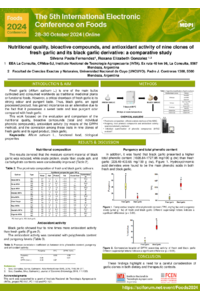
Fresh garlic (Allium sativum L.) is one of the main bulbs cultivated and consumed worldwide as traditional medicinal plants or functional foods. Several biological functions of garlic have been reported and indicated owing to its organosulfur compounds and polyphenols. However, a critical drawback of fresh garlic is its strong odour and pungent taste. Thus, black garlic, an aged processed product, has gained importance as an alternative due to the fact that it possesses a sweet taste and less pungent odor compared with fresh garlic. Previous research has shown that pre-harvest factors like genotype and heat treatment conditions used to produce black garlic are important parameters that affect not only the contents of bioactive compounds but also their nutritional quality and biological properties. This work focused on the evaluation and comparison of the nutritional quality, bioactive compounds (total and individual phenolic compounds), antioxidant activity (by means of the DPPH method), and the correlation among these traits in nine clones of fresh garlic and its aged product, black garlic. For this purpose, nine clones, classified according to ecophysiological groups, were chosen from the germplasm collection of INTA La Consulta. Black garlic was produced in a ripening chamber for 7 days at 80 °C and 30 days at room temperature. The results denoted that the moisture content material of black garlic was reduced, while crude protein, crude fiber, crude ash, and carbohydrate contents were considerably improved. In addition, it was found that black garlic presented a higher total phenolic content (1028.84-1727.95 mg/100 g dw) than fresh garlic (228.49-403.65 mg/100 g dw) and four to nine times more antioxidant activity. Hydroxycinnamic acid derivates were found to be the main phenolic acids in both fresh and black garlic. The antioxidant activity was correlated with polyphenols content and pungency levels. These findings highlight a need for a careful consideration of garlic clones in both dietary and therapeutic contexts.
Keywords
Allium sativum L.
functional food
biological properties
Poster
sciforum-098888.pdf
Predicting Bread Volume Class of Hard Red Winter Wheat Cultivars Using Machine Learning Models
Valorization of fennel leaves as a source of bioactive compounds: effects of dehydration on their nutritional and functional properties