Event submissions
Published
This submission belongs to the session S2. Food Nutrition and Functional Foods of the event The 5th International Electronic Conference on Foods
Published date
28 Oct, 2024
Academic Editor
'%3e%3cpath%20d='M12.6657%2010.9104C12.4185%2010.325%2012.0599%209.79327%2011.6097%209.34482C11.1609%208.89508%2010.6293%208.5365%2010.0442%208.28888C10.0389%208.28626%2010.0337%208.28495%2010.0285%208.28233C10.8446%207.69279%2011.3752%206.73249%2011.3752%205.64904C11.3752%203.8542%209.92103%202.39999%208.1262%202.39999C6.33136%202.39999%204.87715%203.8542%204.87715%205.64904C4.87715%206.73249%205.40774%207.69279%206.22393%208.28364C6.21869%208.28626%206.21345%208.28757%206.20821%208.29019C5.62129%208.5378%205.09463%208.89284%204.64265%209.34613C4.1929%209.79493%203.83432%2010.3266%203.58671%2010.9117C3.34345%2011.4845%203.21226%2012.0987%203.20023%2012.7209C3.19988%2012.7349%203.20233%2012.7488%203.20744%2012.7619C3.21255%2012.7749%203.22022%2012.7867%203.22998%2012.7968C3.23975%2012.8068%203.25142%2012.8147%203.26431%2012.8202C3.2772%2012.8256%203.29105%2012.8284%203.30504%2012.8284H4.09109C4.14874%2012.8284%204.19459%2012.7825%204.1959%2012.7262C4.2221%2011.7148%204.62823%2010.7676%205.34617%2010.0497C6.08899%209.30683%207.0755%208.89808%208.1262%208.89808C9.17689%208.89808%2010.1634%209.30683%2010.9062%2010.0497C11.6242%2010.7676%2012.0303%2011.7148%2012.0565%2012.7262C12.0578%2012.7838%2012.1037%2012.8284%2012.1613%2012.8284H12.9474C12.9613%2012.8284%2012.9752%2012.8256%2012.9881%2012.8202C13.001%2012.8147%2013.0126%2012.8068%2013.0224%2012.7968C13.0322%2012.7867%2013.0398%2012.7749%2013.0449%2012.7619C13.0501%2012.7488%2013.0525%2012.7349%2013.0522%2012.7209C13.0391%2012.0947%2012.9094%2011.4855%2012.6657%2010.9104ZM8.1262%207.9024C7.52486%207.9024%206.9589%207.6679%206.53312%207.24211C6.10733%206.81633%205.87283%206.25037%205.87283%205.64904C5.87283%205.0477%206.10733%204.48174%206.53312%204.05596C6.9589%203.63018%207.52486%203.39567%208.1262%203.39567C8.72753%203.39567%209.29349%203.63018%209.71927%204.05596C10.1451%204.48174%2010.3796%205.0477%2010.3796%205.64904C10.3796%206.25037%2010.1451%206.81633%209.71927%207.24211C9.29349%207.6679%208.72753%207.9024%208.1262%207.9024Z'%20fill='%235D1EE1'/%3e%3c/g%3e%3c/svg%3e) Antonello Santini
Antonello SantiniCitation
Laura Candela Salvador, Raquel Lucas-Gonzalez, Juana Fernández-López, José Ángel Pérez-Álvarez, Manuel Viuda-Martos, Antioxidant and techno-functional properties of silverskin coproducts obtained from the Coffea arabica cultivated in Brazil and Coffea canephora cultivated in Vietnam, in Proceedings of The 5th International Electronic Conference on Foods, 28 October–30 October 2024, MDPI: Basel, Switzerland
Share
Email
Facebook
Twitter
LinkedIn
Antioxidant and techno-functional properties of silverskin coproducts obtained from the Coffea arabica cultivated in Brazil and Coffea canephora cultivated in Vietnam
'%3e%3cpath%20d='M12.6647%2010.9104C12.4176%2010.325%2012.0589%209.7933%2011.6088%209.34485C11.16%208.89511%2010.6283%208.53653%2010.0432%208.28891C10.038%208.28629%2010.0327%208.28498%2010.0275%208.28236C10.8437%207.69282%2011.3743%206.73252%2011.3743%205.64907C11.3743%203.85423%209.92005%202.40002%208.12522%202.40002C6.33038%202.40002%204.87618%203.85423%204.87618%205.64907C4.87618%206.73252%205.40677%207.69282%206.22296%208.28367C6.21772%208.28629%206.21248%208.2876%206.20724%208.29022C5.62031%208.53783%205.09365%208.89287%204.64167%209.34616C4.19192%209.79496%203.83334%2010.3266%203.58573%2010.9117C3.34247%2011.4846%203.21128%2012.0987%203.19925%2012.721C3.1989%2012.735%203.20135%2012.7489%203.20646%2012.7619C3.21157%2012.7749%203.21924%2012.7868%203.22901%2012.7968C3.23877%2012.8068%203.25045%2012.8148%203.26334%2012.8202C3.27623%2012.8256%203.29007%2012.8284%203.30406%2012.8284H4.09012C4.14776%2012.8284%204.19362%2012.7825%204.19493%2012.7262C4.22113%2011.7148%204.62726%2010.7676%205.34519%2010.0497C6.08802%209.30686%207.07452%208.89811%208.12522%208.89811C9.17592%208.89811%2010.1624%209.30686%2010.9052%2010.0497C11.6232%2010.7676%2012.0293%2011.7148%2012.0555%2012.7262C12.0568%2012.7839%2012.1027%2012.8284%2012.1603%2012.8284H12.9464C12.9604%2012.8284%2012.9742%2012.8256%2012.9871%2012.8202C13%2012.8148%2013.0117%2012.8068%2013.0214%2012.7968C13.0312%2012.7868%2013.0389%2012.7749%2013.044%2012.7619C13.0491%2012.7489%2013.0515%2012.735%2013.0512%2012.721C13.0381%2012.0947%2012.9084%2011.4856%2012.6647%2010.9104ZM8.12522%207.90243C7.52388%207.90243%206.95792%207.66793%206.53214%207.24215C6.10636%206.81636%205.87185%206.2504%205.87185%205.64907C5.87185%205.04773%206.10636%204.48177%206.53214%204.05599C6.95792%203.63021%207.52388%203.3957%208.12522%203.3957C8.72655%203.3957%209.29252%203.63021%209.7183%204.05599C10.1441%204.48177%2010.3786%205.04773%2010.3786%205.64907C10.3786%206.2504%2010.1441%206.81636%209.7183%207.24215C9.29252%207.66793%208.72655%207.90243%208.12522%207.90243Z'%20fill='%235D1EE1'/%3e%3c/g%3e%3c/svg%3e)
Laura Candela Salvador 1

Raquel Lucas-Gonzalez 1

Juana Fernández-López 1
José Ángel Pérez-Álvarez 1

Manuel Viuda-Martos 1
1. IPOA Research Group, Agro-Food Technology Departament, Centro de Investigación e Innovación Agroalimentaria y Agroambiental (CIAGRO-UMH), Miguel Hernández University, 03312, Orihuela, Spain.
Abstract
The number of coffee consumers has increased, as has coffee's annual production and, consequently, the generation of coffee co-products. One of these co-products is a membrane that coats the coffee bean and is released during the roasting process of green coffee (silverskin). This study evaluated the physicochemical properties, antioxidant capacity, and techno-functional properties of silverskin obtained from roasted coffee varieties Coffea arabica from Brazil and Coffea canephora from Vietnam. The skins were obtained after roasting and ground in a coffee grinder for the analyses. Physicochemical properties were determined by measuring the samples' pH and water activity (Aw). Antioxidant capacity was determined by three different assays: ABTS, DPPH, and FRAP. The techno-functional properties measured were water-holding capacity (WRC), oil-holding capacity (ORC), and swelling capacity (SWC). For the pH of the samples, the results showed values (p<0.05) of 4.78 and 4.86 for Vietnamese and Brazilian coffee, respectively, while Aw showed no significant differences (p>0.05) between the samples. For antioxidant capacity, the DPPH test showed no significant differences (p>0.05) between samples, while the ABTS test showed values (p>0.05) of 15.07µgTrolox/g flour and 15.10µgTrolox/g flour for silver skin from Vietnam and Brazil, respectively. In the FRAP test, the samples showed significant differences (p<0.05) between them with values of 21.49µgTrolox/g flour and 16.76µg Trolox/g flour for silver skin from Vietnam and Brazil, respectively. As for the techno-functional properties, WRC and SWC showed significant differences between the samples (p<0.05); however, ORC showed no significant differences (p>0.05) between the two flours. The results obtained show that the utilization of coffee silver skin can help to reduce food waste generated by coffee production. Different origins and species of coffee beans may cause differences in antioxidant activity. Further studies on coffee silver skin should be conducted to promote its use in different formulations of new food products.
Keywords
coffee
coproducts
antioxidant
techno-functional properties
silverskin.
Poster
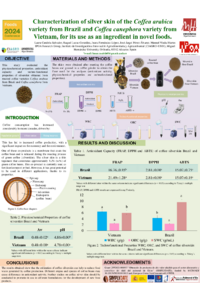
Poster congreso Foods.pdf
Antioxidant and antibacterial properties of red macroalgae protein hydrolysates and their potential use as bio-preservatives ffor beef
ArtisaneR: An online generic process risk model for sausage-making