Event submissions
Published
This submission belongs to the session S4. Food Microbiology of the event The 5th International Electronic Conference on Foods
Published date
28 Oct, 2024
Academic Editor
'%3e%3cpath%20d='M12.6657%2010.9104C12.4185%2010.325%2012.0599%209.79327%2011.6097%209.34482C11.1609%208.89508%2010.6293%208.5365%2010.0442%208.28888C10.0389%208.28626%2010.0337%208.28495%2010.0285%208.28233C10.8446%207.69279%2011.3752%206.73249%2011.3752%205.64904C11.3752%203.8542%209.92103%202.39999%208.1262%202.39999C6.33136%202.39999%204.87715%203.8542%204.87715%205.64904C4.87715%206.73249%205.40774%207.69279%206.22393%208.28364C6.21869%208.28626%206.21345%208.28757%206.20821%208.29019C5.62129%208.5378%205.09463%208.89284%204.64265%209.34613C4.1929%209.79493%203.83432%2010.3266%203.58671%2010.9117C3.34345%2011.4845%203.21226%2012.0987%203.20023%2012.7209C3.19988%2012.7349%203.20233%2012.7488%203.20744%2012.7619C3.21255%2012.7749%203.22022%2012.7867%203.22998%2012.7968C3.23975%2012.8068%203.25142%2012.8147%203.26431%2012.8202C3.2772%2012.8256%203.29105%2012.8284%203.30504%2012.8284H4.09109C4.14874%2012.8284%204.19459%2012.7825%204.1959%2012.7262C4.2221%2011.7148%204.62823%2010.7676%205.34617%2010.0497C6.08899%209.30683%207.0755%208.89808%208.1262%208.89808C9.17689%208.89808%2010.1634%209.30683%2010.9062%2010.0497C11.6242%2010.7676%2012.0303%2011.7148%2012.0565%2012.7262C12.0578%2012.7838%2012.1037%2012.8284%2012.1613%2012.8284H12.9474C12.9613%2012.8284%2012.9752%2012.8256%2012.9881%2012.8202C13.001%2012.8147%2013.0126%2012.8068%2013.0224%2012.7968C13.0322%2012.7867%2013.0398%2012.7749%2013.0449%2012.7619C13.0501%2012.7488%2013.0525%2012.7349%2013.0522%2012.7209C13.0391%2012.0947%2012.9094%2011.4855%2012.6657%2010.9104ZM8.1262%207.9024C7.52486%207.9024%206.9589%207.6679%206.53312%207.24211C6.10733%206.81633%205.87283%206.25037%205.87283%205.64904C5.87283%205.0477%206.10733%204.48174%206.53312%204.05596C6.9589%203.63018%207.52486%203.39567%208.1262%203.39567C8.72753%203.39567%209.29349%203.63018%209.71927%204.05596C10.1451%204.48174%2010.3796%205.0477%2010.3796%205.64904C10.3796%206.25037%2010.1451%206.81633%209.71927%207.24211C9.29349%207.6679%208.72753%207.9024%208.1262%207.9024Z'%20fill='%235D1EE1'/%3e%3c/g%3e%3c/svg%3e) Antonio Bevilacqua
Antonio BevilacquaCitation
Maria João Nunes, Luís Escobar, Lucia Noronha, Maria Inês Cruz, Norton Komora, Joana Barbosa, Fátima Carvalho, Paula Teixeira, Evaluating the Efficacy of Four Preservatives Against Pathogenic Bacteria in Meat Analogues, in Proceedings of The 5th International Electronic Conference on Foods, 28 October–30 October 2024, MDPI: Basel, Switzerland
Share
Email
Facebook
Twitter
LinkedIn
Evaluating the Efficacy of Four Preservatives Against Pathogenic Bacteria in Meat Analogues
'%3e%3cpath%20d='M12.6647%2010.9104C12.4176%2010.325%2012.0589%209.7933%2011.6088%209.34485C11.16%208.89511%2010.6283%208.53653%2010.0432%208.28891C10.038%208.28629%2010.0327%208.28498%2010.0275%208.28236C10.8437%207.69282%2011.3743%206.73252%2011.3743%205.64907C11.3743%203.85423%209.92005%202.40002%208.12522%202.40002C6.33038%202.40002%204.87618%203.85423%204.87618%205.64907C4.87618%206.73252%205.40677%207.69282%206.22296%208.28367C6.21772%208.28629%206.21248%208.2876%206.20724%208.29022C5.62031%208.53783%205.09365%208.89287%204.64167%209.34616C4.19192%209.79496%203.83334%2010.3266%203.58573%2010.9117C3.34247%2011.4846%203.21128%2012.0987%203.19925%2012.721C3.1989%2012.735%203.20135%2012.7489%203.20646%2012.7619C3.21157%2012.7749%203.21924%2012.7868%203.22901%2012.7968C3.23877%2012.8068%203.25045%2012.8148%203.26334%2012.8202C3.27623%2012.8256%203.29007%2012.8284%203.30406%2012.8284H4.09012C4.14776%2012.8284%204.19362%2012.7825%204.19493%2012.7262C4.22113%2011.7148%204.62726%2010.7676%205.34519%2010.0497C6.08802%209.30686%207.07452%208.89811%208.12522%208.89811C9.17592%208.89811%2010.1624%209.30686%2010.9052%2010.0497C11.6232%2010.7676%2012.0293%2011.7148%2012.0555%2012.7262C12.0568%2012.7839%2012.1027%2012.8284%2012.1603%2012.8284H12.9464C12.9604%2012.8284%2012.9742%2012.8256%2012.9871%2012.8202C13%2012.8148%2013.0117%2012.8068%2013.0214%2012.7968C13.0312%2012.7868%2013.0389%2012.7749%2013.044%2012.7619C13.0491%2012.7489%2013.0515%2012.735%2013.0512%2012.721C13.0381%2012.0947%2012.9084%2011.4856%2012.6647%2010.9104ZM8.12522%207.90243C7.52388%207.90243%206.95792%207.66793%206.53214%207.24215C6.10636%206.81636%205.87185%206.2504%205.87185%205.64907C5.87185%205.04773%206.10636%204.48177%206.53214%204.05599C6.95792%203.63021%207.52388%203.3957%208.12522%203.3957C8.72655%203.3957%209.29252%203.63021%209.7183%204.05599C10.1441%204.48177%2010.3786%205.04773%2010.3786%205.64907C10.3786%206.2504%2010.1441%206.81636%209.7183%207.24215C9.29252%207.66793%208.72655%207.90243%208.12522%207.90243Z'%20fill='%235D1EE1'/%3e%3c/g%3e%3c/svg%3e)
Maria João Nunes 1,2,3
Luís Escobar 1
Lucia Noronha 4
Maria Inês Cruz 5
Norton Komora 6

Joana Barbosa 1
Fátima Carvalho 3
Paula Teixeira 1
1. Centro de Biotecnologia e Química Fina
2. Coalb4Food
3. Primor - Charcutaria Prima, S.A.
4. Colab4Food
5. Primor - Charcutaria Prima S.A.
6. Casa Mendes Gonçalves
Abstract
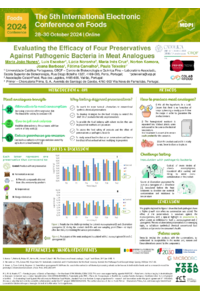
Meat products represent a large proportion of the human diet and can be included into the diet in a variety of ways. Recently, with changing consumer perceptions of sustainability, some food intolerances, and even animal welfare concerns, trends have emerged to reduce meat consumption. To achieve this, the industry has had to come up with vegan or vegetarian alternatives—meat analogues—“products that mimic meat in their functionality, bearing similar appearance, texture, and sensory attributes to meat”.
Meat analogues typically include synthetic chemical preservatives in their formulation, namely, ascorbic acid, nitrite and nitrate, or phosphates. This study aimed to evaluate the effectiveness of four clean label alternatives as replacements for conventional chemical preservatives. These preservatives include cultured dextrose, phenolic compounds obtained from Olea europaea by-products, grape extracts, and vinagre derivatives. Each preservative has different properties, and the focus of this research was to determine which one(s) has a greater activity against pathogenic bacteria such as Clostridium sporogenes (DSM 767, NCA 3679). and a cocktail of Listeria monocytogenes (2542, FSL J1-177, FSL J1-031, FSL N3-013, FSL R2-499, FSL N1-227 and MF4077), while also preserving the product during its shelf life. This study involves the production of laboratory-scale meat analogues using the original industry formulation and formulations with each clean label preservative, followed by inoculation with pathogenic bacteria. The evolution of the pathogens was monitored, and the shelf life of the products was evaluated according to ISO standards. The results show positive prospects for clean label alternatives to replace current preservatives with healthier alternatives, in particular grape extracts and cultured dextrose, which have shown the best antimicrobial properties when added to meat analogues. However, further studies need to be conducted to assess the safety of these preservatives and their impact on the technological properties of meat analogues.
Keywords
food safety
meat analogues
challenge tests
pathogenic bacteria
clean label
Poster
FOODS V4.pdf
Sodium Content of Restaurant Foods: Publishing Trends
Production of exopolysaccharides through fermentation of secondary whey with kefir grains