Event submissions
Published
This submission belongs to the session S5. Chemistry and Physicochemical Properties of Foods of the event The 5th International Electronic Conference on Foods
Published date
28 Oct, 2024
Academic Editor
'%3e%3cpath%20d='M12.6657%2010.9104C12.4185%2010.325%2012.0599%209.79327%2011.6097%209.34482C11.1609%208.89508%2010.6293%208.5365%2010.0442%208.28888C10.0389%208.28626%2010.0337%208.28495%2010.0285%208.28233C10.8446%207.69279%2011.3752%206.73249%2011.3752%205.64904C11.3752%203.8542%209.92103%202.39999%208.1262%202.39999C6.33136%202.39999%204.87715%203.8542%204.87715%205.64904C4.87715%206.73249%205.40774%207.69279%206.22393%208.28364C6.21869%208.28626%206.21345%208.28757%206.20821%208.29019C5.62129%208.5378%205.09463%208.89284%204.64265%209.34613C4.1929%209.79493%203.83432%2010.3266%203.58671%2010.9117C3.34345%2011.4845%203.21226%2012.0987%203.20023%2012.7209C3.19988%2012.7349%203.20233%2012.7488%203.20744%2012.7619C3.21255%2012.7749%203.22022%2012.7867%203.22998%2012.7968C3.23975%2012.8068%203.25142%2012.8147%203.26431%2012.8202C3.2772%2012.8256%203.29105%2012.8284%203.30504%2012.8284H4.09109C4.14874%2012.8284%204.19459%2012.7825%204.1959%2012.7262C4.2221%2011.7148%204.62823%2010.7676%205.34617%2010.0497C6.08899%209.30683%207.0755%208.89808%208.1262%208.89808C9.17689%208.89808%2010.1634%209.30683%2010.9062%2010.0497C11.6242%2010.7676%2012.0303%2011.7148%2012.0565%2012.7262C12.0578%2012.7838%2012.1037%2012.8284%2012.1613%2012.8284H12.9474C12.9613%2012.8284%2012.9752%2012.8256%2012.9881%2012.8202C13.001%2012.8147%2013.0126%2012.8068%2013.0224%2012.7968C13.0322%2012.7867%2013.0398%2012.7749%2013.0449%2012.7619C13.0501%2012.7488%2013.0525%2012.7349%2013.0522%2012.7209C13.0391%2012.0947%2012.9094%2011.4855%2012.6657%2010.9104ZM8.1262%207.9024C7.52486%207.9024%206.9589%207.6679%206.53312%207.24211C6.10733%206.81633%205.87283%206.25037%205.87283%205.64904C5.87283%205.0477%206.10733%204.48174%206.53312%204.05596C6.9589%203.63018%207.52486%203.39567%208.1262%203.39567C8.72753%203.39567%209.29349%203.63018%209.71927%204.05596C10.1451%204.48174%2010.3796%205.0477%2010.3796%205.64904C10.3796%206.25037%2010.1451%206.81633%209.71927%207.24211C9.29349%207.6679%208.72753%207.9024%208.1262%207.9024Z'%20fill='%235D1EE1'/%3e%3c/g%3e%3c/svg%3e) Joana Amaral
Joana AmaralCitation
Aidalu Hernandez-Martinez, Carlos Jiménez-Pérez, Alma Cruz-Guerrero, John F. Trant, Sergio Alatorre-Santamaría, Production of exopolysaccharides through fermentation of secondary whey with kefir grains, in Proceedings of The 5th International Electronic Conference on Foods, 28 October–30 October 2024, MDPI: Basel, Switzerland
Share
Email
Facebook
Twitter
LinkedIn
Production of exopolysaccharides through fermentation of secondary whey with kefir grains

Aidalu Hernandez-Martinez 1,2
'%3e%3cpath%20d='M12.6647%2010.9104C12.4176%2010.325%2012.0589%209.7933%2011.6088%209.34485C11.16%208.89511%2010.6283%208.53653%2010.0432%208.28891C10.038%208.28629%2010.0327%208.28498%2010.0275%208.28236C10.8437%207.69282%2011.3743%206.73252%2011.3743%205.64907C11.3743%203.85423%209.92005%202.40002%208.12522%202.40002C6.33038%202.40002%204.87618%203.85423%204.87618%205.64907C4.87618%206.73252%205.40677%207.69282%206.22296%208.28367C6.21772%208.28629%206.21248%208.2876%206.20724%208.29022C5.62031%208.53783%205.09365%208.89287%204.64167%209.34616C4.19192%209.79496%203.83334%2010.3266%203.58573%2010.9117C3.34247%2011.4846%203.21128%2012.0987%203.19925%2012.721C3.1989%2012.735%203.20135%2012.7489%203.20646%2012.7619C3.21157%2012.7749%203.21924%2012.7868%203.22901%2012.7968C3.23877%2012.8068%203.25045%2012.8148%203.26334%2012.8202C3.27623%2012.8256%203.29007%2012.8284%203.30406%2012.8284H4.09012C4.14776%2012.8284%204.19362%2012.7825%204.19493%2012.7262C4.22113%2011.7148%204.62726%2010.7676%205.34519%2010.0497C6.08802%209.30686%207.07452%208.89811%208.12522%208.89811C9.17592%208.89811%2010.1624%209.30686%2010.9052%2010.0497C11.6232%2010.7676%2012.0293%2011.7148%2012.0555%2012.7262C12.0568%2012.7839%2012.1027%2012.8284%2012.1603%2012.8284H12.9464C12.9604%2012.8284%2012.9742%2012.8256%2012.9871%2012.8202C13%2012.8148%2013.0117%2012.8068%2013.0214%2012.7968C13.0312%2012.7868%2013.0389%2012.7749%2013.044%2012.7619C13.0491%2012.7489%2013.0515%2012.735%2013.0512%2012.721C13.0381%2012.0947%2012.9084%2011.4856%2012.6647%2010.9104ZM8.12522%207.90243C7.52388%207.90243%206.95792%207.66793%206.53214%207.24215C6.10636%206.81636%205.87185%206.2504%205.87185%205.64907C5.87185%205.04773%206.10636%204.48177%206.53214%204.05599C6.95792%203.63021%207.52388%203.3957%208.12522%203.3957C8.72655%203.3957%209.29252%203.63021%209.7183%204.05599C10.1441%204.48177%2010.3786%205.04773%2010.3786%205.64907C10.3786%206.2504%2010.1441%206.81636%209.7183%207.24215C9.29252%207.66793%208.72655%207.90243%208.12522%207.90243Z'%20fill='%235D1EE1'/%3e%3c/g%3e%3c/svg%3e)
Carlos Jiménez-Pérez 2
Alma Cruz-Guerrero 2
John F. Trant 3
Sergio Alatorre-Santamaría 2
1. Faculty of Chemistry, Universidad Nacional Autónoma de México, 04510, Ciudad de México, México
2. Department of Biotechnology, Universidad Autónoma Metropolitana - Iztapalapa, 09340, Ciudad de México, México
3. Department of Chemistry and Biochemistry, University of Windsor, N9B3P4, Windsor, Ontario, Canada
Abstract
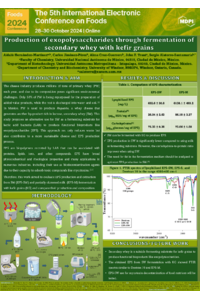
The disposal of whey, the main by-product of the cheese industry, represents a challenge as it is a significant pollutant due to its complex composition. In Mexico, whey is used to produce Requesón, a type of protein-rich whey cheese that generates another by-product, secondary whey. This residue has a lower protein content but still retains the lactose of primary whey, which means it still represents an environmental hazard. Therefore, simple and economical solutions are needed. In the present study, secondary whey was used as a fermenting substrate for kefir grains to produce functional bioproducts such as exopolysaccharides (EPSs) like kefiran. The secondary whey was pasteurized at 121 °C for 10 min before its inoculation with 10% (w/v) kefir grains and then incubated at 30 °C for 24 h. After the removal of kefir grains by filtration, the fermented whey was heated in a boiling water bath for 15 min and then centrifuged. The supernatant was adjusted to pH 7.0, and the EPSs were precipitated by the addition of two volumes of absolute ethanol and then kept at 4 °C for 24 h. The precipitate was separated by centrifugation, resuspended in deionized water, dialyzed for 24 hours using a 10 kDa pore-sized membrane and finally lyophilized. The phenol–sulfuric acid method was used to determine total carbohydrates and the Bradford method was used for protein content. The isolated solid had a composition of 57.96 ± 0.34 µg of carbohydrates/mg and 36.62 ± 0.59 µg of protein/mg. Hence, secondary whey fermentation with kefir grains is a suitable solution to reduce the environmental impact of whey and to produce functional bioproducts like EPSs.
Keywords
Exopolysaccharides
secondary whey
lactose
kefir grains
fermentation
Poster
Foods-Cartel-3.pdf
Evaluating the Efficacy of Four Preservatives Against Pathogenic Bacteria in Meat Analogues
A Sustainable Approach to Food Waste Management: Optimizing Mycoprotein Production from Immature Rice Kernels Using Neurospora crassa