Event submissions
Published
This submission belongs to the session S4. Food Microbiology of the event The 5th International Electronic Conference on Foods
Published date
28 Oct, 2024
Academic Editor
'%3e%3cpath%20d='M12.6657%2010.9104C12.4185%2010.325%2012.0599%209.79327%2011.6097%209.34482C11.1609%208.89508%2010.6293%208.5365%2010.0442%208.28888C10.0389%208.28626%2010.0337%208.28495%2010.0285%208.28233C10.8446%207.69279%2011.3752%206.73249%2011.3752%205.64904C11.3752%203.8542%209.92103%202.39999%208.1262%202.39999C6.33136%202.39999%204.87715%203.8542%204.87715%205.64904C4.87715%206.73249%205.40774%207.69279%206.22393%208.28364C6.21869%208.28626%206.21345%208.28757%206.20821%208.29019C5.62129%208.5378%205.09463%208.89284%204.64265%209.34613C4.1929%209.79493%203.83432%2010.3266%203.58671%2010.9117C3.34345%2011.4845%203.21226%2012.0987%203.20023%2012.7209C3.19988%2012.7349%203.20233%2012.7488%203.20744%2012.7619C3.21255%2012.7749%203.22022%2012.7867%203.22998%2012.7968C3.23975%2012.8068%203.25142%2012.8147%203.26431%2012.8202C3.2772%2012.8256%203.29105%2012.8284%203.30504%2012.8284H4.09109C4.14874%2012.8284%204.19459%2012.7825%204.1959%2012.7262C4.2221%2011.7148%204.62823%2010.7676%205.34617%2010.0497C6.08899%209.30683%207.0755%208.89808%208.1262%208.89808C9.17689%208.89808%2010.1634%209.30683%2010.9062%2010.0497C11.6242%2010.7676%2012.0303%2011.7148%2012.0565%2012.7262C12.0578%2012.7838%2012.1037%2012.8284%2012.1613%2012.8284H12.9474C12.9613%2012.8284%2012.9752%2012.8256%2012.9881%2012.8202C13.001%2012.8147%2013.0126%2012.8068%2013.0224%2012.7968C13.0322%2012.7867%2013.0398%2012.7749%2013.0449%2012.7619C13.0501%2012.7488%2013.0525%2012.7349%2013.0522%2012.7209C13.0391%2012.0947%2012.9094%2011.4855%2012.6657%2010.9104ZM8.1262%207.9024C7.52486%207.9024%206.9589%207.6679%206.53312%207.24211C6.10733%206.81633%205.87283%206.25037%205.87283%205.64904C5.87283%205.0477%206.10733%204.48174%206.53312%204.05596C6.9589%203.63018%207.52486%203.39567%208.1262%203.39567C8.72753%203.39567%209.29349%203.63018%209.71927%204.05596C10.1451%204.48174%2010.3796%205.0477%2010.3796%205.64904C10.3796%206.25037%2010.1451%206.81633%209.71927%207.24211C9.29349%207.6679%208.72753%207.9024%208.1262%207.9024Z'%20fill='%235D1EE1'/%3e%3c/g%3e%3c/svg%3e) Antonio Bevilacqua
Antonio BevilacquaCitation
Maria Grazia Bonomo, Rocco Rossano, Giovanni Salzano, Proteomic and transcriptomic analyses revealed cell changes and physiological adaptations in ethanol-stressed Oenococcus oeni strain, in Proceedings of The 5th International Electronic Conference on Foods, 28 October–30 October 2024, MDPI: Basel, Switzerland
Share
Email
Facebook
Twitter
LinkedIn
Proteomic and transcriptomic analyses revealed cell changes and physiological adaptations in ethanol-stressed Oenococcus oeni strain
'%3e%3cpath%20d='M12.6647%2010.9104C12.4176%2010.325%2012.0589%209.7933%2011.6088%209.34485C11.16%208.89511%2010.6283%208.53653%2010.0432%208.28891C10.038%208.28629%2010.0327%208.28498%2010.0275%208.28236C10.8437%207.69282%2011.3743%206.73252%2011.3743%205.64907C11.3743%203.85423%209.92005%202.40002%208.12522%202.40002C6.33038%202.40002%204.87618%203.85423%204.87618%205.64907C4.87618%206.73252%205.40677%207.69282%206.22296%208.28367C6.21772%208.28629%206.21248%208.2876%206.20724%208.29022C5.62031%208.53783%205.09365%208.89287%204.64167%209.34616C4.19192%209.79496%203.83334%2010.3266%203.58573%2010.9117C3.34247%2011.4846%203.21128%2012.0987%203.19925%2012.721C3.1989%2012.735%203.20135%2012.7489%203.20646%2012.7619C3.21157%2012.7749%203.21924%2012.7868%203.22901%2012.7968C3.23877%2012.8068%203.25045%2012.8148%203.26334%2012.8202C3.27623%2012.8256%203.29007%2012.8284%203.30406%2012.8284H4.09012C4.14776%2012.8284%204.19362%2012.7825%204.19493%2012.7262C4.22113%2011.7148%204.62726%2010.7676%205.34519%2010.0497C6.08802%209.30686%207.07452%208.89811%208.12522%208.89811C9.17592%208.89811%2010.1624%209.30686%2010.9052%2010.0497C11.6232%2010.7676%2012.0293%2011.7148%2012.0555%2012.7262C12.0568%2012.7839%2012.1027%2012.8284%2012.1603%2012.8284H12.9464C12.9604%2012.8284%2012.9742%2012.8256%2012.9871%2012.8202C13%2012.8148%2013.0117%2012.8068%2013.0214%2012.7968C13.0312%2012.7868%2013.0389%2012.7749%2013.044%2012.7619C13.0491%2012.7489%2013.0515%2012.735%2013.0512%2012.721C13.0381%2012.0947%2012.9084%2011.4856%2012.6647%2010.9104ZM8.12522%207.90243C7.52388%207.90243%206.95792%207.66793%206.53214%207.24215C6.10636%206.81636%205.87185%206.2504%205.87185%205.64907C5.87185%205.04773%206.10636%204.48177%206.53214%204.05599C6.95792%203.63021%207.52388%203.3957%208.12522%203.3957C8.72655%203.3957%209.29252%203.63021%209.7183%204.05599C10.1441%204.48177%2010.3786%205.04773%2010.3786%205.64907C10.3786%206.2504%2010.1441%206.81636%209.7183%207.24215C9.29252%207.66793%208.72655%207.90243%208.12522%207.90243Z'%20fill='%235D1EE1'/%3e%3c/g%3e%3c/svg%3e)
Maria Grazia Bonomo 1
Rocco Rossano 1

Giovanni Salzano 1
1. Department of Science, University of Basilicata, Viale dell'Ateneo Lucano 10, Potenza, Italy
Abstract
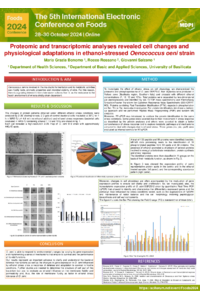
Introduction: Oenococcus oeni is involved in the malolactic fermentation and its metabolic activities can modify the taste, aromatic properties, and microbial stability of wine. For this reason, there is growing interest in formulate starter cultures from it, as the resistance to the harsh environment of wine is strictly strain-dependent.
Methods: To investigate the effect of ethanol stress on cell physiology, we characterized the proteome and phosphoproteome of O. oeni DSPZS12 from Aglianico wine produced in the Vulture zone (Basilicata region, Southern Italy). Total proteins were separated by two-dimensional gel electrophoresis and identified by MALDI-TOF mass spectrometry and ElectroSpray Ionization-Fourier Transform Ion Cyclotron Resonance Mass Spectrometry (ESI-ICR/FT-MS). Proteins exhibiting Post-Translation Modification (PTM), especially phosphorilation on Ser, Thr, or Tyr, were also investigated. For protein identification, we chose a bottom-up approach and we performed Peptide Mass Fingerprinting (PMF) and tandem MS analyses. A total of 133 peptide and 99 proteins were identified; in addition, MS/MS data processing leads to the identification of 78 phosphorylated peptides from 50 spots and 39 proteins.
Results: The presence of ethanol promoted a shutdown of several proteins involved in energy/carbohydrate metabolism, protein synthesis and stress response. Moreover, changes in cell physiology are often accompanied by the modulation of gene expression profiles to ensure cell vitality and proliferation. So, we also investigated the transcriptome expression profile of O. oeni DSPZS12 strain by quantitative Real Time PCR (qPCR) that allowed us to identify and characterize the differentially expressed genes and the pathways most influenced by stress conditions tested, such as the regeneration of NADPH and maintenance of redox balance and the cell morphology, involving peptidoglycan biosynthesis and cell wall components.
Conclusions: O. oeni is able to respond to environmental changes by varying its gene expression and implementing a series of mechanisms that ensure its survival and the performance of its vital functions.
Keywords
Oenococcus oeni
ethanol stress conditions
ESI-ICR/FT-MS
MALDI-TOF mass spectrometry
quantitative Real Time PCR
Poster
Poster BonomoMG.pdf
Incorporation of ash during traditional black olive processing: Effects on
bioactive compounds and antioxidant activity
bioactive compounds and antioxidant activity
Effect of hydro-extraction conditions on yields and physicochemical properties of refined sea salt