Event submissions
Published
This submission belongs to the session S3. Sustainable Food Security and Food System of the event The 5th International Electronic Conference on Foods
Published date
28 Oct, 2024
Academic Editor
'%3e%3cpath%20d='M12.6657%2010.9104C12.4185%2010.325%2012.0599%209.79327%2011.6097%209.34482C11.1609%208.89508%2010.6293%208.5365%2010.0442%208.28888C10.0389%208.28626%2010.0337%208.28495%2010.0285%208.28233C10.8446%207.69279%2011.3752%206.73249%2011.3752%205.64904C11.3752%203.8542%209.92103%202.39999%208.1262%202.39999C6.33136%202.39999%204.87715%203.8542%204.87715%205.64904C4.87715%206.73249%205.40774%207.69279%206.22393%208.28364C6.21869%208.28626%206.21345%208.28757%206.20821%208.29019C5.62129%208.5378%205.09463%208.89284%204.64265%209.34613C4.1929%209.79493%203.83432%2010.3266%203.58671%2010.9117C3.34345%2011.4845%203.21226%2012.0987%203.20023%2012.7209C3.19988%2012.7349%203.20233%2012.7488%203.20744%2012.7619C3.21255%2012.7749%203.22022%2012.7867%203.22998%2012.7968C3.23975%2012.8068%203.25142%2012.8147%203.26431%2012.8202C3.2772%2012.8256%203.29105%2012.8284%203.30504%2012.8284H4.09109C4.14874%2012.8284%204.19459%2012.7825%204.1959%2012.7262C4.2221%2011.7148%204.62823%2010.7676%205.34617%2010.0497C6.08899%209.30683%207.0755%208.89808%208.1262%208.89808C9.17689%208.89808%2010.1634%209.30683%2010.9062%2010.0497C11.6242%2010.7676%2012.0303%2011.7148%2012.0565%2012.7262C12.0578%2012.7838%2012.1037%2012.8284%2012.1613%2012.8284H12.9474C12.9613%2012.8284%2012.9752%2012.8256%2012.9881%2012.8202C13.001%2012.8147%2013.0126%2012.8068%2013.0224%2012.7968C13.0322%2012.7867%2013.0398%2012.7749%2013.0449%2012.7619C13.0501%2012.7488%2013.0525%2012.7349%2013.0522%2012.7209C13.0391%2012.0947%2012.9094%2011.4855%2012.6657%2010.9104ZM8.1262%207.9024C7.52486%207.9024%206.9589%207.6679%206.53312%207.24211C6.10733%206.81633%205.87283%206.25037%205.87283%205.64904C5.87283%205.0477%206.10733%204.48174%206.53312%204.05596C6.9589%203.63018%207.52486%203.39567%208.1262%203.39567C8.72753%203.39567%209.29349%203.63018%209.71927%204.05596C10.1451%204.48174%2010.3796%205.0477%2010.3796%205.64904C10.3796%206.25037%2010.1451%206.81633%209.71927%207.24211C9.29349%207.6679%208.72753%207.9024%208.1262%207.9024Z'%20fill='%235D1EE1'/%3e%3c/g%3e%3c/svg%3e) Theodoros Varzakas
Theodoros VarzakasCitation
Gloria López-Gámez, Raquel Del Pino-García, María Asunción López-Bascón, Inmaculada Moscoso-Ruiz, Ana Lemus-Conejo, Vito Verardo, Optimizing carotenoid and amino acid extraction from tomato waste for biostimulant production, in Proceedings of The 5th International Electronic Conference on Foods, 28 October–30 October 2024, MDPI: Basel, Switzerland
Share
Email
Facebook
Twitter
LinkedIn
Optimizing carotenoid and amino acid extraction from tomato waste for biostimulant production
'%3e%3cpath%20d='M12.6647%2010.9104C12.4176%2010.325%2012.0589%209.7933%2011.6088%209.34485C11.16%208.89511%2010.6283%208.53653%2010.0432%208.28891C10.038%208.28629%2010.0327%208.28498%2010.0275%208.28236C10.8437%207.69282%2011.3743%206.73252%2011.3743%205.64907C11.3743%203.85423%209.92005%202.40002%208.12522%202.40002C6.33038%202.40002%204.87618%203.85423%204.87618%205.64907C4.87618%206.73252%205.40677%207.69282%206.22296%208.28367C6.21772%208.28629%206.21248%208.2876%206.20724%208.29022C5.62031%208.53783%205.09365%208.89287%204.64167%209.34616C4.19192%209.79496%203.83334%2010.3266%203.58573%2010.9117C3.34247%2011.4846%203.21128%2012.0987%203.19925%2012.721C3.1989%2012.735%203.20135%2012.7489%203.20646%2012.7619C3.21157%2012.7749%203.21924%2012.7868%203.22901%2012.7968C3.23877%2012.8068%203.25045%2012.8148%203.26334%2012.8202C3.27623%2012.8256%203.29007%2012.8284%203.30406%2012.8284H4.09012C4.14776%2012.8284%204.19362%2012.7825%204.19493%2012.7262C4.22113%2011.7148%204.62726%2010.7676%205.34519%2010.0497C6.08802%209.30686%207.07452%208.89811%208.12522%208.89811C9.17592%208.89811%2010.1624%209.30686%2010.9052%2010.0497C11.6232%2010.7676%2012.0293%2011.7148%2012.0555%2012.7262C12.0568%2012.7839%2012.1027%2012.8284%2012.1603%2012.8284H12.9464C12.9604%2012.8284%2012.9742%2012.8256%2012.9871%2012.8202C13%2012.8148%2013.0117%2012.8068%2013.0214%2012.7968C13.0312%2012.7868%2013.0389%2012.7749%2013.044%2012.7619C13.0491%2012.7489%2013.0515%2012.735%2013.0512%2012.721C13.0381%2012.0947%2012.9084%2011.4856%2012.6647%2010.9104ZM8.12522%207.90243C7.52388%207.90243%206.95792%207.66793%206.53214%207.24215C6.10636%206.81636%205.87185%206.2504%205.87185%205.64907C5.87185%205.04773%206.10636%204.48177%206.53214%204.05599C6.95792%203.63021%207.52388%203.3957%208.12522%203.3957C8.72655%203.3957%209.29252%203.63021%209.7183%204.05599C10.1441%204.48177%2010.3786%205.04773%2010.3786%205.64907C10.3786%206.2504%2010.1441%206.81636%209.7183%207.24215C9.29252%207.66793%208.72655%207.90243%208.12522%207.90243Z'%20fill='%235D1EE1'/%3e%3c/g%3e%3c/svg%3e)
Gloria López-Gámez 1
Raquel Del Pino-García 2
María Asunción López-Bascón 2
Inmaculada Moscoso-Ruiz 2
Ana Lemus-Conejo 2

Vito Verardo 1,3,4
1. Centro de Investigación y Desarrollo del Alimento Funcional (CIDAF), Avda. del Conocimiento, 37, 18016 Granada, Spain.
2. Centro de Investigación y Desarrollo del Alimento Funcional (CIDAF), Avda. del Conocimiento, 37, 18016 Granada, España.
3. Department of Nutrition and Food Science, Campus of Cartuja, University of Granada, 18071 Granada, Spain.
4. Institute of Nutrition and Food Technology Jose Mataix, Biomedical Research Center, University of Granada, Avda. Conocimiento s/n, 18100 Granada, Spain
Abstract
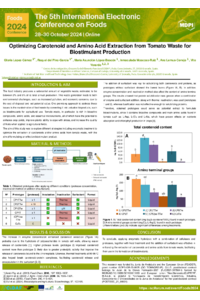
The food industry generates 2-5% of its annual production as vegetable waste, causing significant environmental and economic issues. Revalorizing this waste into bioproducts like biostimulants is a potential solution. Tomato waste, which is rich in bioactive compounds, amino acids, and other micronutrients, can improve crop yield, stress response, and fruit quality when applied to fields. This study aimed to evaluate different strategies to improve the extraction of carotenoids and/or amino acids from tomato wastes for biostimulant formulation.
Tomato spoils were homogenized and submitted to different treatments, including sequential enzymatic hydrolysis at 50ºC for 4h with different concentrations of commercial cellulases and proteases. Enzymes were inactivated by means of heating (80ºC for 5 min). A surfactant (Tween20, 2% w/w) was added before centrifugation to improve solubilization, and supernatants were collected. Controls were established for each treatment step to ensure reliability. Total carotenoids and amino acid release were evaluated spectrophotometrically using standard curves of β-carotene and L-Arginine, respectively.
Enzymatic hydrolysis with the highest protease concentration favored the release of carotenoids and amino acids from the tomato matrix. Moreover, the presence of a surfactant was critical for enhancing solubilisation into the aqueous media. The highest carotenoid (132 mg β-c/L) and amino acid (160 mg L-Arg/L) contents were obtained when the surfactant was added. The combination of cellulases and proteases, along with thermal treatment, likely depolymerized the cell wall and broke the protein–carotenoid complexes in chromoplasts, releasing soluble peptides and carotenoids, which were then more readily entrapped by the surfactant. L-Asp, L-Glu, and L-Ala are the main amino acids found in tomato, which have proven effects on nutrient absorption and chlorophyll production.
Applying enzymatic hydrolysis with a combination of cellulases and proteases, together with heat treatment and surfactant addition, effectively enhanced the extraction of carotenoids and amino acids from tomato waste, facilitating their use in the formulation of biostimulants.
Keywords
Biostimulant
tomato waste
circular bioeconomy
revalorization
biofertilizer
carotenoids
amino acids
Poster
plantilla poster foods online 2024 tomagroup _logos.pdf
Nutritional, elemental and toxicity assessment of three tropical fruits pulps and seeds
Insight into the occurrence of betaines in plant foods for human nutrition.