Event submissions
Published
This submission belongs to the session S2. Food Nutrition and Functional Foods of the event The 5th International Electronic Conference on Foods
Published date
28 Oct, 2024
Academic Editor
'%3e%3cpath%20d='M12.6657%2010.9104C12.4185%2010.325%2012.0599%209.79327%2011.6097%209.34482C11.1609%208.89508%2010.6293%208.5365%2010.0442%208.28888C10.0389%208.28626%2010.0337%208.28495%2010.0285%208.28233C10.8446%207.69279%2011.3752%206.73249%2011.3752%205.64904C11.3752%203.8542%209.92103%202.39999%208.1262%202.39999C6.33136%202.39999%204.87715%203.8542%204.87715%205.64904C4.87715%206.73249%205.40774%207.69279%206.22393%208.28364C6.21869%208.28626%206.21345%208.28757%206.20821%208.29019C5.62129%208.5378%205.09463%208.89284%204.64265%209.34613C4.1929%209.79493%203.83432%2010.3266%203.58671%2010.9117C3.34345%2011.4845%203.21226%2012.0987%203.20023%2012.7209C3.19988%2012.7349%203.20233%2012.7488%203.20744%2012.7619C3.21255%2012.7749%203.22022%2012.7867%203.22998%2012.7968C3.23975%2012.8068%203.25142%2012.8147%203.26431%2012.8202C3.2772%2012.8256%203.29105%2012.8284%203.30504%2012.8284H4.09109C4.14874%2012.8284%204.19459%2012.7825%204.1959%2012.7262C4.2221%2011.7148%204.62823%2010.7676%205.34617%2010.0497C6.08899%209.30683%207.0755%208.89808%208.1262%208.89808C9.17689%208.89808%2010.1634%209.30683%2010.9062%2010.0497C11.6242%2010.7676%2012.0303%2011.7148%2012.0565%2012.7262C12.0578%2012.7838%2012.1037%2012.8284%2012.1613%2012.8284H12.9474C12.9613%2012.8284%2012.9752%2012.8256%2012.9881%2012.8202C13.001%2012.8147%2013.0126%2012.8068%2013.0224%2012.7968C13.0322%2012.7867%2013.0398%2012.7749%2013.0449%2012.7619C13.0501%2012.7488%2013.0525%2012.7349%2013.0522%2012.7209C13.0391%2012.0947%2012.9094%2011.4855%2012.6657%2010.9104ZM8.1262%207.9024C7.52486%207.9024%206.9589%207.6679%206.53312%207.24211C6.10733%206.81633%205.87283%206.25037%205.87283%205.64904C5.87283%205.0477%206.10733%204.48174%206.53312%204.05596C6.9589%203.63018%207.52486%203.39567%208.1262%203.39567C8.72753%203.39567%209.29349%203.63018%209.71927%204.05596C10.1451%204.48174%2010.3796%205.0477%2010.3796%205.64904C10.3796%206.25037%2010.1451%206.81633%209.71927%207.24211C9.29349%207.6679%208.72753%207.9024%208.1262%207.9024Z'%20fill='%235D1EE1'/%3e%3c/g%3e%3c/svg%3e) Manuel Viuda-Martos
Manuel Viuda-MartosCitation
Gloria López-Gámez, Raquel del Pino-García, Armando Lara-Cambil, Inmaculada Moscoso-Ruiz, David Manteca-Bautista, Vito Verardo, Revalorising tomato by-products from salmorejo and gazpacho production for nutritional and functional food ingredients, in Proceedings of The 5th International Electronic Conference on Foods, 28 October–30 October 2024, MDPI: Basel, Switzerland
Share
Email
Facebook
Twitter
LinkedIn
Revalorising tomato by-products from salmorejo and gazpacho production for nutritional and functional food ingredients
'%3e%3cpath%20d='M12.6647%2010.9104C12.4176%2010.325%2012.0589%209.7933%2011.6088%209.34485C11.16%208.89511%2010.6283%208.53653%2010.0432%208.28891C10.038%208.28629%2010.0327%208.28498%2010.0275%208.28236C10.8437%207.69282%2011.3743%206.73252%2011.3743%205.64907C11.3743%203.85423%209.92005%202.40002%208.12522%202.40002C6.33038%202.40002%204.87618%203.85423%204.87618%205.64907C4.87618%206.73252%205.40677%207.69282%206.22296%208.28367C6.21772%208.28629%206.21248%208.2876%206.20724%208.29022C5.62031%208.53783%205.09365%208.89287%204.64167%209.34616C4.19192%209.79496%203.83334%2010.3266%203.58573%2010.9117C3.34247%2011.4846%203.21128%2012.0987%203.19925%2012.721C3.1989%2012.735%203.20135%2012.7489%203.20646%2012.7619C3.21157%2012.7749%203.21924%2012.7868%203.22901%2012.7968C3.23877%2012.8068%203.25045%2012.8148%203.26334%2012.8202C3.27623%2012.8256%203.29007%2012.8284%203.30406%2012.8284H4.09012C4.14776%2012.8284%204.19362%2012.7825%204.19493%2012.7262C4.22113%2011.7148%204.62726%2010.7676%205.34519%2010.0497C6.08802%209.30686%207.07452%208.89811%208.12522%208.89811C9.17592%208.89811%2010.1624%209.30686%2010.9052%2010.0497C11.6232%2010.7676%2012.0293%2011.7148%2012.0555%2012.7262C12.0568%2012.7839%2012.1027%2012.8284%2012.1603%2012.8284H12.9464C12.9604%2012.8284%2012.9742%2012.8256%2012.9871%2012.8202C13%2012.8148%2013.0117%2012.8068%2013.0214%2012.7968C13.0312%2012.7868%2013.0389%2012.7749%2013.044%2012.7619C13.0491%2012.7489%2013.0515%2012.735%2013.0512%2012.721C13.0381%2012.0947%2012.9084%2011.4856%2012.6647%2010.9104ZM8.12522%207.90243C7.52388%207.90243%206.95792%207.66793%206.53214%207.24215C6.10636%206.81636%205.87185%206.2504%205.87185%205.64907C5.87185%205.04773%206.10636%204.48177%206.53214%204.05599C6.95792%203.63021%207.52388%203.3957%208.12522%203.3957C8.72655%203.3957%209.29252%203.63021%209.7183%204.05599C10.1441%204.48177%2010.3786%205.04773%2010.3786%205.64907C10.3786%206.2504%2010.1441%206.81636%209.7183%207.24215C9.29252%207.66793%208.72655%207.90243%208.12522%207.90243Z'%20fill='%235D1EE1'/%3e%3c/g%3e%3c/svg%3e)
Gloria López-Gámez 1
Raquel del Pino-García 1
Armando Lara-Cambil 1
Inmaculada Moscoso-Ruiz 1
David Manteca-Bautista 1

Vito Verardo 1,2,3
1. Centro de Investigación y Desarrollo del Alimento Funcional (CIDAF), Avda. del Conocimiento, 37, 18016 Granada, Spain.
2. Department of Nutrition and Food Science, Campus of Cartuja, University of Granada, 18071 Granada, Spain.
3. Institute of Nutrition and Food Technology Jose Mataix, Biomedical Research Center, University of Granada, Avda. Conocimiento s/n, 18100 Granada, Spain.
Abstract
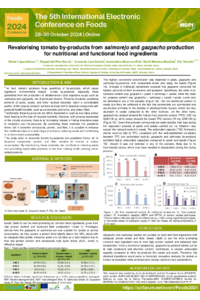
The food industry generates substantial amounts of by-products, which present both environmental challenges and opportunities for resource recovery. Tomato by-products, particularly from the production of the typical Mediterranean cold vegetable soups salmorejo and gazpacho, retain great amounts of tomato nutrients and are rich in bioactive compounds with potential functional benefits. The main aim of this study was to revalorise tomato by-products into powdered ingredients with a high content of bioactive compounds, protein, and/or fibre to formulate foods for human or animal consumption.
The complete by-product obtained after the industrial production of V-range salmorejo and gazpacho, in addition to the tomato peels and seeds separated from the gazpacho by-product, were dried in an infrared oven at 80 ºC until the moisture content was below 10 %. Then, the dried tomato by-products were ground and sieved to 2 mm particle size, resulting in four potential ingredients. Total carotenoids, phenolic compounds, and antioxidant activity were evaluated spectrophotometrically, whereas individual carotenoids and vitamin C were determined by HPLC-DAD. Protein content was measured using the Dumas method, and fibre fraction contents were also assessed.
The highest carotenoid, phenolic content, and antioxidant capacity were found in gazpacho waste > salmorejo waste > tomato peel > tomato seeds, whereas vitamin C was not detected. However, the highest protein content was found in seeds (26%), while gazpacho and salmorejo wastes had among 18-21%, and peels had 8%. Regarding acid detergent fibre, related to fermentability in the rumen, the content was acceptable in all the by-products except for tomato peel, which had a high content that is difficult to digest.
Therefore, gazpacho waste exhibited the best combination of nutritional and functional properties, making it a promising ingredient for use in food or feed.
Keywords
Tomato by-products
carotenoids
phenolic compounds
antioxidant capacity
fibre content
protein content
circular bioeconomy
Poster
plantilla poster foods online 2024_Cherry4food_logos_nuevo.pdf
Insight into the occurrence of betaines in plant foods for human nutrition.
Valorisation of plant beverage by-products with fungi to obtain mycoprotein