Event submissions
Published
This submission belongs to the session S2. Food Nutrition and Functional Foods of the event The 5th International Electronic Conference on Foods
Published date
28 Oct, 2024
Academic Editor
'%3e%3cpath%20d='M12.6657%2010.9104C12.4185%2010.325%2012.0599%209.79327%2011.6097%209.34482C11.1609%208.89508%2010.6293%208.5365%2010.0442%208.28888C10.0389%208.28626%2010.0337%208.28495%2010.0285%208.28233C10.8446%207.69279%2011.3752%206.73249%2011.3752%205.64904C11.3752%203.8542%209.92103%202.39999%208.1262%202.39999C6.33136%202.39999%204.87715%203.8542%204.87715%205.64904C4.87715%206.73249%205.40774%207.69279%206.22393%208.28364C6.21869%208.28626%206.21345%208.28757%206.20821%208.29019C5.62129%208.5378%205.09463%208.89284%204.64265%209.34613C4.1929%209.79493%203.83432%2010.3266%203.58671%2010.9117C3.34345%2011.4845%203.21226%2012.0987%203.20023%2012.7209C3.19988%2012.7349%203.20233%2012.7488%203.20744%2012.7619C3.21255%2012.7749%203.22022%2012.7867%203.22998%2012.7968C3.23975%2012.8068%203.25142%2012.8147%203.26431%2012.8202C3.2772%2012.8256%203.29105%2012.8284%203.30504%2012.8284H4.09109C4.14874%2012.8284%204.19459%2012.7825%204.1959%2012.7262C4.2221%2011.7148%204.62823%2010.7676%205.34617%2010.0497C6.08899%209.30683%207.0755%208.89808%208.1262%208.89808C9.17689%208.89808%2010.1634%209.30683%2010.9062%2010.0497C11.6242%2010.7676%2012.0303%2011.7148%2012.0565%2012.7262C12.0578%2012.7838%2012.1037%2012.8284%2012.1613%2012.8284H12.9474C12.9613%2012.8284%2012.9752%2012.8256%2012.9881%2012.8202C13.001%2012.8147%2013.0126%2012.8068%2013.0224%2012.7968C13.0322%2012.7867%2013.0398%2012.7749%2013.0449%2012.7619C13.0501%2012.7488%2013.0525%2012.7349%2013.0522%2012.7209C13.0391%2012.0947%2012.9094%2011.4855%2012.6657%2010.9104ZM8.1262%207.9024C7.52486%207.9024%206.9589%207.6679%206.53312%207.24211C6.10733%206.81633%205.87283%206.25037%205.87283%205.64904C5.87283%205.0477%206.10733%204.48174%206.53312%204.05596C6.9589%203.63018%207.52486%203.39567%208.1262%203.39567C8.72753%203.39567%209.29349%203.63018%209.71927%204.05596C10.1451%204.48174%2010.3796%205.0477%2010.3796%205.64904C10.3796%206.25037%2010.1451%206.81633%209.71927%207.24211C9.29349%207.6679%208.72753%207.9024%208.1262%207.9024Z'%20fill='%235D1EE1'/%3e%3c/g%3e%3c/svg%3e) Manuel Viuda-Martos
Manuel Viuda-MartosCitation
Facundo Carlos Namor, Maria Laura Coppo, Ana Victoria Montiveros, Candela Shaiel Mendinueta Morales, Carolina Antonella Paulino, FUNCTIONAL POTENTIAL OF DIFFERENT PRODUCTS BASED ON MAQUI BERRIES (Aristotelia Chilensis), in Proceedings of The 5th International Electronic Conference on Foods, 28 October–30 October 2024, MDPI: Basel, Switzerland
Share
Email
Facebook
Twitter
LinkedIn
FUNCTIONAL POTENTIAL OF DIFFERENT PRODUCTS BASED ON MAQUI BERRIES (Aristotelia Chilensis)
'%3e%3cpath%20d='M12.6647%2010.9104C12.4176%2010.325%2012.0589%209.7933%2011.6088%209.34485C11.16%208.89511%2010.6283%208.53653%2010.0432%208.28891C10.038%208.28629%2010.0327%208.28498%2010.0275%208.28236C10.8437%207.69282%2011.3743%206.73252%2011.3743%205.64907C11.3743%203.85423%209.92005%202.40002%208.12522%202.40002C6.33038%202.40002%204.87618%203.85423%204.87618%205.64907C4.87618%206.73252%205.40677%207.69282%206.22296%208.28367C6.21772%208.28629%206.21248%208.2876%206.20724%208.29022C5.62031%208.53783%205.09365%208.89287%204.64167%209.34616C4.19192%209.79496%203.83334%2010.3266%203.58573%2010.9117C3.34247%2011.4846%203.21128%2012.0987%203.19925%2012.721C3.1989%2012.735%203.20135%2012.7489%203.20646%2012.7619C3.21157%2012.7749%203.21924%2012.7868%203.22901%2012.7968C3.23877%2012.8068%203.25045%2012.8148%203.26334%2012.8202C3.27623%2012.8256%203.29007%2012.8284%203.30406%2012.8284H4.09012C4.14776%2012.8284%204.19362%2012.7825%204.19493%2012.7262C4.22113%2011.7148%204.62726%2010.7676%205.34519%2010.0497C6.08802%209.30686%207.07452%208.89811%208.12522%208.89811C9.17592%208.89811%2010.1624%209.30686%2010.9052%2010.0497C11.6232%2010.7676%2012.0293%2011.7148%2012.0555%2012.7262C12.0568%2012.7839%2012.1027%2012.8284%2012.1603%2012.8284H12.9464C12.9604%2012.8284%2012.9742%2012.8256%2012.9871%2012.8202C13%2012.8148%2013.0117%2012.8068%2013.0214%2012.7968C13.0312%2012.7868%2013.0389%2012.7749%2013.044%2012.7619C13.0491%2012.7489%2013.0515%2012.735%2013.0512%2012.721C13.0381%2012.0947%2012.9084%2011.4856%2012.6647%2010.9104ZM8.12522%207.90243C7.52388%207.90243%206.95792%207.66793%206.53214%207.24215C6.10636%206.81636%205.87185%206.2504%205.87185%205.64907C5.87185%205.04773%206.10636%204.48177%206.53214%204.05599C6.95792%203.63021%207.52388%203.3957%208.12522%203.3957C8.72655%203.3957%209.29252%203.63021%209.7183%204.05599C10.1441%204.48177%2010.3786%205.04773%2010.3786%205.64907C10.3786%206.2504%2010.1441%206.81636%209.7183%207.24215C9.29252%207.66793%208.72655%207.90243%208.12522%207.90243Z'%20fill='%235D1EE1'/%3e%3c/g%3e%3c/svg%3e)
Facundo Carlos Namor 1
Maria Laura Coppo 1
Ana Victoria Montiveros 1
Candela Shaiel Mendinueta Morales 1
Carolina Antonella Paulino 1
1. Facultad de Ciencias y Tecnología de los Alimentos – Universidad Nacional del Comahue. Villa Regina, Río Negro
Abstract
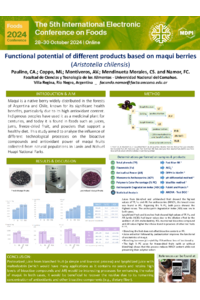
Maqui is a small, intensely purple wild berry obtained from a native plant in the Andean--Patagonian forests of Chile and Argentina, not marketed as fresh produce due to its astringency and high seed content. It has been shown to possess significant health benefits, although there is limited information on the preparation and use of functional ingredients based on maqui as a value-added strategy. The aim of this study was to analyze the functional potential of different products derived from maqui berries collected in natural populations of the Lanín and Nahuel Huapi National Parks, Argentina. The products evaluated were the following: fresh (F), blanched (E), and freeze-dried (FL) fruit; pasteurized juice (from unblanched fruit, JPSE, and blanched fruit, JPE); blanched freeze-dried fruit (FEL); and freeze-dried juice with maltodextrin (JMDEL). Extracts were prepared at 37°C using a 1% HCl aqueous solution in ethanol, and total phenols (TF), flavonoids (Fv), monomeric anthocyanins (ACY), percentages of polymeric color (% CP), anthocyanin degradation indexes (IDAs), and radical scavenging capacity (PAs) were determined. Pasteurization increased TF, Fv, and PA values (by more than 50%) due to enhanced extractability from temperature effects, inhibition of oxidative enzymes, and solute concentration in the absence of seeds. ACY content was affected by the combined effect of blanching and pasteurization, resulting in a 9% decrease. FL and FEL treatments tripled TF, Fv, and PA values compared to the fresh matrix, whereas JMDEL decreased those values by 50% (owing to the dilution from the addition of maltodextrin) but maintained a high ACY content and low % CP due to polysaccharide protection. The industrialization alternatives considered preserved or enhanced the functional potential of the fruits. Freeze-dried products demonstrated the best performance, albeit requiring an expensive process. JPE stands out due to its simple, cost-effective processes and high functional potential (TF 5403 ± 206 mg gallic acid equivalent/100g; Fv 507 ± 48 mg catequin/100g; ACY 728 ± 15 mg cyanidin-3-glucoside equivalent/100g; PA 0,45 ± 0,04 mg-1)
Keywords
functional foods
maqui
wild berries
bioactive compounds
Poster
Functional potential of different products based on maqui berries.pdf
Innovative dehydrated snack using low-value horticultural products: Beetroot, apple and orange, a crispy combination
IMPACT OF OAT GRAIN ROASTING ON NUTRITIONAL AND PHYSICOCHEMICAL PROPERTIES OF TWO DIFFERENT OAT VARIETIES