Event submissions
Published
This submission belongs to the session S8. Food Quality and Safety of the event The 5th International Electronic Conference on Foods
Published date
28 Oct, 2024
Academic Editor
'%3e%3cpath%20d='M12.6657%2010.9104C12.4185%2010.325%2012.0599%209.79327%2011.6097%209.34482C11.1609%208.89508%2010.6293%208.5365%2010.0442%208.28888C10.0389%208.28626%2010.0337%208.28495%2010.0285%208.28233C10.8446%207.69279%2011.3752%206.73249%2011.3752%205.64904C11.3752%203.8542%209.92103%202.39999%208.1262%202.39999C6.33136%202.39999%204.87715%203.8542%204.87715%205.64904C4.87715%206.73249%205.40774%207.69279%206.22393%208.28364C6.21869%208.28626%206.21345%208.28757%206.20821%208.29019C5.62129%208.5378%205.09463%208.89284%204.64265%209.34613C4.1929%209.79493%203.83432%2010.3266%203.58671%2010.9117C3.34345%2011.4845%203.21226%2012.0987%203.20023%2012.7209C3.19988%2012.7349%203.20233%2012.7488%203.20744%2012.7619C3.21255%2012.7749%203.22022%2012.7867%203.22998%2012.7968C3.23975%2012.8068%203.25142%2012.8147%203.26431%2012.8202C3.2772%2012.8256%203.29105%2012.8284%203.30504%2012.8284H4.09109C4.14874%2012.8284%204.19459%2012.7825%204.1959%2012.7262C4.2221%2011.7148%204.62823%2010.7676%205.34617%2010.0497C6.08899%209.30683%207.0755%208.89808%208.1262%208.89808C9.17689%208.89808%2010.1634%209.30683%2010.9062%2010.0497C11.6242%2010.7676%2012.0303%2011.7148%2012.0565%2012.7262C12.0578%2012.7838%2012.1037%2012.8284%2012.1613%2012.8284H12.9474C12.9613%2012.8284%2012.9752%2012.8256%2012.9881%2012.8202C13.001%2012.8147%2013.0126%2012.8068%2013.0224%2012.7968C13.0322%2012.7867%2013.0398%2012.7749%2013.0449%2012.7619C13.0501%2012.7488%2013.0525%2012.7349%2013.0522%2012.7209C13.0391%2012.0947%2012.9094%2011.4855%2012.6657%2010.9104ZM8.1262%207.9024C7.52486%207.9024%206.9589%207.6679%206.53312%207.24211C6.10733%206.81633%205.87283%206.25037%205.87283%205.64904C5.87283%205.0477%206.10733%204.48174%206.53312%204.05596C6.9589%203.63018%207.52486%203.39567%208.1262%203.39567C8.72753%203.39567%209.29349%203.63018%209.71927%204.05596C10.1451%204.48174%2010.3796%205.0477%2010.3796%205.64904C10.3796%206.25037%2010.1451%206.81633%209.71927%207.24211C9.29349%207.6679%208.72753%207.9024%208.1262%207.9024Z'%20fill='%235D1EE1'/%3e%3c/g%3e%3c/svg%3e) Antonello Santini
Antonello SantiniCitation
Simone Alves da Silva, Adriana Palma de Almeida, Ana Lúcia Rosa de Faria, Janete Alaburda, Gloria Maria Guizellini, Elizabeth Aparecida Ferraz da Silva Torres, Geni Rodrigues Sampaio, Evaluation of Deoxynivalenol in Foods of São Paulo State, Brazil, in Proceedings of The 5th International Electronic Conference on Foods, 28 October–30 October 2024, MDPI: Basel, Switzerland
Share
Email
Facebook
Twitter
LinkedIn
Evaluation of Deoxynivalenol in Foods of São Paulo State, Brazil
'%3e%3cpath%20d='M12.6647%2010.9104C12.4176%2010.325%2012.0589%209.7933%2011.6088%209.34485C11.16%208.89511%2010.6283%208.53653%2010.0432%208.28891C10.038%208.28629%2010.0327%208.28498%2010.0275%208.28236C10.8437%207.69282%2011.3743%206.73252%2011.3743%205.64907C11.3743%203.85423%209.92005%202.40002%208.12522%202.40002C6.33038%202.40002%204.87618%203.85423%204.87618%205.64907C4.87618%206.73252%205.40677%207.69282%206.22296%208.28367C6.21772%208.28629%206.21248%208.2876%206.20724%208.29022C5.62031%208.53783%205.09365%208.89287%204.64167%209.34616C4.19192%209.79496%203.83334%2010.3266%203.58573%2010.9117C3.34247%2011.4846%203.21128%2012.0987%203.19925%2012.721C3.1989%2012.735%203.20135%2012.7489%203.20646%2012.7619C3.21157%2012.7749%203.21924%2012.7868%203.22901%2012.7968C3.23877%2012.8068%203.25045%2012.8148%203.26334%2012.8202C3.27623%2012.8256%203.29007%2012.8284%203.30406%2012.8284H4.09012C4.14776%2012.8284%204.19362%2012.7825%204.19493%2012.7262C4.22113%2011.7148%204.62726%2010.7676%205.34519%2010.0497C6.08802%209.30686%207.07452%208.89811%208.12522%208.89811C9.17592%208.89811%2010.1624%209.30686%2010.9052%2010.0497C11.6232%2010.7676%2012.0293%2011.7148%2012.0555%2012.7262C12.0568%2012.7839%2012.1027%2012.8284%2012.1603%2012.8284H12.9464C12.9604%2012.8284%2012.9742%2012.8256%2012.9871%2012.8202C13%2012.8148%2013.0117%2012.8068%2013.0214%2012.7968C13.0312%2012.7868%2013.0389%2012.7749%2013.044%2012.7619C13.0491%2012.7489%2013.0515%2012.735%2013.0512%2012.721C13.0381%2012.0947%2012.9084%2011.4856%2012.6647%2010.9104ZM8.12522%207.90243C7.52388%207.90243%206.95792%207.66793%206.53214%207.24215C6.10636%206.81636%205.87185%206.2504%205.87185%205.64907C5.87185%205.04773%206.10636%204.48177%206.53214%204.05599C6.95792%203.63021%207.52388%203.3957%208.12522%203.3957C8.72655%203.3957%209.29252%203.63021%209.7183%204.05599C10.1441%204.48177%2010.3786%205.04773%2010.3786%205.64907C10.3786%206.2504%2010.1441%206.81636%209.7183%207.24215C9.29252%207.66793%208.72655%207.90243%208.12522%207.90243Z'%20fill='%235D1EE1'/%3e%3c/g%3e%3c/svg%3e)
Simone Alves da Silva 1
Adriana Palma de Almeida 1
Ana Lúcia Rosa de Faria 1
Janete Alaburda 2
Gloria Maria Guizellini 3
Elizabeth Aparecida Ferraz da Silva Torres 3
Geni Rodrigues Sampaio 3
1. Organic Contaminant Core, Contaminant Centre, Adolfo Lutz Institute, São Paulo – Zip code: 01246-000, Brazil
2. Contaminant Centre, Adolfo Lutz Institute, São Paulo – Zip code: 01246-000, Brazil
3. Department of Nutrition, School of Public Health, University of São Paulo, São Paulo – Zip code: 01246-904, Brazil
Abstract
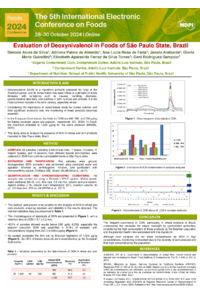
Deoxynivalenol (DON) is a mycotoxin produced by Fusarium species, commonly contaminating cereals such as wheat, corn, and others. This mycotoxin is a significant food contaminant due to its high prevalence and stability during storage, milling, and processing, as it withstands high temperatures. DON may give adverse health effects, including abdominal issues and immune system impairment in severe cases. Consequently, its presence in food is strictly monitored and regulated worldwide. Brazilian legislation sets a maximum limit of 1,000 µg/kg for cereal and bakery products, while the European Commission's limits are 400, 600, and 750 μg/kg for bakery products, pasta, and popcorn, respectively. This study aims to analyze DON in wheat and corn products marketed in São Paulo state, Brazil. In total, 56 samples, with different brands and batches, were collected in 2024 from commercial establishments, including 3 mini bread roll, 17 toast, 11 instant noodle, 13 pasta, and 12 popcorn sample. DON extraction was performed with deionized water, followed by purification using an immunoaffinity column (DONtestWB, Vicam), and quantification by liquid chromatography and ultraviolet detection (Shimadzu). The limit of quantification (LOQ) was 200 μg/kg. DON was quantified in 51.8% of samples, with concentrations ranging from 240.0 to 658.4 μg/kg. The mean values of the quantified results were 463.8 μg/kg (mini bread rolls), 389.4 μg/kg (toast), 410.7 μg/kg (pasta), and 378.9 μg/kg (instant noodles). All popcorn showed levels below the LOQ. No sample exceeded the limit of Brazilian legislation. However, considering the European Commission's limits, 66.7% of the mini bread rolls, 27.3% of the toast, and 12.5% of the instant noodles exceeded the maximum value allowed by legislation. The recurrent presence of DON reinforces the need for effective control by government authorities, given the high consumption of these products by the Brazilian population, and the possible health hazards related to this mycotoxin.
Keywords
mycotoxin
wheat
corn
Poster
FOODS_Silva SA.pdf
The Effect of Vacuum Storage on the Preservation of Extra Virgin Olive Oil After Opening
An Exploration of Nutrition Sustainability for Individual and Global Health