Event submissions
Published
This submission belongs to the session S8. Food Quality and Safety of the event The 5th International Electronic Conference on Foods
Published date
28 Oct, 2024
Academic Editor
'%3e%3cpath%20d='M12.6657%2010.9104C12.4185%2010.325%2012.0599%209.79327%2011.6097%209.34482C11.1609%208.89508%2010.6293%208.5365%2010.0442%208.28888C10.0389%208.28626%2010.0337%208.28495%2010.0285%208.28233C10.8446%207.69279%2011.3752%206.73249%2011.3752%205.64904C11.3752%203.8542%209.92103%202.39999%208.1262%202.39999C6.33136%202.39999%204.87715%203.8542%204.87715%205.64904C4.87715%206.73249%205.40774%207.69279%206.22393%208.28364C6.21869%208.28626%206.21345%208.28757%206.20821%208.29019C5.62129%208.5378%205.09463%208.89284%204.64265%209.34613C4.1929%209.79493%203.83432%2010.3266%203.58671%2010.9117C3.34345%2011.4845%203.21226%2012.0987%203.20023%2012.7209C3.19988%2012.7349%203.20233%2012.7488%203.20744%2012.7619C3.21255%2012.7749%203.22022%2012.7867%203.22998%2012.7968C3.23975%2012.8068%203.25142%2012.8147%203.26431%2012.8202C3.2772%2012.8256%203.29105%2012.8284%203.30504%2012.8284H4.09109C4.14874%2012.8284%204.19459%2012.7825%204.1959%2012.7262C4.2221%2011.7148%204.62823%2010.7676%205.34617%2010.0497C6.08899%209.30683%207.0755%208.89808%208.1262%208.89808C9.17689%208.89808%2010.1634%209.30683%2010.9062%2010.0497C11.6242%2010.7676%2012.0303%2011.7148%2012.0565%2012.7262C12.0578%2012.7838%2012.1037%2012.8284%2012.1613%2012.8284H12.9474C12.9613%2012.8284%2012.9752%2012.8256%2012.9881%2012.8202C13.001%2012.8147%2013.0126%2012.8068%2013.0224%2012.7968C13.0322%2012.7867%2013.0398%2012.7749%2013.0449%2012.7619C13.0501%2012.7488%2013.0525%2012.7349%2013.0522%2012.7209C13.0391%2012.0947%2012.9094%2011.4855%2012.6657%2010.9104ZM8.1262%207.9024C7.52486%207.9024%206.9589%207.6679%206.53312%207.24211C6.10733%206.81633%205.87283%206.25037%205.87283%205.64904C5.87283%205.0477%206.10733%204.48174%206.53312%204.05596C6.9589%203.63018%207.52486%203.39567%208.1262%203.39567C8.72753%203.39567%209.29349%203.63018%209.71927%204.05596C10.1451%204.48174%2010.3796%205.0477%2010.3796%205.64904C10.3796%206.25037%2010.1451%206.81633%209.71927%207.24211C9.29349%207.6679%208.72753%207.9024%208.1262%207.9024Z'%20fill='%235D1EE1'/%3e%3c/g%3e%3c/svg%3e) Antonello Santini
Antonello SantiniCitation
Katarzyna Szkolnicka, Anna Mituniewicz-Małek, Izabela Dmytrów, Elżbieta Bogusławska-Wąs, The quality of organic kefirs produced with kefir grains and freeze-dried starter cultures, in Proceedings of The 5th International Electronic Conference on Foods, 28 October–30 October 2024, MDPI: Basel, Switzerland
Share
Email
Facebook
Twitter
LinkedIn
The quality of organic kefirs produced with kefir grains and freeze-dried starter cultures
'%3e%3cpath%20d='M12.6647%2010.9104C12.4176%2010.325%2012.0589%209.7933%2011.6088%209.34485C11.16%208.89511%2010.6283%208.53653%2010.0432%208.28891C10.038%208.28629%2010.0327%208.28498%2010.0275%208.28236C10.8437%207.69282%2011.3743%206.73252%2011.3743%205.64907C11.3743%203.85423%209.92005%202.40002%208.12522%202.40002C6.33038%202.40002%204.87618%203.85423%204.87618%205.64907C4.87618%206.73252%205.40677%207.69282%206.22296%208.28367C6.21772%208.28629%206.21248%208.2876%206.20724%208.29022C5.62031%208.53783%205.09365%208.89287%204.64167%209.34616C4.19192%209.79496%203.83334%2010.3266%203.58573%2010.9117C3.34247%2011.4846%203.21128%2012.0987%203.19925%2012.721C3.1989%2012.735%203.20135%2012.7489%203.20646%2012.7619C3.21157%2012.7749%203.21924%2012.7868%203.22901%2012.7968C3.23877%2012.8068%203.25045%2012.8148%203.26334%2012.8202C3.27623%2012.8256%203.29007%2012.8284%203.30406%2012.8284H4.09012C4.14776%2012.8284%204.19362%2012.7825%204.19493%2012.7262C4.22113%2011.7148%204.62726%2010.7676%205.34519%2010.0497C6.08802%209.30686%207.07452%208.89811%208.12522%208.89811C9.17592%208.89811%2010.1624%209.30686%2010.9052%2010.0497C11.6232%2010.7676%2012.0293%2011.7148%2012.0555%2012.7262C12.0568%2012.7839%2012.1027%2012.8284%2012.1603%2012.8284H12.9464C12.9604%2012.8284%2012.9742%2012.8256%2012.9871%2012.8202C13%2012.8148%2013.0117%2012.8068%2013.0214%2012.7968C13.0312%2012.7868%2013.0389%2012.7749%2013.044%2012.7619C13.0491%2012.7489%2013.0515%2012.735%2013.0512%2012.721C13.0381%2012.0947%2012.9084%2011.4856%2012.6647%2010.9104ZM8.12522%207.90243C7.52388%207.90243%206.95792%207.66793%206.53214%207.24215C6.10636%206.81636%205.87185%206.2504%205.87185%205.64907C5.87185%205.04773%206.10636%204.48177%206.53214%204.05599C6.95792%203.63021%207.52388%203.3957%208.12522%203.3957C8.72655%203.3957%209.29252%203.63021%209.7183%204.05599C10.1441%204.48177%2010.3786%205.04773%2010.3786%205.64907C10.3786%206.2504%2010.1441%206.81636%209.7183%207.24215C9.29252%207.66793%208.72655%207.90243%208.12522%207.90243Z'%20fill='%235D1EE1'/%3e%3c/g%3e%3c/svg%3e)
Katarzyna Szkolnicka 1
Anna Mituniewicz-Małek 2

Izabela Dmytrów 2
Elżbieta Bogusławska-Wąs 3
1. Department of Toxicology, Dairy Technology and Food Storage, Faculty of Food Science and Fisheries, West Pomeranian University of Technology
2. Department of Toxicology, Dairy Technology and Food Storage, Faculty of Food Sciences and Fisheries, West Pomeranian University of Technology, Szczecin, Poland
3. Department of Applied Microbiology and Physiology of Human Nutrition, Faculty of Food Sciences and Fisheries, West Pomeranian University of Technology, Szczecin, Poland
Abstract
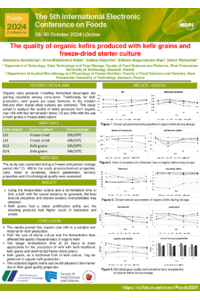
Organic dairy products made from organic milk, are gaining popularity among consumers. Fermented dairy beverages are products with excellent nutritional properties. Among them, we can distinguish kefir, which is produced with the use of started culture containing lactic acid bacteria and yeasts. Traditionally, for kefir production, kefir grains are used; however, the modern dairy industry often produces kefir with the use of freeze-dried cultures. This study aimed to analyse the quality of kefirs produced from organic cow milk with two fermentation times (12 and 24h) with the use of kefir grains (G12 and G24) or freeze-dried cultures (L12 and L24). This study was conducted during a 3-week refrigerated storage period. Within the study, physicochemical properties, color, index of syneresis, texture, sensory properties, and microbiological quality were evaluated. The results proved that organic cow milk is a suitable raw material for kefir production. Both the type of starter culture and the fermentation time affected the quality characteristics of organic kefir. Using the freeze-dried culture and a fermentation time of 24 h, a kefir with the lowest tendency to syneresis (3.65-9.62%) and the best textural properties and desired sensory characteristics was obtained. Kefir grains had a better acidification ability and the resulting products had higher count of yeasts (5.69-6.88 log cfu/g) compared with kefirs obtained with freeze-dried cultures (3.81-4.71 log cfu/g). The count of lactobacilli and lactococi was at a similar level in all kefir variants. The study showed that both freeze-dried cultures and kefir grains are appropriate to produce organic kefir. However, kefir grains, as a traditional form of kefir culture, may be preferred in organic kefir production. The longer fermentation time of 24 hours is more appropriate for the production of kefir with both traditional kefir grains and freeze-dried culture. The obtained organic kefirs can be introduced to the market due to their good quality properties.
Keywords
kefir
kefir grains
freeze-dried kefir culture
organic milk
Poster
9882.pdf
Green solvent extraction of pitaya (Stenocereus spp.) seed oil.
VALUİNG ENDOGENOUS AND THERMAL RESOURCES İN THE PRODUCTİON OF HEALTHY FOOD: CHESTNUT BY-PRODUCT FLOUR WİTH THERMAL WATER