Event submissions
Published
This submission belongs to the session S7. Novel Preservation and Packaging Technologies of the event The 5th International Electronic Conference on Foods
Published date
28 Oct, 2024
Academic Editor
'%3e%3cpath%20d='M12.6657%2010.9104C12.4185%2010.325%2012.0599%209.79327%2011.6097%209.34482C11.1609%208.89508%2010.6293%208.5365%2010.0442%208.28888C10.0389%208.28626%2010.0337%208.28495%2010.0285%208.28233C10.8446%207.69279%2011.3752%206.73249%2011.3752%205.64904C11.3752%203.8542%209.92103%202.39999%208.1262%202.39999C6.33136%202.39999%204.87715%203.8542%204.87715%205.64904C4.87715%206.73249%205.40774%207.69279%206.22393%208.28364C6.21869%208.28626%206.21345%208.28757%206.20821%208.29019C5.62129%208.5378%205.09463%208.89284%204.64265%209.34613C4.1929%209.79493%203.83432%2010.3266%203.58671%2010.9117C3.34345%2011.4845%203.21226%2012.0987%203.20023%2012.7209C3.19988%2012.7349%203.20233%2012.7488%203.20744%2012.7619C3.21255%2012.7749%203.22022%2012.7867%203.22998%2012.7968C3.23975%2012.8068%203.25142%2012.8147%203.26431%2012.8202C3.2772%2012.8256%203.29105%2012.8284%203.30504%2012.8284H4.09109C4.14874%2012.8284%204.19459%2012.7825%204.1959%2012.7262C4.2221%2011.7148%204.62823%2010.7676%205.34617%2010.0497C6.08899%209.30683%207.0755%208.89808%208.1262%208.89808C9.17689%208.89808%2010.1634%209.30683%2010.9062%2010.0497C11.6242%2010.7676%2012.0303%2011.7148%2012.0565%2012.7262C12.0578%2012.7838%2012.1037%2012.8284%2012.1613%2012.8284H12.9474C12.9613%2012.8284%2012.9752%2012.8256%2012.9881%2012.8202C13.001%2012.8147%2013.0126%2012.8068%2013.0224%2012.7968C13.0322%2012.7867%2013.0398%2012.7749%2013.0449%2012.7619C13.0501%2012.7488%2013.0525%2012.7349%2013.0522%2012.7209C13.0391%2012.0947%2012.9094%2011.4855%2012.6657%2010.9104ZM8.1262%207.9024C7.52486%207.9024%206.9589%207.6679%206.53312%207.24211C6.10733%206.81633%205.87283%206.25037%205.87283%205.64904C5.87283%205.0477%206.10733%204.48174%206.53312%204.05596C6.9589%203.63018%207.52486%203.39567%208.1262%203.39567C8.72753%203.39567%209.29349%203.63018%209.71927%204.05596C10.1451%204.48174%2010.3796%205.0477%2010.3796%205.64904C10.3796%206.25037%2010.1451%206.81633%209.71927%207.24211C9.29349%207.6679%208.72753%207.9024%208.1262%207.9024Z'%20fill='%235D1EE1'/%3e%3c/g%3e%3c/svg%3e) Saji George
Saji GeorgeCitation
Valter Martins, Fatima Poças, Manuela Pintado, Rui Morais, Alcina Morais, EDIBLE FILMS WITH PROTEIN AND BIOACTIVE COMPOUNDS FROM ARTHROSPIRA SP. MICROALGAE, in Proceedings of The 5th International Electronic Conference on Foods, 28 October–30 October 2024, MDPI: Basel, Switzerland
Share
Email
Facebook
Twitter
LinkedIn
EDIBLE FILMS WITH PROTEIN AND BIOACTIVE COMPOUNDS FROM ARTHROSPIRA SP. MICROALGAE
'%3e%3cpath%20d='M12.6647%2010.9104C12.4176%2010.325%2012.0589%209.7933%2011.6088%209.34485C11.16%208.89511%2010.6283%208.53653%2010.0432%208.28891C10.038%208.28629%2010.0327%208.28498%2010.0275%208.28236C10.8437%207.69282%2011.3743%206.73252%2011.3743%205.64907C11.3743%203.85423%209.92005%202.40002%208.12522%202.40002C6.33038%202.40002%204.87618%203.85423%204.87618%205.64907C4.87618%206.73252%205.40677%207.69282%206.22296%208.28367C6.21772%208.28629%206.21248%208.2876%206.20724%208.29022C5.62031%208.53783%205.09365%208.89287%204.64167%209.34616C4.19192%209.79496%203.83334%2010.3266%203.58573%2010.9117C3.34247%2011.4846%203.21128%2012.0987%203.19925%2012.721C3.1989%2012.735%203.20135%2012.7489%203.20646%2012.7619C3.21157%2012.7749%203.21924%2012.7868%203.22901%2012.7968C3.23877%2012.8068%203.25045%2012.8148%203.26334%2012.8202C3.27623%2012.8256%203.29007%2012.8284%203.30406%2012.8284H4.09012C4.14776%2012.8284%204.19362%2012.7825%204.19493%2012.7262C4.22113%2011.7148%204.62726%2010.7676%205.34519%2010.0497C6.08802%209.30686%207.07452%208.89811%208.12522%208.89811C9.17592%208.89811%2010.1624%209.30686%2010.9052%2010.0497C11.6232%2010.7676%2012.0293%2011.7148%2012.0555%2012.7262C12.0568%2012.7839%2012.1027%2012.8284%2012.1603%2012.8284H12.9464C12.9604%2012.8284%2012.9742%2012.8256%2012.9871%2012.8202C13%2012.8148%2013.0117%2012.8068%2013.0214%2012.7968C13.0312%2012.7868%2013.0389%2012.7749%2013.044%2012.7619C13.0491%2012.7489%2013.0515%2012.735%2013.0512%2012.721C13.0381%2012.0947%2012.9084%2011.4856%2012.6647%2010.9104ZM8.12522%207.90243C7.52388%207.90243%206.95792%207.66793%206.53214%207.24215C6.10636%206.81636%205.87185%206.2504%205.87185%205.64907C5.87185%205.04773%206.10636%204.48177%206.53214%204.05599C6.95792%203.63021%207.52388%203.3957%208.12522%203.3957C8.72655%203.3957%209.29252%203.63021%209.7183%204.05599C10.1441%204.48177%2010.3786%205.04773%2010.3786%205.64907C10.3786%206.2504%2010.1441%206.81636%209.7183%207.24215C9.29252%207.66793%208.72655%207.90243%208.12522%207.90243Z'%20fill='%235D1EE1'/%3e%3c/g%3e%3c/svg%3e)
Valter Martins 1

Fatima Poças 1

Manuela Pintado 1

Rui Morais 1

Alcina Morais 1
1. Universidade Católica Portuguesa, CBQF - Centro de Biotecnologia e Química Fina
Abstract
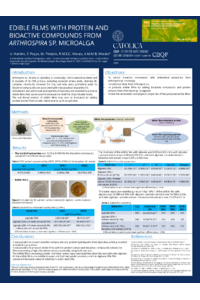
Arthrospira sp. (Spirulina) is rich in natural nutrients, and it consists of 60–70% protein, including essential amino acids, vitamins (B-complex and vitamin E), minerals (Fe and Ca), and γ-linolenic acid. It also contains antioxidants and carotenoids, such as phycocyanin and lutein. These compounds are associated with therapeutical properties, such as anti-aging and anti-UV radiation, and they increase immunity [1]. Spirulina was used as a source of protein and bioactive compounds to produce an edible film. The bioactive compounds were extracted through hydroethanolic maceration [2]. The protein was extracted with water (50 °C, 2 h), cellulase, and protease at an adequate pH and temperature (40 ˚ C, 2 h), followed by centrifugation and freeze drying. The total phenolic content (TPC) and the antioxidant activity (ABTS, DPPH, ORAC) of the extracts with bioactives were determined. Casting was the method used to investigate the edible films. Their antioxidant activity (ABTS, DPPH) and physico-chemical properties were determined. The TPC of the bioactives extract was 0.973±0.061 mg GAE/100 mg DW, and the ABTS, DPPH, and ORAC were 2.846±0.452, 2.284±0.064, and 18.378±1.004 µmol TE/100 mg DW, respectively. The edible film with 2% alginate and 0.5% protein extract presented ABTS=922.36±129.06 and DPPH=95.93±15.91 µM TE/mg film. The color parameters of this film were L*=61.16±9.54, hue=75.5±1.9°, and chroma=7.02±0.49; its thickness was 0.063±0.004 mm; its water vapor permeability (WVP) was 14.388±3.636 (g.mm.m-2.day-1.kPa-1); and its solubility was 100% in hydroalcoholic solutions (0–50%) and 27.34±6.77% in 3% acetic acid. The incorporation of the bioactive extract in the film formulation resulted in significantly higher ABTS and DPPH values and a lower WVP. However, the color became darker, with significantly lower L* and hue values. The thickness and solubility were not significantly different. Therefore, Arthrospira sp. is a good source of protein and bioactive compounds, allowing for the production of edible films with potential to be used in food applications.
Keywords
Microalga
Arthrospira sp.
edible film
protein
bioactives
total phenolic content
antioxidant activity.
Poster
POSTER FOODS_Martins et al (1).pdf
FATTY ACIDS AND TOCOPHEROL PROFILES OF REGULAR AND DECAFFEINATED INSTANT COFFEES
Developing GC and HPLC methods for the γ-aminobutyric acid quantification in rice samples