Event submissions
Published
This submission belongs to the session S6. Emerging Methods of Food Analysis of the event The 5th International Electronic Conference on Foods
Published date
28 Oct, 2024
Academic Editor
'%3e%3cpath%20d='M12.6657%2010.9104C12.4185%2010.325%2012.0599%209.79327%2011.6097%209.34482C11.1609%208.89508%2010.6293%208.5365%2010.0442%208.28888C10.0389%208.28626%2010.0337%208.28495%2010.0285%208.28233C10.8446%207.69279%2011.3752%206.73249%2011.3752%205.64904C11.3752%203.8542%209.92103%202.39999%208.1262%202.39999C6.33136%202.39999%204.87715%203.8542%204.87715%205.64904C4.87715%206.73249%205.40774%207.69279%206.22393%208.28364C6.21869%208.28626%206.21345%208.28757%206.20821%208.29019C5.62129%208.5378%205.09463%208.89284%204.64265%209.34613C4.1929%209.79493%203.83432%2010.3266%203.58671%2010.9117C3.34345%2011.4845%203.21226%2012.0987%203.20023%2012.7209C3.19988%2012.7349%203.20233%2012.7488%203.20744%2012.7619C3.21255%2012.7749%203.22022%2012.7867%203.22998%2012.7968C3.23975%2012.8068%203.25142%2012.8147%203.26431%2012.8202C3.2772%2012.8256%203.29105%2012.8284%203.30504%2012.8284H4.09109C4.14874%2012.8284%204.19459%2012.7825%204.1959%2012.7262C4.2221%2011.7148%204.62823%2010.7676%205.34617%2010.0497C6.08899%209.30683%207.0755%208.89808%208.1262%208.89808C9.17689%208.89808%2010.1634%209.30683%2010.9062%2010.0497C11.6242%2010.7676%2012.0303%2011.7148%2012.0565%2012.7262C12.0578%2012.7838%2012.1037%2012.8284%2012.1613%2012.8284H12.9474C12.9613%2012.8284%2012.9752%2012.8256%2012.9881%2012.8202C13.001%2012.8147%2013.0126%2012.8068%2013.0224%2012.7968C13.0322%2012.7867%2013.0398%2012.7749%2013.0449%2012.7619C13.0501%2012.7488%2013.0525%2012.7349%2013.0522%2012.7209C13.0391%2012.0947%2012.9094%2011.4855%2012.6657%2010.9104ZM8.1262%207.9024C7.52486%207.9024%206.9589%207.6679%206.53312%207.24211C6.10733%206.81633%205.87283%206.25037%205.87283%205.64904C5.87283%205.0477%206.10733%204.48174%206.53312%204.05596C6.9589%203.63018%207.52486%203.39567%208.1262%203.39567C8.72753%203.39567%209.29349%203.63018%209.71927%204.05596C10.1451%204.48174%2010.3796%205.0477%2010.3796%205.64904C10.3796%206.25037%2010.1451%206.81633%209.71927%207.24211C9.29349%207.6679%208.72753%207.9024%208.1262%207.9024Z'%20fill='%235D1EE1'/%3e%3c/g%3e%3c/svg%3e) Susana Casal
Susana CasalCitation
Cristiana Lucas Pereira, Ana Partidário, Andreia Soares, Luísa Cristina Roseiro, Carla Brites, Developing GC and HPLC methods for the γ-aminobutyric acid quantification in rice samples, in Proceedings of The 5th International Electronic Conference on Foods, 28 October–30 October 2024, MDPI: Basel, Switzerland
Share
Email
Facebook
Twitter
LinkedIn
Developing GC and HPLC methods for the γ-aminobutyric acid quantification in rice samples
'%3e%3cpath%20d='M12.6647%2010.9104C12.4176%2010.325%2012.0589%209.7933%2011.6088%209.34485C11.16%208.89511%2010.6283%208.53653%2010.0432%208.28891C10.038%208.28629%2010.0327%208.28498%2010.0275%208.28236C10.8437%207.69282%2011.3743%206.73252%2011.3743%205.64907C11.3743%203.85423%209.92005%202.40002%208.12522%202.40002C6.33038%202.40002%204.87618%203.85423%204.87618%205.64907C4.87618%206.73252%205.40677%207.69282%206.22296%208.28367C6.21772%208.28629%206.21248%208.2876%206.20724%208.29022C5.62031%208.53783%205.09365%208.89287%204.64167%209.34616C4.19192%209.79496%203.83334%2010.3266%203.58573%2010.9117C3.34247%2011.4846%203.21128%2012.0987%203.19925%2012.721C3.1989%2012.735%203.20135%2012.7489%203.20646%2012.7619C3.21157%2012.7749%203.21924%2012.7868%203.22901%2012.7968C3.23877%2012.8068%203.25045%2012.8148%203.26334%2012.8202C3.27623%2012.8256%203.29007%2012.8284%203.30406%2012.8284H4.09012C4.14776%2012.8284%204.19362%2012.7825%204.19493%2012.7262C4.22113%2011.7148%204.62726%2010.7676%205.34519%2010.0497C6.08802%209.30686%207.07452%208.89811%208.12522%208.89811C9.17592%208.89811%2010.1624%209.30686%2010.9052%2010.0497C11.6232%2010.7676%2012.0293%2011.7148%2012.0555%2012.7262C12.0568%2012.7839%2012.1027%2012.8284%2012.1603%2012.8284H12.9464C12.9604%2012.8284%2012.9742%2012.8256%2012.9871%2012.8202C13%2012.8148%2013.0117%2012.8068%2013.0214%2012.7968C13.0312%2012.7868%2013.0389%2012.7749%2013.044%2012.7619C13.0491%2012.7489%2013.0515%2012.735%2013.0512%2012.721C13.0381%2012.0947%2012.9084%2011.4856%2012.6647%2010.9104ZM8.12522%207.90243C7.52388%207.90243%206.95792%207.66793%206.53214%207.24215C6.10636%206.81636%205.87185%206.2504%205.87185%205.64907C5.87185%205.04773%206.10636%204.48177%206.53214%204.05599C6.95792%203.63021%207.52388%203.3957%208.12522%203.3957C8.72655%203.3957%209.29252%203.63021%209.7183%204.05599C10.1441%204.48177%2010.3786%205.04773%2010.3786%205.64907C10.3786%206.2504%2010.1441%206.81636%209.7183%207.24215C9.29252%207.66793%208.72655%207.90243%208.12522%207.90243Z'%20fill='%235D1EE1'/%3e%3c/g%3e%3c/svg%3e)
Cristiana Lucas Pereira 1
Ana Partidário 2
Andreia Soares 2
Luísa Cristina Roseiro 2

Carla Brites 2
1. INIAV
2. National Institute for Agricultural and Veterinary Research (INIAV), I.P., Av. da República, 2780-157 Oeiras, Portugal
Abstract
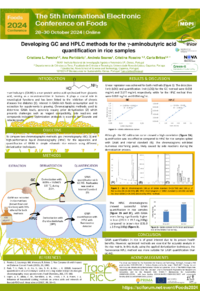
γ-aminobutyric (GABA) is a non-protein amino acid produced from glutamic acid, which acts as a neurotransmitter in humans playing a role in neurological functions and inhibiting chronic diseases like diabetes [1]. The consumption of GABA-rich foods and its extraction for supplements are of great interest. Chromatographic methodologies, the most widely used for GABA determination, require previous derivatization [2]. This work aimed at applying and comparing different derivatizations and chromatographic methods (gas chromatography and high-performance liquid chromatography) to separate and quantify GABA in simple ethanolic rice extracts. GABA was extracted from brown flour and rice bran of the Ariete variety using 70% ethanol for both methods. Separation and quantification were performed using GC-FID, after a BSTFA-1%TMCS derivatization, and using norleucine as an internal standard (IS) [3]. In the HPLC method, o-phthaldialdehyde (OPA) derivatization and a fluorescence detector were used. A linear regression between the relative area of IS and GABA standard solutions yielded 0.046-0.457mg/mL with an R2=0.9975 for the GC method, and 0.011-0.083 mg/mL with an R2 = 0.9929 for the HPLC method. The detection limit (LOD) and quantification limit (LOQ) were 0.058 mg/mL and 0.177 mg/mL for the GC method, and 0.018 and 0.054 mg/mL for the HPLC method. Although GABA quantification by means of GC gave good results with the standards, this did not happen with rice samples. Rice samples fortified with GABA standard and norleucine were analyzed, but the obtained chromatograms showed too many interfering peaks which probably came from the extraction process. Based on these results, testing other extraction/cleaning methods for GABA quantification in rice matrices will be necessary. On the other hand, it was possible to quantify GABA using the HPLC method in rice samples, where the concentration in bran was higher (222.1 ± 19.3 mg/100g) than in brown rice (131.0 ± 3.9 mg/100g). This method also proved to be more sensitive than the GC method.
Keywords
GABA
GC method
HPLC method
brown rice
rice bran
Poster
Poster _5th Foods Conference2024.pdf
EDIBLE FILMS WITH PROTEIN AND BIOACTIVE COMPOUNDS FROM ARTHROSPIRA SP. MICROALGAE
Machine learning and isotopic composition of foods: determination of the geographical origin of milk and eggs