Event submissions
Published
This submission belongs to the session S8. Food Quality and Safety of the event The 5th International Electronic Conference on Foods
Published date
28 Oct, 2024
Academic Editor
'%3e%3cpath%20d='M12.6657%2010.9104C12.4185%2010.325%2012.0599%209.79327%2011.6097%209.34482C11.1609%208.89508%2010.6293%208.5365%2010.0442%208.28888C10.0389%208.28626%2010.0337%208.28495%2010.0285%208.28233C10.8446%207.69279%2011.3752%206.73249%2011.3752%205.64904C11.3752%203.8542%209.92103%202.39999%208.1262%202.39999C6.33136%202.39999%204.87715%203.8542%204.87715%205.64904C4.87715%206.73249%205.40774%207.69279%206.22393%208.28364C6.21869%208.28626%206.21345%208.28757%206.20821%208.29019C5.62129%208.5378%205.09463%208.89284%204.64265%209.34613C4.1929%209.79493%203.83432%2010.3266%203.58671%2010.9117C3.34345%2011.4845%203.21226%2012.0987%203.20023%2012.7209C3.19988%2012.7349%203.20233%2012.7488%203.20744%2012.7619C3.21255%2012.7749%203.22022%2012.7867%203.22998%2012.7968C3.23975%2012.8068%203.25142%2012.8147%203.26431%2012.8202C3.2772%2012.8256%203.29105%2012.8284%203.30504%2012.8284H4.09109C4.14874%2012.8284%204.19459%2012.7825%204.1959%2012.7262C4.2221%2011.7148%204.62823%2010.7676%205.34617%2010.0497C6.08899%209.30683%207.0755%208.89808%208.1262%208.89808C9.17689%208.89808%2010.1634%209.30683%2010.9062%2010.0497C11.6242%2010.7676%2012.0303%2011.7148%2012.0565%2012.7262C12.0578%2012.7838%2012.1037%2012.8284%2012.1613%2012.8284H12.9474C12.9613%2012.8284%2012.9752%2012.8256%2012.9881%2012.8202C13.001%2012.8147%2013.0126%2012.8068%2013.0224%2012.7968C13.0322%2012.7867%2013.0398%2012.7749%2013.0449%2012.7619C13.0501%2012.7488%2013.0525%2012.7349%2013.0522%2012.7209C13.0391%2012.0947%2012.9094%2011.4855%2012.6657%2010.9104ZM8.1262%207.9024C7.52486%207.9024%206.9589%207.6679%206.53312%207.24211C6.10733%206.81633%205.87283%206.25037%205.87283%205.64904C5.87283%205.0477%206.10733%204.48174%206.53312%204.05596C6.9589%203.63018%207.52486%203.39567%208.1262%203.39567C8.72753%203.39567%209.29349%203.63018%209.71927%204.05596C10.1451%204.48174%2010.3796%205.0477%2010.3796%205.64904C10.3796%206.25037%2010.1451%206.81633%209.71927%207.24211C9.29349%207.6679%208.72753%207.9024%208.1262%207.9024Z'%20fill='%235D1EE1'/%3e%3c/g%3e%3c/svg%3e) Antonello Santini
Antonello SantiniCitation
Sebastian Elgueta, Gabriela Contreras, The removal of pesticide residues and their effects on tomato quality using cold plasma, in Proceedings of The 5th International Electronic Conference on Foods, 28 October–30 October 2024, MDPI: Basel, Switzerland
Share
Email
Facebook
Twitter
LinkedIn
The removal of pesticide residues and their effects on tomato quality using cold plasma

Sebastian Elgueta 1
'%3e%3cpath%20d='M12.6647%2010.9104C12.4176%2010.325%2012.0589%209.7933%2011.6088%209.34485C11.16%208.89511%2010.6283%208.53653%2010.0432%208.28891C10.038%208.28629%2010.0327%208.28498%2010.0275%208.28236C10.8437%207.69282%2011.3743%206.73252%2011.3743%205.64907C11.3743%203.85423%209.92005%202.40002%208.12522%202.40002C6.33038%202.40002%204.87618%203.85423%204.87618%205.64907C4.87618%206.73252%205.40677%207.69282%206.22296%208.28367C6.21772%208.28629%206.21248%208.2876%206.20724%208.29022C5.62031%208.53783%205.09365%208.89287%204.64167%209.34616C4.19192%209.79496%203.83334%2010.3266%203.58573%2010.9117C3.34247%2011.4846%203.21128%2012.0987%203.19925%2012.721C3.1989%2012.735%203.20135%2012.7489%203.20646%2012.7619C3.21157%2012.7749%203.21924%2012.7868%203.22901%2012.7968C3.23877%2012.8068%203.25045%2012.8148%203.26334%2012.8202C3.27623%2012.8256%203.29007%2012.8284%203.30406%2012.8284H4.09012C4.14776%2012.8284%204.19362%2012.7825%204.19493%2012.7262C4.22113%2011.7148%204.62726%2010.7676%205.34519%2010.0497C6.08802%209.30686%207.07452%208.89811%208.12522%208.89811C9.17592%208.89811%2010.1624%209.30686%2010.9052%2010.0497C11.6232%2010.7676%2012.0293%2011.7148%2012.0555%2012.7262C12.0568%2012.7839%2012.1027%2012.8284%2012.1603%2012.8284H12.9464C12.9604%2012.8284%2012.9742%2012.8256%2012.9871%2012.8202C13%2012.8148%2013.0117%2012.8068%2013.0214%2012.7968C13.0312%2012.7868%2013.0389%2012.7749%2013.044%2012.7619C13.0491%2012.7489%2013.0515%2012.735%2013.0512%2012.721C13.0381%2012.0947%2012.9084%2011.4856%2012.6647%2010.9104ZM8.12522%207.90243C7.52388%207.90243%206.95792%207.66793%206.53214%207.24215C6.10636%206.81636%205.87185%206.2504%205.87185%205.64907C5.87185%205.04773%206.10636%204.48177%206.53214%204.05599C6.95792%203.63021%207.52388%203.3957%208.12522%203.3957C8.72655%203.3957%209.29252%203.63021%209.7183%204.05599C10.1441%204.48177%2010.3786%205.04773%2010.3786%205.64907C10.3786%206.2504%2010.1441%206.81636%209.7183%207.24215C9.29252%207.66793%208.72655%207.90243%208.12522%207.90243Z'%20fill='%235D1EE1'/%3e%3c/g%3e%3c/svg%3e)
Gabriela Contreras 2
1. Universidad San Sebastián, Facultad de Ciencias para el Cuidado de la Salud, Sede Los Leones, Providencia, Chile.
2. Universidad San Sebastián, Facultad de Ciencias para el Cuidado de la Salud, Sede Santiago.
Abstract
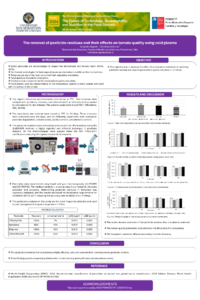
Pesticides control pests and diseases in fresh vegetables. However, their overuse impacts the environment and human health. Tomatoes are the main fresh vegetable consumed in Chile and are reported by the national food surveillance as one of the most contaminated due to pesticide residues. Cold plasma is an oxidation process suitable for reducing chemical contaminants and improving food quality. This study aimed to evaluate the effect of cold plasma on removing pesticides in tomatoes (iprodione, chlorothalonil, linuron, lambda-cyhalothrin) and some quality indicators. Tomatoes were sprayed at a double field rate (to emulate an overuse) and subjected to cold plasma for 3 minutes at 40 KHz. Treatments and controls were stored at 7ºC for 21 days. Tomato samples were collected on the 1st, 6th, 11th, 16th, and 21st days after treatment, and the following parameters were evaluated: firmness, soluble solid, titratable acidity, phenolic content, lycopene, and ascorbic acid. The pesticide residues were analytically validated according to ISO 17025:2017 and SANTE guidelines. The pesticides were extracted via the QuEChERS method and analyzed using GC MS/MS and LC-MS/MS. The results showed a reduction in all pesticide residues after 24 hours for iprodione, chlorothalonil, linuron, and lambda-cyhalothrin: 37%, 36%,36%, and 39%, respectively. The firmness values ranged between 15 and 35 Newtons; the soluble solid values between 4.3 and 6.4 brix; the titratable acidity values between 0.24 and 0.50 dry matter/100 g tomato; the phenolic content values between 0.14 and 0.47 mg gallic acid/100 g tomato; the lycopene value between 2 and 5.7 mg quercetin /100 g tomato; the ascorbic acid between 5.6 and 16.5 mg lycopene/100 g tomato. This study's findings demonstrate the high effectiveness, safety, and convenience of cold plasma in removing tomato pesticide residues, which have the potential to significantly enhance dietary safety and provide a crucial reference for tomato cleaning.
Keywords
COLD PLASMA
PESTICIDE RESIDUES
TOMATO
Poster
POSTER 1.pdf
Evaluation of the effect of plant sterol food supplement intake on eryptotic markers in statin-treated hypercholesterolemic patients
EVALUATION OF THE NUTRITIONAL COMPOSITION AND BIOACTIVE COMPOUNDS FROM HASS AVOCADO CAKE