Event submissions
Published
This submission belongs to the session S5. Chemistry and Physicochemical Properties of Foods of the event The 5th International Electronic Conference on Foods
Published date
28 Oct, 2024
Academic Editor
'%3e%3cpath%20d='M12.6657%2010.9104C12.4185%2010.325%2012.0599%209.79327%2011.6097%209.34482C11.1609%208.89508%2010.6293%208.5365%2010.0442%208.28888C10.0389%208.28626%2010.0337%208.28495%2010.0285%208.28233C10.8446%207.69279%2011.3752%206.73249%2011.3752%205.64904C11.3752%203.8542%209.92103%202.39999%208.1262%202.39999C6.33136%202.39999%204.87715%203.8542%204.87715%205.64904C4.87715%206.73249%205.40774%207.69279%206.22393%208.28364C6.21869%208.28626%206.21345%208.28757%206.20821%208.29019C5.62129%208.5378%205.09463%208.89284%204.64265%209.34613C4.1929%209.79493%203.83432%2010.3266%203.58671%2010.9117C3.34345%2011.4845%203.21226%2012.0987%203.20023%2012.7209C3.19988%2012.7349%203.20233%2012.7488%203.20744%2012.7619C3.21255%2012.7749%203.22022%2012.7867%203.22998%2012.7968C3.23975%2012.8068%203.25142%2012.8147%203.26431%2012.8202C3.2772%2012.8256%203.29105%2012.8284%203.30504%2012.8284H4.09109C4.14874%2012.8284%204.19459%2012.7825%204.1959%2012.7262C4.2221%2011.7148%204.62823%2010.7676%205.34617%2010.0497C6.08899%209.30683%207.0755%208.89808%208.1262%208.89808C9.17689%208.89808%2010.1634%209.30683%2010.9062%2010.0497C11.6242%2010.7676%2012.0303%2011.7148%2012.0565%2012.7262C12.0578%2012.7838%2012.1037%2012.8284%2012.1613%2012.8284H12.9474C12.9613%2012.8284%2012.9752%2012.8256%2012.9881%2012.8202C13.001%2012.8147%2013.0126%2012.8068%2013.0224%2012.7968C13.0322%2012.7867%2013.0398%2012.7749%2013.0449%2012.7619C13.0501%2012.7488%2013.0525%2012.7349%2013.0522%2012.7209C13.0391%2012.0947%2012.9094%2011.4855%2012.6657%2010.9104ZM8.1262%207.9024C7.52486%207.9024%206.9589%207.6679%206.53312%207.24211C6.10733%206.81633%205.87283%206.25037%205.87283%205.64904C5.87283%205.0477%206.10733%204.48174%206.53312%204.05596C6.9589%203.63018%207.52486%203.39567%208.1262%203.39567C8.72753%203.39567%209.29349%203.63018%209.71927%204.05596C10.1451%204.48174%2010.3796%205.0477%2010.3796%205.64904C10.3796%206.25037%2010.1451%206.81633%209.71927%207.24211C9.29349%207.6679%208.72753%207.9024%208.1262%207.9024Z'%20fill='%235D1EE1'/%3e%3c/g%3e%3c/svg%3e) Joana Amaral
Joana AmaralCitation
Luane Souza Silva Lage, Alex de Aguiar Novo, Eliane Przytyk Jung, Claudete Norie Kunigami, Suely Pereira Freitas, Leilson de Oliveira Ribeiro, EVALUATION OF THE NUTRITIONAL COMPOSITION AND BIOACTIVE COMPOUNDS FROM HASS AVOCADO CAKE, in Proceedings of The 5th International Electronic Conference on Foods, 28 October–30 October 2024, MDPI: Basel, Switzerland
Share
Email
Facebook
Twitter
LinkedIn
EVALUATION OF THE NUTRITIONAL COMPOSITION AND BIOACTIVE COMPOUNDS FROM HASS AVOCADO CAKE
'%3e%3cpath%20d='M12.6647%2010.9104C12.4176%2010.325%2012.0589%209.7933%2011.6088%209.34485C11.16%208.89511%2010.6283%208.53653%2010.0432%208.28891C10.038%208.28629%2010.0327%208.28498%2010.0275%208.28236C10.8437%207.69282%2011.3743%206.73252%2011.3743%205.64907C11.3743%203.85423%209.92005%202.40002%208.12522%202.40002C6.33038%202.40002%204.87618%203.85423%204.87618%205.64907C4.87618%206.73252%205.40677%207.69282%206.22296%208.28367C6.21772%208.28629%206.21248%208.2876%206.20724%208.29022C5.62031%208.53783%205.09365%208.89287%204.64167%209.34616C4.19192%209.79496%203.83334%2010.3266%203.58573%2010.9117C3.34247%2011.4846%203.21128%2012.0987%203.19925%2012.721C3.1989%2012.735%203.20135%2012.7489%203.20646%2012.7619C3.21157%2012.7749%203.21924%2012.7868%203.22901%2012.7968C3.23877%2012.8068%203.25045%2012.8148%203.26334%2012.8202C3.27623%2012.8256%203.29007%2012.8284%203.30406%2012.8284H4.09012C4.14776%2012.8284%204.19362%2012.7825%204.19493%2012.7262C4.22113%2011.7148%204.62726%2010.7676%205.34519%2010.0497C6.08802%209.30686%207.07452%208.89811%208.12522%208.89811C9.17592%208.89811%2010.1624%209.30686%2010.9052%2010.0497C11.6232%2010.7676%2012.0293%2011.7148%2012.0555%2012.7262C12.0568%2012.7839%2012.1027%2012.8284%2012.1603%2012.8284H12.9464C12.9604%2012.8284%2012.9742%2012.8256%2012.9871%2012.8202C13%2012.8148%2013.0117%2012.8068%2013.0214%2012.7968C13.0312%2012.7868%2013.0389%2012.7749%2013.044%2012.7619C13.0491%2012.7489%2013.0515%2012.735%2013.0512%2012.721C13.0381%2012.0947%2012.9084%2011.4856%2012.6647%2010.9104ZM8.12522%207.90243C7.52388%207.90243%206.95792%207.66793%206.53214%207.24215C6.10636%206.81636%205.87185%206.2504%205.87185%205.64907C5.87185%205.04773%206.10636%204.48177%206.53214%204.05599C6.95792%203.63021%207.52388%203.3957%208.12522%203.3957C8.72655%203.3957%209.29252%203.63021%209.7183%204.05599C10.1441%204.48177%2010.3786%205.04773%2010.3786%205.64907C10.3786%206.2504%2010.1441%206.81636%209.7183%207.24215C9.29252%207.66793%208.72655%207.90243%208.12522%207.90243Z'%20fill='%235D1EE1'/%3e%3c/g%3e%3c/svg%3e)
Luane Souza Silva Lage 1,2
Alex de Aguiar Novo 1
Eliane Przytyk Jung 1
Claudete Norie Kunigami 1
Suely Pereira Freitas 2
Leilson de Oliveira Ribeiro 1
1. Laboratory of Organic and Inorganic Chemical Analysis, National Institute of Technology, Rio de Janeiro 20081-312, Brazil
2. Laboratory of Vegetable Oil, Federal University of Rio de Janeiro, Rio de Janeiro 21941-909, Brazil
Abstract
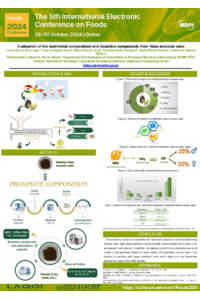
Originally from Central America, the avocado (Persea americana Mill.) has spread throughout the world, being used to extract oil, and is consumed fresh or in based-foods. However, fruit processing generates a waste that is still rich in macro- and micronutrients, as well as bioactive compounds. This work aimed to evaluate the nutritional potential of Hass avocado cake, generated after cold-pressing to oil extraction from its pulp and peel. Proximate composition, mineral profile, fatty acid composition, and bioactive compounds were evaluated. Results were expressed on a dry basis, except for moisture content. The Hass avocado cake, composed of pulp and peel, presented moisture, lipid, ash, protein, and carbohydrate content equal to 9.6% 27.2%, 8.3%, 10.2%, and 54.3%, respectively. Potassium (2621.7 mg/100 g), iron (6.0 mg/100 g), and zinc (4.0 mg/100 g) were the most abundant minerals in the sample. The residual oil had a fatty acid profile composed of oleic acid (54%), palmitic acid (20%), linoleic acid (15%), and palmitoleic acid (10%). Furthermore, the cake extract showed antioxidant potential via the assays ABTS•+ (159 µmol of Trolox/g), DPPH• (199 µmol of Trolox/g), and FRAP (552 µmol of Trolox/g). The Hass avocado cake showed a total phenolic compound content of 4326 mg GAE/100 g and a total carotenoid content of 2983 µg β-carotene/100 g, thus making it a potential source of bioactive compounds. Based on these results, this by-product can be used in the recovery of products with higher nutritional value, which aligns with the sustainable development goals of the 2030 Agenda.
Keywords
Persea americana
minerals
fatty acids
antioxidant capacity.
Poster
poster FOODs LUANE pdf.pdf
The removal of pesticide residues and their effects on tomato quality using cold plasma
Assessment of nitrates, nitrites, and selected heavy metal contaminants in the microgreens of rare oilseed plants.