Event submissions
Published
This submission belongs to the session S8. Food Quality and Safety of the event The 5th International Electronic Conference on Foods
Published date
28 Oct, 2024
Academic Editor
'%3e%3cpath%20d='M12.6657%2010.9104C12.4185%2010.325%2012.0599%209.79327%2011.6097%209.34482C11.1609%208.89508%2010.6293%208.5365%2010.0442%208.28888C10.0389%208.28626%2010.0337%208.28495%2010.0285%208.28233C10.8446%207.69279%2011.3752%206.73249%2011.3752%205.64904C11.3752%203.8542%209.92103%202.39999%208.1262%202.39999C6.33136%202.39999%204.87715%203.8542%204.87715%205.64904C4.87715%206.73249%205.40774%207.69279%206.22393%208.28364C6.21869%208.28626%206.21345%208.28757%206.20821%208.29019C5.62129%208.5378%205.09463%208.89284%204.64265%209.34613C4.1929%209.79493%203.83432%2010.3266%203.58671%2010.9117C3.34345%2011.4845%203.21226%2012.0987%203.20023%2012.7209C3.19988%2012.7349%203.20233%2012.7488%203.20744%2012.7619C3.21255%2012.7749%203.22022%2012.7867%203.22998%2012.7968C3.23975%2012.8068%203.25142%2012.8147%203.26431%2012.8202C3.2772%2012.8256%203.29105%2012.8284%203.30504%2012.8284H4.09109C4.14874%2012.8284%204.19459%2012.7825%204.1959%2012.7262C4.2221%2011.7148%204.62823%2010.7676%205.34617%2010.0497C6.08899%209.30683%207.0755%208.89808%208.1262%208.89808C9.17689%208.89808%2010.1634%209.30683%2010.9062%2010.0497C11.6242%2010.7676%2012.0303%2011.7148%2012.0565%2012.7262C12.0578%2012.7838%2012.1037%2012.8284%2012.1613%2012.8284H12.9474C12.9613%2012.8284%2012.9752%2012.8256%2012.9881%2012.8202C13.001%2012.8147%2013.0126%2012.8068%2013.0224%2012.7968C13.0322%2012.7867%2013.0398%2012.7749%2013.0449%2012.7619C13.0501%2012.7488%2013.0525%2012.7349%2013.0522%2012.7209C13.0391%2012.0947%2012.9094%2011.4855%2012.6657%2010.9104ZM8.1262%207.9024C7.52486%207.9024%206.9589%207.6679%206.53312%207.24211C6.10733%206.81633%205.87283%206.25037%205.87283%205.64904C5.87283%205.0477%206.10733%204.48174%206.53312%204.05596C6.9589%203.63018%207.52486%203.39567%208.1262%203.39567C8.72753%203.39567%209.29349%203.63018%209.71927%204.05596C10.1451%204.48174%2010.3796%205.0477%2010.3796%205.64904C10.3796%206.25037%2010.1451%206.81633%209.71927%207.24211C9.29349%207.6679%208.72753%207.9024%208.1262%207.9024Z'%20fill='%235D1EE1'/%3e%3c/g%3e%3c/svg%3e) Antonello Santini
Antonello SantiniCitation
Jelena Banovic Fuentes, Danijela Lukic, Ljilja Torovic, HEALTH RISK ASSOCIATED WITH ELEMENTAL IMPURITIES IN ALGAE OMEGA-3 FATTY ACID FOOD SUPPLEMENTS, in Proceedings of The 5th International Electronic Conference on Foods, 28 October–30 October 2024, MDPI: Basel, Switzerland
Share
Email
Facebook
Twitter
LinkedIn
HEALTH RISK ASSOCIATED WITH ELEMENTAL IMPURITIES IN ALGAE OMEGA-3 FATTY ACID FOOD SUPPLEMENTS
'%3e%3cpath%20d='M12.6647%2010.9104C12.4176%2010.325%2012.0589%209.7933%2011.6088%209.34485C11.16%208.89511%2010.6283%208.53653%2010.0432%208.28891C10.038%208.28629%2010.0327%208.28498%2010.0275%208.28236C10.8437%207.69282%2011.3743%206.73252%2011.3743%205.64907C11.3743%203.85423%209.92005%202.40002%208.12522%202.40002C6.33038%202.40002%204.87618%203.85423%204.87618%205.64907C4.87618%206.73252%205.40677%207.69282%206.22296%208.28367C6.21772%208.28629%206.21248%208.2876%206.20724%208.29022C5.62031%208.53783%205.09365%208.89287%204.64167%209.34616C4.19192%209.79496%203.83334%2010.3266%203.58573%2010.9117C3.34247%2011.4846%203.21128%2012.0987%203.19925%2012.721C3.1989%2012.735%203.20135%2012.7489%203.20646%2012.7619C3.21157%2012.7749%203.21924%2012.7868%203.22901%2012.7968C3.23877%2012.8068%203.25045%2012.8148%203.26334%2012.8202C3.27623%2012.8256%203.29007%2012.8284%203.30406%2012.8284H4.09012C4.14776%2012.8284%204.19362%2012.7825%204.19493%2012.7262C4.22113%2011.7148%204.62726%2010.7676%205.34519%2010.0497C6.08802%209.30686%207.07452%208.89811%208.12522%208.89811C9.17592%208.89811%2010.1624%209.30686%2010.9052%2010.0497C11.6232%2010.7676%2012.0293%2011.7148%2012.0555%2012.7262C12.0568%2012.7839%2012.1027%2012.8284%2012.1603%2012.8284H12.9464C12.9604%2012.8284%2012.9742%2012.8256%2012.9871%2012.8202C13%2012.8148%2013.0117%2012.8068%2013.0214%2012.7968C13.0312%2012.7868%2013.0389%2012.7749%2013.044%2012.7619C13.0491%2012.7489%2013.0515%2012.735%2013.0512%2012.721C13.0381%2012.0947%2012.9084%2011.4856%2012.6647%2010.9104ZM8.12522%207.90243C7.52388%207.90243%206.95792%207.66793%206.53214%207.24215C6.10636%206.81636%205.87185%206.2504%205.87185%205.64907C5.87185%205.04773%206.10636%204.48177%206.53214%204.05599C6.95792%203.63021%207.52388%203.3957%208.12522%203.3957C8.72655%203.3957%209.29252%203.63021%209.7183%204.05599C10.1441%204.48177%2010.3786%205.04773%2010.3786%205.64907C10.3786%206.2504%2010.1441%206.81636%209.7183%207.24215C9.29252%207.66793%208.72655%207.90243%208.12522%207.90243Z'%20fill='%235D1EE1'/%3e%3c/g%3e%3c/svg%3e)
Jelena Banovic Fuentes 1
Danijela Lukic 2

Ljilja Torovic 3
1. University of Novi Sad Faculty of Medicine Department of Pharmacy
2. Institute of Public Health of Vojvodina
3. Department of Pharmacy, Faculty of Medicine, University of Novi Sad, 21000 Novi Sad, Serbia
Abstract
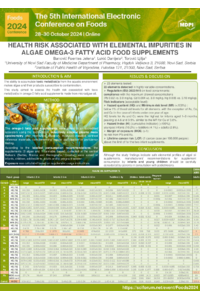
The ability to accumulate toxic metal(loid)s from the aquatic environment makes algae and their products susceptible to contamination.
This study aimed to assess the health risk associated with toxic metal(loid)s in omega-3 fatty acid supplements made from microalgae oil. According to the labelled consumption recommendations, the eight supplements, collected in the central Balkans (Serbia, Bosnia and Herzegovina and Croatia), were aimed at infants, children, adolescents, adults and/or pregnant women. The supplements were tested in an accredited laboratory using the technique of inductively coupled plasma mass spectrometry after microwave digestion. Analyses included certified reference materials, complementing regular participation in proficiency testing.
Of the 23 tested elements, 22 were detected in highly variable concentrations. The highest concentrations of elements were covered by Regulation (EU) 2023/915, complied with the maximum allowed (Pb 0.82 vs. 3.0 mg/kg, Cd 0.004 vs. 3.0 mg/kg, Hg 0.005 vs. 0.10 mg/kg). The risk indicators, the hazard quotient (HQ), and the minimum risk level (MR), calculated based on supplement usage instructions, were below the 1% threshold levels for all elements, with the exception of As, Co, and Cu in the case of infants under one year of age. HQ levels for As and Co were the highest for infants aged 1–3 months, peaking at 4.6 and 3.5%, similar to the MR for Cu of 3.6%. The cumulative exposure indicator (the hazard index) was also highest for the youngest infants (10.2%), followed by toddlers (4.1%) and adults (2.8%). The margin of exposure showed no risk from Pb and As, while the lifetime cancer risk estimates for the two infant supplements were above the limit of one additional cancer case per 100,000 people.
Although the study findings indicate safe elemental profiles of algal oil supplements, manufacturers' recommendations for supplement consumption by infants and young children should be carefully considered by parents in consultation with pediatricians.
Keywords
food safety
public health
risk assessment
supplementation
toxic elements
Poster
Poster - Banovic Fuentes J_2.pdf
Assessment of nitrates, nitrites, and selected heavy metal contaminants in the microgreens of rare oilseed plants.
ELEMENTAL IMPURITIES IN SOY ISOFLAVONE FOOD SUPPLEMENTS