Event submissions
Published
This submission belongs to the session S8. Food Quality and Safety of the event The 5th International Electronic Conference on Foods
Published date
28 Oct, 2024
Academic Editor
'%3e%3cpath%20d='M12.6657%2010.9104C12.4185%2010.325%2012.0599%209.79327%2011.6097%209.34482C11.1609%208.89508%2010.6293%208.5365%2010.0442%208.28888C10.0389%208.28626%2010.0337%208.28495%2010.0285%208.28233C10.8446%207.69279%2011.3752%206.73249%2011.3752%205.64904C11.3752%203.8542%209.92103%202.39999%208.1262%202.39999C6.33136%202.39999%204.87715%203.8542%204.87715%205.64904C4.87715%206.73249%205.40774%207.69279%206.22393%208.28364C6.21869%208.28626%206.21345%208.28757%206.20821%208.29019C5.62129%208.5378%205.09463%208.89284%204.64265%209.34613C4.1929%209.79493%203.83432%2010.3266%203.58671%2010.9117C3.34345%2011.4845%203.21226%2012.0987%203.20023%2012.7209C3.19988%2012.7349%203.20233%2012.7488%203.20744%2012.7619C3.21255%2012.7749%203.22022%2012.7867%203.22998%2012.7968C3.23975%2012.8068%203.25142%2012.8147%203.26431%2012.8202C3.2772%2012.8256%203.29105%2012.8284%203.30504%2012.8284H4.09109C4.14874%2012.8284%204.19459%2012.7825%204.1959%2012.7262C4.2221%2011.7148%204.62823%2010.7676%205.34617%2010.0497C6.08899%209.30683%207.0755%208.89808%208.1262%208.89808C9.17689%208.89808%2010.1634%209.30683%2010.9062%2010.0497C11.6242%2010.7676%2012.0303%2011.7148%2012.0565%2012.7262C12.0578%2012.7838%2012.1037%2012.8284%2012.1613%2012.8284H12.9474C12.9613%2012.8284%2012.9752%2012.8256%2012.9881%2012.8202C13.001%2012.8147%2013.0126%2012.8068%2013.0224%2012.7968C13.0322%2012.7867%2013.0398%2012.7749%2013.0449%2012.7619C13.0501%2012.7488%2013.0525%2012.7349%2013.0522%2012.7209C13.0391%2012.0947%2012.9094%2011.4855%2012.6657%2010.9104ZM8.1262%207.9024C7.52486%207.9024%206.9589%207.6679%206.53312%207.24211C6.10733%206.81633%205.87283%206.25037%205.87283%205.64904C5.87283%205.0477%206.10733%204.48174%206.53312%204.05596C6.9589%203.63018%207.52486%203.39567%208.1262%203.39567C8.72753%203.39567%209.29349%203.63018%209.71927%204.05596C10.1451%204.48174%2010.3796%205.0477%2010.3796%205.64904C10.3796%206.25037%2010.1451%206.81633%209.71927%207.24211C9.29349%207.6679%208.72753%207.9024%208.1262%207.9024Z'%20fill='%235D1EE1'/%3e%3c/g%3e%3c/svg%3e) Antonello Santini
Antonello SantiniCitation
Ljilja Torovic, Danijela Lukic, Maja Amidzic, ELEMENTAL IMPURITIES IN SOY ISOFLAVONE FOOD SUPPLEMENTS, in Proceedings of The 5th International Electronic Conference on Foods, 28 October–30 October 2024, MDPI: Basel, Switzerland
Share
Email
Facebook
Twitter
LinkedIn
ELEMENTAL IMPURITIES IN SOY ISOFLAVONE FOOD SUPPLEMENTS

Ljilja Torovic 1
'%3e%3cpath%20d='M12.6647%2010.9104C12.4176%2010.325%2012.0589%209.7933%2011.6088%209.34485C11.16%208.89511%2010.6283%208.53653%2010.0432%208.28891C10.038%208.28629%2010.0327%208.28498%2010.0275%208.28236C10.8437%207.69282%2011.3743%206.73252%2011.3743%205.64907C11.3743%203.85423%209.92005%202.40002%208.12522%202.40002C6.33038%202.40002%204.87618%203.85423%204.87618%205.64907C4.87618%206.73252%205.40677%207.69282%206.22296%208.28367C6.21772%208.28629%206.21248%208.2876%206.20724%208.29022C5.62031%208.53783%205.09365%208.89287%204.64167%209.34616C4.19192%209.79496%203.83334%2010.3266%203.58573%2010.9117C3.34247%2011.4846%203.21128%2012.0987%203.19925%2012.721C3.1989%2012.735%203.20135%2012.7489%203.20646%2012.7619C3.21157%2012.7749%203.21924%2012.7868%203.22901%2012.7968C3.23877%2012.8068%203.25045%2012.8148%203.26334%2012.8202C3.27623%2012.8256%203.29007%2012.8284%203.30406%2012.8284H4.09012C4.14776%2012.8284%204.19362%2012.7825%204.19493%2012.7262C4.22113%2011.7148%204.62726%2010.7676%205.34519%2010.0497C6.08802%209.30686%207.07452%208.89811%208.12522%208.89811C9.17592%208.89811%2010.1624%209.30686%2010.9052%2010.0497C11.6232%2010.7676%2012.0293%2011.7148%2012.0555%2012.7262C12.0568%2012.7839%2012.1027%2012.8284%2012.1603%2012.8284H12.9464C12.9604%2012.8284%2012.9742%2012.8256%2012.9871%2012.8202C13%2012.8148%2013.0117%2012.8068%2013.0214%2012.7968C13.0312%2012.7868%2013.0389%2012.7749%2013.044%2012.7619C13.0491%2012.7489%2013.0515%2012.735%2013.0512%2012.721C13.0381%2012.0947%2012.9084%2011.4856%2012.6647%2010.9104ZM8.12522%207.90243C7.52388%207.90243%206.95792%207.66793%206.53214%207.24215C6.10636%206.81636%205.87185%206.2504%205.87185%205.64907C5.87185%205.04773%206.10636%204.48177%206.53214%204.05599C6.95792%203.63021%207.52388%203.3957%208.12522%203.3957C8.72655%203.3957%209.29252%203.63021%209.7183%204.05599C10.1441%204.48177%2010.3786%205.04773%2010.3786%205.64907C10.3786%206.2504%2010.1441%206.81636%209.7183%207.24215C9.29252%207.66793%208.72655%207.90243%208.12522%207.90243Z'%20fill='%235D1EE1'/%3e%3c/g%3e%3c/svg%3e)
Danijela Lukic 2
Maja Amidzic 3
1. Department of Pharmacy, Faculty of Medicine, University of Novi Sad, 21000 Novi Sad, Serbia
2. Institute of Public Health of Vojvodina
3. University of Novi Sad Faculty of Medicine Department of Pharmacy
Abstract
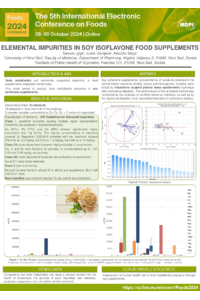
Toxic metal(loid)s are commonly suspected impurities in food supplements, especially herbal ones.
This study aimed to analyze their presence in soy isoflavone supplements, represented by 21 products collected in the central Balkan countries (Serbia, Bosna and Hercegovina, Croatia) and tested by an inductively coupled plasma mass spectrometry technique after microwave digestion. The performance of the analytical method was monitored by the analyses of certified reference materials, as well as by the regular participation of an accredited laboratory in proficiency testing.
The elemental profiles consisted of 23 elements, most of which (18) were detected in more than half of the products, in extremely variable concentrations—in the case of Sr, Fe and Zn, over three orders of magnitude. The elements are classified according to the ICH Guidelines for Elemental Impurities. Regarding Class 1 elements (systemic toxicants causing multiple organ injuries/failure; limited/no use production of pharmaceuticals), the frequency of detection of As (91%), Pb (77%) and Cd (68%) was significantly higher than that of of Hg (41%). The highest concentrations of elements covered by Regulation (EU) 2023/915 complied with the maximum that was allowed (Pb 0.30 vs. 3.0 mg/kg, Cd 0.38 vs. 1.0 mg/kg, Hg 0.08 vs. 0.10 mg/kg). Class 2A elements (route-dependent toxicants; high probability of occurrence), Co, V and Ni, were found in all samples, in concentrations up to 1.37, 0.65 and 2.58 mg/kg, respectively. The Class 2B elements (route-dependent toxicants; low probability of occurrence) Se and Tl were rarely detected. The Class 3 elements (low oral toxicity) Ba and Cu were found in all, and Cr in all but one supplement, Sb in half and Sn in none. Among the non-classified elements (low inherent toxicity), Te, Be and Sr were detected.
Considering that toxic metal(loid)s can pose a serious concern for the health of consumers, the sources of such impurities (raw materials, production equipment, etc.) should be strictly controlled.
Keywords
food safety
public health
supplementation
toxic metals
Poster
Poster - Torovic L_2.pdf
HEALTH RISK ASSOCIATED WITH ELEMENTAL IMPURITIES IN ALGAE OMEGA-3 FATTY ACID FOOD SUPPLEMENTS
Characterization of edible films from croaker (Pseudotolithus senegalensis), tilapia (Oreochromis niloticus) and mullet (Mugil cephalus) scale gelatin