Event submissions
Published
This submission belongs to the session S7. Novel Preservation and Packaging Technologies of the event The 5th International Electronic Conference on Foods
Published date
28 Oct, 2024
Academic Editor
'%3e%3cpath%20d='M12.6657%2010.9104C12.4185%2010.325%2012.0599%209.79327%2011.6097%209.34482C11.1609%208.89508%2010.6293%208.5365%2010.0442%208.28888C10.0389%208.28626%2010.0337%208.28495%2010.0285%208.28233C10.8446%207.69279%2011.3752%206.73249%2011.3752%205.64904C11.3752%203.8542%209.92103%202.39999%208.1262%202.39999C6.33136%202.39999%204.87715%203.8542%204.87715%205.64904C4.87715%206.73249%205.40774%207.69279%206.22393%208.28364C6.21869%208.28626%206.21345%208.28757%206.20821%208.29019C5.62129%208.5378%205.09463%208.89284%204.64265%209.34613C4.1929%209.79493%203.83432%2010.3266%203.58671%2010.9117C3.34345%2011.4845%203.21226%2012.0987%203.20023%2012.7209C3.19988%2012.7349%203.20233%2012.7488%203.20744%2012.7619C3.21255%2012.7749%203.22022%2012.7867%203.22998%2012.7968C3.23975%2012.8068%203.25142%2012.8147%203.26431%2012.8202C3.2772%2012.8256%203.29105%2012.8284%203.30504%2012.8284H4.09109C4.14874%2012.8284%204.19459%2012.7825%204.1959%2012.7262C4.2221%2011.7148%204.62823%2010.7676%205.34617%2010.0497C6.08899%209.30683%207.0755%208.89808%208.1262%208.89808C9.17689%208.89808%2010.1634%209.30683%2010.9062%2010.0497C11.6242%2010.7676%2012.0303%2011.7148%2012.0565%2012.7262C12.0578%2012.7838%2012.1037%2012.8284%2012.1613%2012.8284H12.9474C12.9613%2012.8284%2012.9752%2012.8256%2012.9881%2012.8202C13.001%2012.8147%2013.0126%2012.8068%2013.0224%2012.7968C13.0322%2012.7867%2013.0398%2012.7749%2013.0449%2012.7619C13.0501%2012.7488%2013.0525%2012.7349%2013.0522%2012.7209C13.0391%2012.0947%2012.9094%2011.4855%2012.6657%2010.9104ZM8.1262%207.9024C7.52486%207.9024%206.9589%207.6679%206.53312%207.24211C6.10733%206.81633%205.87283%206.25037%205.87283%205.64904C5.87283%205.0477%206.10733%204.48174%206.53312%204.05596C6.9589%203.63018%207.52486%203.39567%208.1262%203.39567C8.72753%203.39567%209.29349%203.63018%209.71927%204.05596C10.1451%204.48174%2010.3796%205.0477%2010.3796%205.64904C10.3796%206.25037%2010.1451%206.81633%209.71927%207.24211C9.29349%207.6679%208.72753%207.9024%208.1262%207.9024Z'%20fill='%235D1EE1'/%3e%3c/g%3e%3c/svg%3e) Saji George
Saji GeorgeCitation
Folasade Olabimpe Adeboyejo, Oluwatowo Mayowa Rosanwo, Olaide Ruth Aderibigbe, Characterization of edible films from croaker (Pseudotolithus senegalensis), tilapia (Oreochromis niloticus) and mullet (Mugil cephalus) scale gelatin, in Proceedings of The 5th International Electronic Conference on Foods, 28 October–30 October 2024, MDPI: Basel, Switzerland
Share
Email
Facebook
Twitter
LinkedIn
Characterization of edible films from croaker (Pseudotolithus senegalensis), tilapia (Oreochromis niloticus) and mullet (Mugil cephalus) scale gelatin
'%3e%3cpath%20d='M12.6647%2010.9104C12.4176%2010.325%2012.0589%209.7933%2011.6088%209.34485C11.16%208.89511%2010.6283%208.53653%2010.0432%208.28891C10.038%208.28629%2010.0327%208.28498%2010.0275%208.28236C10.8437%207.69282%2011.3743%206.73252%2011.3743%205.64907C11.3743%203.85423%209.92005%202.40002%208.12522%202.40002C6.33038%202.40002%204.87618%203.85423%204.87618%205.64907C4.87618%206.73252%205.40677%207.69282%206.22296%208.28367C6.21772%208.28629%206.21248%208.2876%206.20724%208.29022C5.62031%208.53783%205.09365%208.89287%204.64167%209.34616C4.19192%209.79496%203.83334%2010.3266%203.58573%2010.9117C3.34247%2011.4846%203.21128%2012.0987%203.19925%2012.721C3.1989%2012.735%203.20135%2012.7489%203.20646%2012.7619C3.21157%2012.7749%203.21924%2012.7868%203.22901%2012.7968C3.23877%2012.8068%203.25045%2012.8148%203.26334%2012.8202C3.27623%2012.8256%203.29007%2012.8284%203.30406%2012.8284H4.09012C4.14776%2012.8284%204.19362%2012.7825%204.19493%2012.7262C4.22113%2011.7148%204.62726%2010.7676%205.34519%2010.0497C6.08802%209.30686%207.07452%208.89811%208.12522%208.89811C9.17592%208.89811%2010.1624%209.30686%2010.9052%2010.0497C11.6232%2010.7676%2012.0293%2011.7148%2012.0555%2012.7262C12.0568%2012.7839%2012.1027%2012.8284%2012.1603%2012.8284H12.9464C12.9604%2012.8284%2012.9742%2012.8256%2012.9871%2012.8202C13%2012.8148%2013.0117%2012.8068%2013.0214%2012.7968C13.0312%2012.7868%2013.0389%2012.7749%2013.044%2012.7619C13.0491%2012.7489%2013.0515%2012.735%2013.0512%2012.721C13.0381%2012.0947%2012.9084%2011.4856%2012.6647%2010.9104ZM8.12522%207.90243C7.52388%207.90243%206.95792%207.66793%206.53214%207.24215C6.10636%206.81636%205.87185%206.2504%205.87185%205.64907C5.87185%205.04773%206.10636%204.48177%206.53214%204.05599C6.95792%203.63021%207.52388%203.3957%208.12522%203.3957C8.72655%203.3957%209.29252%203.63021%209.7183%204.05599C10.1441%204.48177%2010.3786%205.04773%2010.3786%205.64907C10.3786%206.2504%2010.1441%206.81636%209.7183%207.24215C9.29252%207.66793%208.72655%207.90243%208.12522%207.90243Z'%20fill='%235D1EE1'/%3e%3c/g%3e%3c/svg%3e)
Folasade Olabimpe Adeboyejo 1
Oluwatowo Mayowa Rosanwo 1
Olaide Ruth Aderibigbe 2
1. Department of Food Technology, University of Ibadan, Nigeria
2. Product Development Programme, National Horticultural Research Institute, Ibadan, Nigeria
Abstract
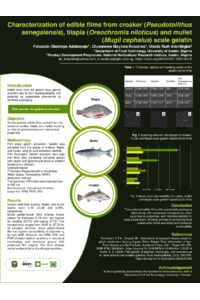
The global seafood industry generates about 60–70 million tons of fish scales as waste. This poses significant environmental and societal challenges by increasing the volume of methane emissions. The valorization of seafood waste for the generation of value-added products like gelatin, applicable in edible film formulations, offers an innovative solution to mitigating these impacts, in addition to increased economic value. Moreover, replacing synthetic edible films with natural alternatives could promote eco-friendly packaging practices amidst global efforts to reduce plastic usage. In this study, selected physical, structural, thermal and microbiological qualities of edible films produced from the scales of three commonly consumed fish species, croaker (Pseudotolithus senegalensis), tilapia (Oreochromis niloticus) and mullet (Mugil cephalus), were examined.
Edible films were produced by combining fish scale gelatin from the three fish species with starch and glycerol. Gelatin yield, film thickness, transparency, opacity, colour, water vapour permeability (WVP) and swelling power were evaluated using standard procedures. The gelatin-starch films were further assessed by SEM, DSC and FTIR for morphological, thermal and structural properties.
The gelatin yield from croaker, tilapia and mullet fish scales was 9.1, 20.38 and 8.19%, respectively. Mullet gelatin-based films showed the lowest values for thickness (0.10 mm) but the highest for swelling (207%) and opacity (5.73). Film transparency ranged from 10.87 to 27.00 for all samples, whereas tilapia gelatin-based film had the highest hydrophilicity, as depicted by its high WVP. However, the SEM, DSC and FTIR showed distinct variations in structural morphology and functional groups with preserved film integrity. The films showed varied antibacterial and antifungal activities.
The produced edible films offer sustainable packaging alternatives, with acceptable transparency, water vapour barrier properties, and microbial stability for food preservation, showing promise in enhancing food preservation while promoting environmental sustainability.
Keywords
fish scale gelatin
edible films
sustainable packaging
Poster
sciforum-103818.pdf
ELEMENTAL IMPURITIES IN SOY ISOFLAVONE FOOD SUPPLEMENTS
Refining Bromelain Extraction: Procedures and Precipitant Effects on Enzyme Activity Recovered from Pineapple Peel