Event submissions
Published
This submission belongs to the session S3. Sustainable Food Security and Food System of the event The 5th International Electronic Conference on Foods
Published date
28 Oct, 2024
Academic Editor
'%3e%3cpath%20d='M12.6657%2010.9104C12.4185%2010.325%2012.0599%209.79327%2011.6097%209.34482C11.1609%208.89508%2010.6293%208.5365%2010.0442%208.28888C10.0389%208.28626%2010.0337%208.28495%2010.0285%208.28233C10.8446%207.69279%2011.3752%206.73249%2011.3752%205.64904C11.3752%203.8542%209.92103%202.39999%208.1262%202.39999C6.33136%202.39999%204.87715%203.8542%204.87715%205.64904C4.87715%206.73249%205.40774%207.69279%206.22393%208.28364C6.21869%208.28626%206.21345%208.28757%206.20821%208.29019C5.62129%208.5378%205.09463%208.89284%204.64265%209.34613C4.1929%209.79493%203.83432%2010.3266%203.58671%2010.9117C3.34345%2011.4845%203.21226%2012.0987%203.20023%2012.7209C3.19988%2012.7349%203.20233%2012.7488%203.20744%2012.7619C3.21255%2012.7749%203.22022%2012.7867%203.22998%2012.7968C3.23975%2012.8068%203.25142%2012.8147%203.26431%2012.8202C3.2772%2012.8256%203.29105%2012.8284%203.30504%2012.8284H4.09109C4.14874%2012.8284%204.19459%2012.7825%204.1959%2012.7262C4.2221%2011.7148%204.62823%2010.7676%205.34617%2010.0497C6.08899%209.30683%207.0755%208.89808%208.1262%208.89808C9.17689%208.89808%2010.1634%209.30683%2010.9062%2010.0497C11.6242%2010.7676%2012.0303%2011.7148%2012.0565%2012.7262C12.0578%2012.7838%2012.1037%2012.8284%2012.1613%2012.8284H12.9474C12.9613%2012.8284%2012.9752%2012.8256%2012.9881%2012.8202C13.001%2012.8147%2013.0126%2012.8068%2013.0224%2012.7968C13.0322%2012.7867%2013.0398%2012.7749%2013.0449%2012.7619C13.0501%2012.7488%2013.0525%2012.7349%2013.0522%2012.7209C13.0391%2012.0947%2012.9094%2011.4855%2012.6657%2010.9104ZM8.1262%207.9024C7.52486%207.9024%206.9589%207.6679%206.53312%207.24211C6.10733%206.81633%205.87283%206.25037%205.87283%205.64904C5.87283%205.0477%206.10733%204.48174%206.53312%204.05596C6.9589%203.63018%207.52486%203.39567%208.1262%203.39567C8.72753%203.39567%209.29349%203.63018%209.71927%204.05596C10.1451%204.48174%2010.3796%205.0477%2010.3796%205.64904C10.3796%206.25037%2010.1451%206.81633%209.71927%207.24211C9.29349%207.6679%208.72753%207.9024%208.1262%207.9024Z'%20fill='%235D1EE1'/%3e%3c/g%3e%3c/svg%3e) Theodoros Varzakas
Theodoros VarzakasCitation
Jorge Carlos García-Saavedra, Pablo Letón, Juan José González-Campos, Francisco Román Collado, Lucía Cava, Almudena Lázaro, Daniel Martínez-Maqueda, Circular gastronomy applied to green asparagus by-products: Development, characterization and evaluation by consumers of derived pasta formulations., in Proceedings of The 5th International Electronic Conference on Foods, 28 October–30 October 2024, MDPI: Basel, Switzerland
Share
Email
Facebook
Twitter
LinkedIn
Circular gastronomy applied to green asparagus by-products: Development, characterization and evaluation by consumers of derived pasta formulations.
'%3e%3cpath%20d='M12.6647%2010.9104C12.4176%2010.325%2012.0589%209.7933%2011.6088%209.34485C11.16%208.89511%2010.6283%208.53653%2010.0432%208.28891C10.038%208.28629%2010.0327%208.28498%2010.0275%208.28236C10.8437%207.69282%2011.3743%206.73252%2011.3743%205.64907C11.3743%203.85423%209.92005%202.40002%208.12522%202.40002C6.33038%202.40002%204.87618%203.85423%204.87618%205.64907C4.87618%206.73252%205.40677%207.69282%206.22296%208.28367C6.21772%208.28629%206.21248%208.2876%206.20724%208.29022C5.62031%208.53783%205.09365%208.89287%204.64167%209.34616C4.19192%209.79496%203.83334%2010.3266%203.58573%2010.9117C3.34247%2011.4846%203.21128%2012.0987%203.19925%2012.721C3.1989%2012.735%203.20135%2012.7489%203.20646%2012.7619C3.21157%2012.7749%203.21924%2012.7868%203.22901%2012.7968C3.23877%2012.8068%203.25045%2012.8148%203.26334%2012.8202C3.27623%2012.8256%203.29007%2012.8284%203.30406%2012.8284H4.09012C4.14776%2012.8284%204.19362%2012.7825%204.19493%2012.7262C4.22113%2011.7148%204.62726%2010.7676%205.34519%2010.0497C6.08802%209.30686%207.07452%208.89811%208.12522%208.89811C9.17592%208.89811%2010.1624%209.30686%2010.9052%2010.0497C11.6232%2010.7676%2012.0293%2011.7148%2012.0555%2012.7262C12.0568%2012.7839%2012.1027%2012.8284%2012.1603%2012.8284H12.9464C12.9604%2012.8284%2012.9742%2012.8256%2012.9871%2012.8202C13%2012.8148%2013.0117%2012.8068%2013.0214%2012.7968C13.0312%2012.7868%2013.0389%2012.7749%2013.044%2012.7619C13.0491%2012.7489%2013.0515%2012.735%2013.0512%2012.721C13.0381%2012.0947%2012.9084%2011.4856%2012.6647%2010.9104ZM8.12522%207.90243C7.52388%207.90243%206.95792%207.66793%206.53214%207.24215C6.10636%206.81636%205.87185%206.2504%205.87185%205.64907C5.87185%205.04773%206.10636%204.48177%206.53214%204.05599C6.95792%203.63021%207.52388%203.3957%208.12522%203.3957C8.72655%203.3957%209.29252%203.63021%209.7183%204.05599C10.1441%204.48177%2010.3786%205.04773%2010.3786%205.64907C10.3786%206.2504%2010.1441%206.81636%209.7183%207.24215C9.29252%207.66793%208.72655%207.90243%208.12522%207.90243Z'%20fill='%235D1EE1'/%3e%3c/g%3e%3c/svg%3e)
Jorge Carlos García-Saavedra 1
Pablo Letón 1
Juan José González-Campos 1
Francisco Román Collado 1
Lucía Cava 1
Almudena Lázaro 1
Daniel Martínez-Maqueda 1
1. Gastronomic Innovation Center, Madrid Institute of Rural, Agricultural and Food Research and Development (IMIDRA), Community of Madrid
Abstract
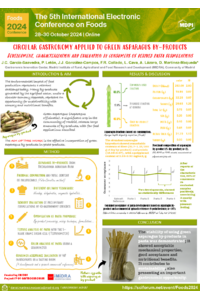
The environmental impact of food production represents a relevant challenge today. Many by-products generated by the agrifood sector, under a circular economy approach, represent an opportunity for sustainability with sensory and nutritional benefits. Green asparagus (Asparagus officinalis), a significant crop in the Community of Madrid, releases large amounts, with few food applications described. The aim of this work is the effective incorporation of green asparagus by-products in pasta products.
Asparagus by-products were collected from Fuenlabrada Agrarian Park and processed via different culinary techniques such as cutting, blending, enzymatic hydrolysis and dehydration. Proximal composition and total polyphenols were determined (via the Folin–Ciocalteu method). Preliminary pasta formulations underwent sensory evaluation under the supervision of 43 gastronomy students. After the optimization of pasta proposals, hardness and color were evaluated with a Kramer probe using a TA.XTPlus texturometer and a CR-400 Konica colorimeter, respectively. The acceptance of four final developments and a spinach commercial reference was evaluated by 107 consumers in a tasting room.
The proportion of green asparagus by-products was about 42% at the source. Lyophilization and dehydration at 40ºC were the most appropriate techniques. The composition showed remarkable contents of fiber (31.7±1.13/100 g of dry by-product) and protein (15.95±0.07), with a polyphenol content of 3.55±0.30 mgGAE/g. Sensory results of preliminary pasta urged us to prioritize moderate flavors (<30g/100g semolina) and improve color and texture. For optimized developments, a global acceptance of 5.75-6.15 (hedonic scale 1-9 points) was observed, two of them being without statistically significant differences compared to the commercial reference. After reports of the characteristics, 85% of consumers re-evaluated samples positively, with 53.3% of the total prioritizing nutritional advantages. Most of the consumers associated developments with pleasant feelings, while only 5.6% would pay less.
The viability of using green asparagus by-products in pasta was demonstrated; it showed acceptable mechanical properties, good acceptance and nutritional benefits. It contributes to sustainability, also presenting an important gastronomic opportunity.
Keywords
Sustainability
Green Asparagus
By-products
Food Pasta
Sensory Analysis
Poster
2024, García-Saavedra et al.pdf
Mushrooms: a fortifying agent for wheat bread
A Comparation Analysis of Cold Brew Coffee's Aroma Using the GC-O-MS Technique: SPE and HS-SPME Methods for the Extraction of Sensory-Active Compounds