Event submissions
Published
This submission belongs to the session S5. Chemistry and Physicochemical Properties of Foods of the event The 5th International Electronic Conference on Foods
Published date
28 Oct, 2024
Academic Editor
'%3e%3cpath%20d='M12.6657%2010.9104C12.4185%2010.325%2012.0599%209.79327%2011.6097%209.34482C11.1609%208.89508%2010.6293%208.5365%2010.0442%208.28888C10.0389%208.28626%2010.0337%208.28495%2010.0285%208.28233C10.8446%207.69279%2011.3752%206.73249%2011.3752%205.64904C11.3752%203.8542%209.92103%202.39999%208.1262%202.39999C6.33136%202.39999%204.87715%203.8542%204.87715%205.64904C4.87715%206.73249%205.40774%207.69279%206.22393%208.28364C6.21869%208.28626%206.21345%208.28757%206.20821%208.29019C5.62129%208.5378%205.09463%208.89284%204.64265%209.34613C4.1929%209.79493%203.83432%2010.3266%203.58671%2010.9117C3.34345%2011.4845%203.21226%2012.0987%203.20023%2012.7209C3.19988%2012.7349%203.20233%2012.7488%203.20744%2012.7619C3.21255%2012.7749%203.22022%2012.7867%203.22998%2012.7968C3.23975%2012.8068%203.25142%2012.8147%203.26431%2012.8202C3.2772%2012.8256%203.29105%2012.8284%203.30504%2012.8284H4.09109C4.14874%2012.8284%204.19459%2012.7825%204.1959%2012.7262C4.2221%2011.7148%204.62823%2010.7676%205.34617%2010.0497C6.08899%209.30683%207.0755%208.89808%208.1262%208.89808C9.17689%208.89808%2010.1634%209.30683%2010.9062%2010.0497C11.6242%2010.7676%2012.0303%2011.7148%2012.0565%2012.7262C12.0578%2012.7838%2012.1037%2012.8284%2012.1613%2012.8284H12.9474C12.9613%2012.8284%2012.9752%2012.8256%2012.9881%2012.8202C13.001%2012.8147%2013.0126%2012.8068%2013.0224%2012.7968C13.0322%2012.7867%2013.0398%2012.7749%2013.0449%2012.7619C13.0501%2012.7488%2013.0525%2012.7349%2013.0522%2012.7209C13.0391%2012.0947%2012.9094%2011.4855%2012.6657%2010.9104ZM8.1262%207.9024C7.52486%207.9024%206.9589%207.6679%206.53312%207.24211C6.10733%206.81633%205.87283%206.25037%205.87283%205.64904C5.87283%205.0477%206.10733%204.48174%206.53312%204.05596C6.9589%203.63018%207.52486%203.39567%208.1262%203.39567C8.72753%203.39567%209.29349%203.63018%209.71927%204.05596C10.1451%204.48174%2010.3796%205.0477%2010.3796%205.64904C10.3796%206.25037%2010.1451%206.81633%209.71927%207.24211C9.29349%207.6679%208.72753%207.9024%208.1262%207.9024Z'%20fill='%235D1EE1'/%3e%3c/g%3e%3c/svg%3e) Maurice O'Sullivan
Maurice O'SullivanCitation
Esteban Narváez, Esteban Zapata, Juan David Dereix, Carlos Lopez, Sandra Torijano-Gutierrez, Julián Zapata, A Comparation Analysis of Cold Brew Coffee's Aroma Using the GC-O-MS Technique: SPE and HS-SPME Methods for the Extraction of Sensory-Active Compounds, in Proceedings of The 5th International Electronic Conference on Foods, 28 October–30 October 2024, MDPI: Basel, Switzerland
Share
Email
Facebook
Twitter
LinkedIn
A Comparation Analysis of Cold Brew Coffee's Aroma Using the GC-O-MS Technique: SPE and HS-SPME Methods for the Extraction of Sensory-Active Compounds
'%3e%3cpath%20d='M12.6647%2010.9104C12.4176%2010.325%2012.0589%209.7933%2011.6088%209.34485C11.16%208.89511%2010.6283%208.53653%2010.0432%208.28891C10.038%208.28629%2010.0327%208.28498%2010.0275%208.28236C10.8437%207.69282%2011.3743%206.73252%2011.3743%205.64907C11.3743%203.85423%209.92005%202.40002%208.12522%202.40002C6.33038%202.40002%204.87618%203.85423%204.87618%205.64907C4.87618%206.73252%205.40677%207.69282%206.22296%208.28367C6.21772%208.28629%206.21248%208.2876%206.20724%208.29022C5.62031%208.53783%205.09365%208.89287%204.64167%209.34616C4.19192%209.79496%203.83334%2010.3266%203.58573%2010.9117C3.34247%2011.4846%203.21128%2012.0987%203.19925%2012.721C3.1989%2012.735%203.20135%2012.7489%203.20646%2012.7619C3.21157%2012.7749%203.21924%2012.7868%203.22901%2012.7968C3.23877%2012.8068%203.25045%2012.8148%203.26334%2012.8202C3.27623%2012.8256%203.29007%2012.8284%203.30406%2012.8284H4.09012C4.14776%2012.8284%204.19362%2012.7825%204.19493%2012.7262C4.22113%2011.7148%204.62726%2010.7676%205.34519%2010.0497C6.08802%209.30686%207.07452%208.89811%208.12522%208.89811C9.17592%208.89811%2010.1624%209.30686%2010.9052%2010.0497C11.6232%2010.7676%2012.0293%2011.7148%2012.0555%2012.7262C12.0568%2012.7839%2012.1027%2012.8284%2012.1603%2012.8284H12.9464C12.9604%2012.8284%2012.9742%2012.8256%2012.9871%2012.8202C13%2012.8148%2013.0117%2012.8068%2013.0214%2012.7968C13.0312%2012.7868%2013.0389%2012.7749%2013.044%2012.7619C13.0491%2012.7489%2013.0515%2012.735%2013.0512%2012.721C13.0381%2012.0947%2012.9084%2011.4856%2012.6647%2010.9104ZM8.12522%207.90243C7.52388%207.90243%206.95792%207.66793%206.53214%207.24215C6.10636%206.81636%205.87185%206.2504%205.87185%205.64907C5.87185%205.04773%206.10636%204.48177%206.53214%204.05599C6.95792%203.63021%207.52388%203.3957%208.12522%203.3957C8.72655%203.3957%209.29252%203.63021%209.7183%204.05599C10.1441%204.48177%2010.3786%205.04773%2010.3786%205.64907C10.3786%206.2504%2010.1441%206.81636%209.7183%207.24215C9.29252%207.66793%208.72655%207.90243%208.12522%207.90243Z'%20fill='%235D1EE1'/%3e%3c/g%3e%3c/svg%3e)
Esteban Narváez 1
Esteban Zapata 1
Juan David Dereix 1
Carlos Lopez 1
Sandra Torijano-Gutierrez 2
Julián Zapata 1
1. Laboratory of Residue Analysis, Faculty of Exact and Natural Sciences, University of Antioquia, Calle 67 No. 53 – 108, Medellín, Colombia.
2. GIBEC Research Group. Life Sciences Faculty. University EIA, Calle 25 Sur # 42-73, Medellín, Colombia.
Abstract
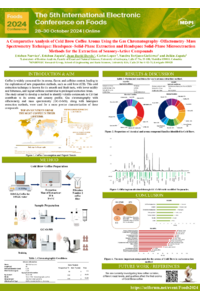
Coffee, one of the most consumed commodities globally, embodies a sensory experience deeply rooted in social, cultural, and hedonic contexts. The Cold Brew (CB) method, characterized by cold extraction, provides a refreshing alternative to traditional coffee. Despite its growing popularity, CB lacks defined preparation parameters and exhaustive analysis of its aromatic composition. In this study, we aimed to obtain a representative extract of CB's volatile matrix and characterize the aroma of its sensory-active compounds using advanced techniques, such as headspace solid-phase microextraction (HS-SPME) and headspace solid-phase extraction (HS-SPE), followed by gas chromatography–olfactometry–mass spectrometry (GC-O-MS). The aroma descriptors for each compound were determined using a sensory panel trained to perform olfactometry. In addition, the odorant impact was estimated by calculating the modified frequencies (%MF) to determine the most essential compounds that had the most significant impact on the aroma. Mass spectra, retention indices (RIs), and aroma descriptors allowed us to identify compounds with sensory activity. Optimization of the HS-SPME parameters resulted in the identification of 36 compounds, while HS-SPE identified 28 compounds, including complementary and similar compounds. In HS-SPME, 15 compounds exhibited sensory activity with descriptors such as floral, caramel, sweet, and almond, whereas 7 exhibited sensory activity with descriptors such as chocolate, floral, coffee, and caramel. This comprehensive approach to HS-SPME and HS-SPE aroma extraction with GC-O-MS provides an efficient methodology for characterizing the aroma profile of CB, paving the way for future research and quality standards for this innovative coffee beverage.
Keywords
Cold Brew (CB)
aroma
flavor
coffee
Headspace-Solid Phase Microextraction (SPME)
Headspace-solid phase extraction (HS-SPE).
Poster
Poster MDPI FOOD2024.pdf
Circular gastronomy applied to green asparagus by-products: Development, characterization and evaluation by consumers of derived pasta formulations.
Time to Cessation of breastfeeding and association factors among women of child aged 2 to 3 years in Bishoftu Town, Oromia regional state, Ethiopia, 2022.