Event submissions
Published
This submission belongs to the session S7. Novel Preservation and Packaging Technologies of the event The 5th International Electronic Conference on Foods
Published date
28 Oct, 2024
Academic Editor
'%3e%3cpath%20d='M12.6657%2010.9104C12.4185%2010.325%2012.0599%209.79327%2011.6097%209.34482C11.1609%208.89508%2010.6293%208.5365%2010.0442%208.28888C10.0389%208.28626%2010.0337%208.28495%2010.0285%208.28233C10.8446%207.69279%2011.3752%206.73249%2011.3752%205.64904C11.3752%203.8542%209.92103%202.39999%208.1262%202.39999C6.33136%202.39999%204.87715%203.8542%204.87715%205.64904C4.87715%206.73249%205.40774%207.69279%206.22393%208.28364C6.21869%208.28626%206.21345%208.28757%206.20821%208.29019C5.62129%208.5378%205.09463%208.89284%204.64265%209.34613C4.1929%209.79493%203.83432%2010.3266%203.58671%2010.9117C3.34345%2011.4845%203.21226%2012.0987%203.20023%2012.7209C3.19988%2012.7349%203.20233%2012.7488%203.20744%2012.7619C3.21255%2012.7749%203.22022%2012.7867%203.22998%2012.7968C3.23975%2012.8068%203.25142%2012.8147%203.26431%2012.8202C3.2772%2012.8256%203.29105%2012.8284%203.30504%2012.8284H4.09109C4.14874%2012.8284%204.19459%2012.7825%204.1959%2012.7262C4.2221%2011.7148%204.62823%2010.7676%205.34617%2010.0497C6.08899%209.30683%207.0755%208.89808%208.1262%208.89808C9.17689%208.89808%2010.1634%209.30683%2010.9062%2010.0497C11.6242%2010.7676%2012.0303%2011.7148%2012.0565%2012.7262C12.0578%2012.7838%2012.1037%2012.8284%2012.1613%2012.8284H12.9474C12.9613%2012.8284%2012.9752%2012.8256%2012.9881%2012.8202C13.001%2012.8147%2013.0126%2012.8068%2013.0224%2012.7968C13.0322%2012.7867%2013.0398%2012.7749%2013.0449%2012.7619C13.0501%2012.7488%2013.0525%2012.7349%2013.0522%2012.7209C13.0391%2012.0947%2012.9094%2011.4855%2012.6657%2010.9104ZM8.1262%207.9024C7.52486%207.9024%206.9589%207.6679%206.53312%207.24211C6.10733%206.81633%205.87283%206.25037%205.87283%205.64904C5.87283%205.0477%206.10733%204.48174%206.53312%204.05596C6.9589%203.63018%207.52486%203.39567%208.1262%203.39567C8.72753%203.39567%209.29349%203.63018%209.71927%204.05596C10.1451%204.48174%2010.3796%205.0477%2010.3796%205.64904C10.3796%206.25037%2010.1451%206.81633%209.71927%207.24211C9.29349%207.6679%208.72753%207.9024%208.1262%207.9024Z'%20fill='%235D1EE1'/%3e%3c/g%3e%3c/svg%3e) Saji George
Saji GeorgeCitation
AGNIESZKA RICHERT, NATALIA HEJDA, Maria Swiontek Brzezinska, Aidana Rysbek, Selected Biological Properties and Practical Importance of Polylactide Films Containing Dyes, in Proceedings of The 5th International Electronic Conference on Foods, 28 October–30 October 2024, MDPI: Basel, Switzerland
Share
Email
Facebook
Twitter
LinkedIn
Selected Biological Properties and Practical Importance of Polylactide Films Containing Dyes

AGNIESZKA RICHERT 1
'%3e%3cpath%20d='M12.6647%2010.9104C12.4176%2010.325%2012.0589%209.7933%2011.6088%209.34485C11.16%208.89511%2010.6283%208.53653%2010.0432%208.28891C10.038%208.28629%2010.0327%208.28498%2010.0275%208.28236C10.8437%207.69282%2011.3743%206.73252%2011.3743%205.64907C11.3743%203.85423%209.92005%202.40002%208.12522%202.40002C6.33038%202.40002%204.87618%203.85423%204.87618%205.64907C4.87618%206.73252%205.40677%207.69282%206.22296%208.28367C6.21772%208.28629%206.21248%208.2876%206.20724%208.29022C5.62031%208.53783%205.09365%208.89287%204.64167%209.34616C4.19192%209.79496%203.83334%2010.3266%203.58573%2010.9117C3.34247%2011.4846%203.21128%2012.0987%203.19925%2012.721C3.1989%2012.735%203.20135%2012.7489%203.20646%2012.7619C3.21157%2012.7749%203.21924%2012.7868%203.22901%2012.7968C3.23877%2012.8068%203.25045%2012.8148%203.26334%2012.8202C3.27623%2012.8256%203.29007%2012.8284%203.30406%2012.8284H4.09012C4.14776%2012.8284%204.19362%2012.7825%204.19493%2012.7262C4.22113%2011.7148%204.62726%2010.7676%205.34519%2010.0497C6.08802%209.30686%207.07452%208.89811%208.12522%208.89811C9.17592%208.89811%2010.1624%209.30686%2010.9052%2010.0497C11.6232%2010.7676%2012.0293%2011.7148%2012.0555%2012.7262C12.0568%2012.7839%2012.1027%2012.8284%2012.1603%2012.8284H12.9464C12.9604%2012.8284%2012.9742%2012.8256%2012.9871%2012.8202C13%2012.8148%2013.0117%2012.8068%2013.0214%2012.7968C13.0312%2012.7868%2013.0389%2012.7749%2013.044%2012.7619C13.0491%2012.7489%2013.0515%2012.735%2013.0512%2012.721C13.0381%2012.0947%2012.9084%2011.4856%2012.6647%2010.9104ZM8.12522%207.90243C7.52388%207.90243%206.95792%207.66793%206.53214%207.24215C6.10636%206.81636%205.87185%206.2504%205.87185%205.64907C5.87185%205.04773%206.10636%204.48177%206.53214%204.05599C6.95792%203.63021%207.52388%203.3957%208.12522%203.3957C8.72655%203.3957%209.29252%203.63021%209.7183%204.05599C10.1441%204.48177%2010.3786%205.04773%2010.3786%205.64907C10.3786%206.2504%2010.1441%206.81636%209.7183%207.24215C9.29252%207.66793%208.72655%207.90243%208.12522%207.90243Z'%20fill='%235D1EE1'/%3e%3c/g%3e%3c/svg%3e)
NATALIA HEJDA 2
Maria Swiontek Brzezinska 3
Aidana Rysbek 4,5
1. Department of Genetics, Faculty of Biology and Veterinary Science, Nicolaus Copernicus University, Gagarina 11, 87-100 Toruń, Poland
2. Nicolaus Copernicus University, Faculty of Biology and Veterinary Science, Department of Genetics, Gagarina 11, 87-100 Toruń, Poland
3. Nicolaus Copernicus University, Department of Environmental Microbiology and Biotechnology, Gagarina 11, 87-100 Toruń, Poland
4. National Center for Biotechnology, 13/5 Kurgalzhynskoye Road, Nur-Sultan 010000, Kazakhstan
5. Department of General Biology and Genomics, L.N. Gumilyov Eurasian National University, Kazhymukan 13 St., Nur-Sultan 010000, Kazakhstan
Abstract
Background and Aims
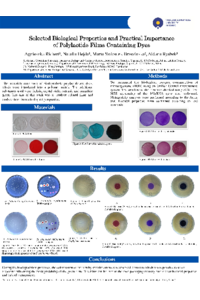
Film materials were made of biodegradable polylactide and dyes, which were introduced into a polymer matrix. The additional substances used were fuchsin, crystal violet, safranin and malachite green. The aim of this work was to produce colored films and analyze them from a biological perspective.
Methods
We measured the biological oxygen consumption of microorganisms (BOD) using an OxiTop Control measurement system. The structure of the film was checked using SEM. The NGS sequencing of the 16SrRNA gene was performed. Mutagenicity analyses were performed according to the Ames test. Biocidal properties were confirmed according to ISO standards.
Results
The most biodegradable foil turned out to be the foil made of PLA containing fuchsin, where the highest oxygen consumption results expressed in mgO2/L were recorded. In turn, the most favorable environment for biological degradation was soil. A number of bacterial strains were also isolated, which showed the greatest impact on the biodegradation of the analyzed materials. Biopreparations were prepared from them. It was also confirmed that none of the foils produced showed mutagenic properties, while their biocidal properties were confirmed.
Conclusions
During the biodegradation processes, the colonization of the film by specific strains was observed, thanks to which it was possible to select a vaccine influencing the biodegradability of the given films. The films can be used in the food packaging industry due to their biocidal properties and lack of mutagenicity.
Funding: This research was funded by the “Excellence Initiative – Research University”, BIO-degradable PACKaging materials research group (Nicolaus Copernicus University in Toruń, Poland).
Keywords
polylactide
dyes
biodegradation
packaging
Poster
Poster_Foods2024.pdf
The Effect of a natural ingredient from plum by-products for the preservation of pork burgers
A Comprehensive study including polyethylene-based food packaging and its substitutes on the European market focusing on GWP, water scarcity and fossil energy.