Event submissions
Published
This submission belongs to the session S9. Food Cultures, Policy and Consumer Science of the event The 5th International Electronic Conference on Foods
Published date
28 Oct, 2024
Academic Editor
'%3e%3cpath%20d='M12.6657%2010.9104C12.4185%2010.325%2012.0599%209.79327%2011.6097%209.34482C11.1609%208.89508%2010.6293%208.5365%2010.0442%208.28888C10.0389%208.28626%2010.0337%208.28495%2010.0285%208.28233C10.8446%207.69279%2011.3752%206.73249%2011.3752%205.64904C11.3752%203.8542%209.92103%202.39999%208.1262%202.39999C6.33136%202.39999%204.87715%203.8542%204.87715%205.64904C4.87715%206.73249%205.40774%207.69279%206.22393%208.28364C6.21869%208.28626%206.21345%208.28757%206.20821%208.29019C5.62129%208.5378%205.09463%208.89284%204.64265%209.34613C4.1929%209.79493%203.83432%2010.3266%203.58671%2010.9117C3.34345%2011.4845%203.21226%2012.0987%203.20023%2012.7209C3.19988%2012.7349%203.20233%2012.7488%203.20744%2012.7619C3.21255%2012.7749%203.22022%2012.7867%203.22998%2012.7968C3.23975%2012.8068%203.25142%2012.8147%203.26431%2012.8202C3.2772%2012.8256%203.29105%2012.8284%203.30504%2012.8284H4.09109C4.14874%2012.8284%204.19459%2012.7825%204.1959%2012.7262C4.2221%2011.7148%204.62823%2010.7676%205.34617%2010.0497C6.08899%209.30683%207.0755%208.89808%208.1262%208.89808C9.17689%208.89808%2010.1634%209.30683%2010.9062%2010.0497C11.6242%2010.7676%2012.0303%2011.7148%2012.0565%2012.7262C12.0578%2012.7838%2012.1037%2012.8284%2012.1613%2012.8284H12.9474C12.9613%2012.8284%2012.9752%2012.8256%2012.9881%2012.8202C13.001%2012.8147%2013.0126%2012.8068%2013.0224%2012.7968C13.0322%2012.7867%2013.0398%2012.7749%2013.0449%2012.7619C13.0501%2012.7488%2013.0525%2012.7349%2013.0522%2012.7209C13.0391%2012.0947%2012.9094%2011.4855%2012.6657%2010.9104ZM8.1262%207.9024C7.52486%207.9024%206.9589%207.6679%206.53312%207.24211C6.10733%206.81633%205.87283%206.25037%205.87283%205.64904C5.87283%205.0477%206.10733%204.48174%206.53312%204.05596C6.9589%203.63018%207.52486%203.39567%208.1262%203.39567C8.72753%203.39567%209.29349%203.63018%209.71927%204.05596C10.1451%204.48174%2010.3796%205.0477%2010.3796%205.64904C10.3796%206.25037%2010.1451%206.81633%209.71927%207.24211C9.29349%207.6679%208.72753%207.9024%208.1262%207.9024Z'%20fill='%235D1EE1'/%3e%3c/g%3e%3c/svg%3e) Maurice O'Sullivan
Maurice O'SullivanCitation
Mauro Lombardo, Effects of Red Wine Consumption on Cardiovascular Health: A Review of Hypertension and Lipid Profile Studies, in Proceedings of The 5th International Electronic Conference on Foods, 28 October–30 October 2024, MDPI: Basel, Switzerland
Share
Email
Facebook
Twitter
LinkedIn
Effects of Red Wine Consumption on Cardiovascular Health: A Review of Hypertension and Lipid Profile Studies

Mauro Lombardo 1
1. Department for the Promotion of Human Science and Quality of Life, San Raffaele Open University, Via di Val Cannuta, 247, 00166 Rome, Italy
Abstract
Background
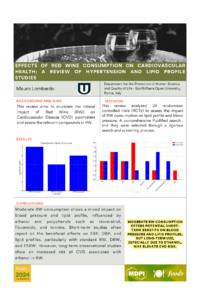
This review aims to elucidate the clinical impact of Red Wine (RW) on Cardiovascular Disease (CVD) parameters and assess the relevant compounds in RW.
Methods
This review analyzed 29 randomized controlled trials (RCTs) to assess the impact of RW consumption on lipid profile and blood pressure. A comprehensive PubMed search was performed using the following keywords: “red” AND “wine” AND “humans” AND “hypertension” AND “lipids”. The studies included were published in English on PubMed between January 1, 2000, and February 28, 2023, and they were selected through a rigorous search and screening process.
Results
The review identified 13 studies focusing on hypertension and 16 studies examining lipid parameters. For hypertension, five studies reported a reduction in systolic blood pressure (SBP), three studies reported an increase, and four studies reported a reduction in diastolic blood pressure (DBP), using RW types including standard RW, dealcoholized RW (DRW), and polyphenol-stripped RW (PSRW). Regarding lipid profiles, cholesterol efflux decreased in one study. Triglyceride (TG) levels increased in two studies and decreased in two studies. Total cholesterol (TC) levels increased in three studies and decreased in three studies. Low-density lipoprotein (LDL) levels increased in two studies and decreased in two studies. High-density lipoprotein cholesterol (HDL-C) levels increased in four studies and decreased in one study. The LDL/HDL ratio decreased in two studies. F2-isoprostane levels decreased in three studies and increased in one study. Lipid peroxidation decreased in two studies. Homocysteine (HCY) levels increased in one study.
Conclusions
Moderate RW consumption shows a mixed impact on blood pressure and lipid profile, influenced by ethanol and polyphenols such as resveratrol, flavonoids, and tannins. Short-term studies often report on the beneficial effects on SBP, DBP, and lipid profiles, particularly with standard RW, DRW, and PSRW. However, long-term observational studies show an increased risk of CVD associated with ethanol in RW.
Keywords
red wine
cardiovascular disease
lipid profile
hypertension
HDL cholesterol
LDL cholesterol
blood pressure
randomized controlled trials
cardiovascular health
moderate wine consumption
de-alcoholized wine
systolic blood pressure
Poster
Poster Effects of Red Wine Consumption on Cardiovascular Health A Review of Hypertension and Lipid Profile Studies-1.pdf
Optimization of alkaline extraction for increased protein recovery from brewer’s spent grain
Development of a whey protein hydrogel as an alternative for the microencapsulation of calyx extracts from Hibiscus sabdariffa