Event submissions
Published
This submission belongs to the session S2. Food Nutrition and Functional Foods of the event The 5th International Electronic Conference on Foods
Published date
29 Oct, 2024
Academic Editor
'%3e%3cpath%20d='M12.6657%2010.9104C12.4185%2010.325%2012.0599%209.79327%2011.6097%209.34482C11.1609%208.89508%2010.6293%208.5365%2010.0442%208.28888C10.0389%208.28626%2010.0337%208.28495%2010.0285%208.28233C10.8446%207.69279%2011.3752%206.73249%2011.3752%205.64904C11.3752%203.8542%209.92103%202.39999%208.1262%202.39999C6.33136%202.39999%204.87715%203.8542%204.87715%205.64904C4.87715%206.73249%205.40774%207.69279%206.22393%208.28364C6.21869%208.28626%206.21345%208.28757%206.20821%208.29019C5.62129%208.5378%205.09463%208.89284%204.64265%209.34613C4.1929%209.79493%203.83432%2010.3266%203.58671%2010.9117C3.34345%2011.4845%203.21226%2012.0987%203.20023%2012.7209C3.19988%2012.7349%203.20233%2012.7488%203.20744%2012.7619C3.21255%2012.7749%203.22022%2012.7867%203.22998%2012.7968C3.23975%2012.8068%203.25142%2012.8147%203.26431%2012.8202C3.2772%2012.8256%203.29105%2012.8284%203.30504%2012.8284H4.09109C4.14874%2012.8284%204.19459%2012.7825%204.1959%2012.7262C4.2221%2011.7148%204.62823%2010.7676%205.34617%2010.0497C6.08899%209.30683%207.0755%208.89808%208.1262%208.89808C9.17689%208.89808%2010.1634%209.30683%2010.9062%2010.0497C11.6242%2010.7676%2012.0303%2011.7148%2012.0565%2012.7262C12.0578%2012.7838%2012.1037%2012.8284%2012.1613%2012.8284H12.9474C12.9613%2012.8284%2012.9752%2012.8256%2012.9881%2012.8202C13.001%2012.8147%2013.0126%2012.8068%2013.0224%2012.7968C13.0322%2012.7867%2013.0398%2012.7749%2013.0449%2012.7619C13.0501%2012.7488%2013.0525%2012.7349%2013.0522%2012.7209C13.0391%2012.0947%2012.9094%2011.4855%2012.6657%2010.9104ZM8.1262%207.9024C7.52486%207.9024%206.9589%207.6679%206.53312%207.24211C6.10733%206.81633%205.87283%206.25037%205.87283%205.64904C5.87283%205.0477%206.10733%204.48174%206.53312%204.05596C6.9589%203.63018%207.52486%203.39567%208.1262%203.39567C8.72753%203.39567%209.29349%203.63018%209.71927%204.05596C10.1451%204.48174%2010.3796%205.0477%2010.3796%205.64904C10.3796%206.25037%2010.1451%206.81633%209.71927%207.24211C9.29349%207.6679%208.72753%207.9024%208.1262%207.9024Z'%20fill='%235D1EE1'/%3e%3c/g%3e%3c/svg%3e) Antonello Santini
Antonello SantiniCitation
Jorge E Angulo-López, Adriana Carolina Flores-Gallegos, Dario compagnone, Juan A. Ascacio-Valdes, Cristian Torres-León, Xochitl Ruelas, Cristobal N. Aguilar, Design of functional meat rich in antioxidant dietary fiber from avocado and mango peels, in Proceedings of The 5th International Electronic Conference on Foods, 28 October–30 October 2024, MDPI: Basel, Switzerland
Share
Email
Facebook
Twitter
LinkedIn
Design of functional meat rich in antioxidant dietary fiber from avocado and mango peels

Jorge E Angulo-López 1

Adriana Carolina Flores-Gallegos 1

Dario compagnone 2
'%3e%3cpath%20d='M12.6647%2010.9104C12.4176%2010.325%2012.0589%209.7933%2011.6088%209.34485C11.16%208.89511%2010.6283%208.53653%2010.0432%208.28891C10.038%208.28629%2010.0327%208.28498%2010.0275%208.28236C10.8437%207.69282%2011.3743%206.73252%2011.3743%205.64907C11.3743%203.85423%209.92005%202.40002%208.12522%202.40002C6.33038%202.40002%204.87618%203.85423%204.87618%205.64907C4.87618%206.73252%205.40677%207.69282%206.22296%208.28367C6.21772%208.28629%206.21248%208.2876%206.20724%208.29022C5.62031%208.53783%205.09365%208.89287%204.64167%209.34616C4.19192%209.79496%203.83334%2010.3266%203.58573%2010.9117C3.34247%2011.4846%203.21128%2012.0987%203.19925%2012.721C3.1989%2012.735%203.20135%2012.7489%203.20646%2012.7619C3.21157%2012.7749%203.21924%2012.7868%203.22901%2012.7968C3.23877%2012.8068%203.25045%2012.8148%203.26334%2012.8202C3.27623%2012.8256%203.29007%2012.8284%203.30406%2012.8284H4.09012C4.14776%2012.8284%204.19362%2012.7825%204.19493%2012.7262C4.22113%2011.7148%204.62726%2010.7676%205.34519%2010.0497C6.08802%209.30686%207.07452%208.89811%208.12522%208.89811C9.17592%208.89811%2010.1624%209.30686%2010.9052%2010.0497C11.6232%2010.7676%2012.0293%2011.7148%2012.0555%2012.7262C12.0568%2012.7839%2012.1027%2012.8284%2012.1603%2012.8284H12.9464C12.9604%2012.8284%2012.9742%2012.8256%2012.9871%2012.8202C13%2012.8148%2013.0117%2012.8068%2013.0214%2012.7968C13.0312%2012.7868%2013.0389%2012.7749%2013.044%2012.7619C13.0491%2012.7489%2013.0515%2012.735%2013.0512%2012.721C13.0381%2012.0947%2012.9084%2011.4856%2012.6647%2010.9104ZM8.12522%207.90243C7.52388%207.90243%206.95792%207.66793%206.53214%207.24215C6.10636%206.81636%205.87185%206.2504%205.87185%205.64907C5.87185%205.04773%206.10636%204.48177%206.53214%204.05599C6.95792%203.63021%207.52388%203.3957%208.12522%203.3957C8.72655%203.3957%209.29252%203.63021%209.7183%204.05599C10.1441%204.48177%2010.3786%205.04773%2010.3786%205.64907C10.3786%206.2504%2010.1441%206.81636%209.7183%207.24215C9.29252%207.66793%208.72655%207.90243%208.12522%207.90243Z'%20fill='%235D1EE1'/%3e%3c/g%3e%3c/svg%3e)
Juan A. Ascacio-Valdes 1

Cristian Torres-León 1

Xochitl Ruelas 3

Cristobal N. Aguilar 4
1. UNIVERSIDAD AUTONOMA DE COAHUILA
2. UNIVERSITY OF TERAMO
3. UNIVERSIDAD AUTONOMA AGRARIA ANTONIO NARRO
4. Food Research Department, School of Chemistry, Campus Saltillo, Autonomous University of Coahuila, Saltillo, Coahuila, 25280, Mexico
Abstract
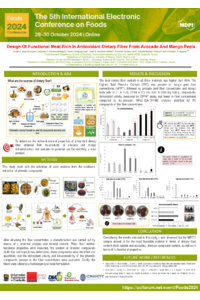
Introduction: Despite scientific and technological efforts to prevent the accumulation of several fruit wastes, such waste ispoorly re-used for valorization, having a negative impact on the environment and increasing the cost of management, representing alternative sources of bioactive compounds required for the food/pharma/cosmetical and fine chemistry industries. This work reports the use of mango and avocado peels as a potential source of antioxidant dietary fiber (DF) to design a functional meat.
Methods: Avocado and mango peels were evaluated by chemical composition, scanning electron microscopy and functional properties. The antioxidant DF was used to formulate meat for a burger, which was physicochemically (according to the following AOAC methods), microbially (yeasts, moulds, mesophilic aerobic bacteria, psychrotrophic bacteria, total coliforms, etc.) and sensorially (overall acceptability) evaluated. The water activity of the DF was determined using the Aqua Lab equipment (Decagon Devices, 3TE, USA). The evaluation of lipid oxidation was performed using the thiobarbituric acid index and quantified as free equivalents of malondialdehyde (MDA).
Results: The DF had desirable techno-functional capabilities; particularly, the water and oil holding capacities were impressive, as was the swelling water capacity. The percentage values showed a significant increase in fiber intake in patties treated with DF compared to traditional formulations. The samples complied with microbiological standards. The evaluation results of the meat samples reveal significant variation in the taste, perceived by consumers. The ratings cover a wide range of flavor categories, indicating that the choice of sample influences meat flavor perception ("Strong taste characteristic of the ingredients and spices used" and "Agreeable taste characteristic of funcitonal meat").
Conclusion: Antioxidant DF ispotentially a profitable, functional and sustainable ingredient for different applications in agroindustry. The results demonstrated that antioxidant DF improved the technofunctional and nutritional properties of meat, permitting the possibility of designing a functional popular product.
Keywords
Functional meat
avocado
mango
byproducts
Poster
Angulo et al ppt.pdf
Development of a whey protein hydrogel as an alternative for the microencapsulation of calyx extracts from Hibiscus sabdariffa
Determination through ATR-FTIR Spectroscopy of the Structural Changes in Dietary Fiber from Pacaya (Chamaedorea tepejilote Liebm) Modified by Thermal, Acid, and Alkali Treatments