Event submissions
Published
This submission belongs to the session S4. Remarkable actuator applications of the event The 2nd International Electronic Conference on Actuator Technology
Published date
30 Oct, 2024
Academic Editor
'%3e%3cpath%20d='M12.6657%2010.9104C12.4185%2010.325%2012.0599%209.79327%2011.6097%209.34482C11.1609%208.89508%2010.6293%208.5365%2010.0442%208.28888C10.0389%208.28626%2010.0337%208.28495%2010.0285%208.28233C10.8446%207.69279%2011.3752%206.73249%2011.3752%205.64904C11.3752%203.8542%209.92103%202.39999%208.1262%202.39999C6.33136%202.39999%204.87715%203.8542%204.87715%205.64904C4.87715%206.73249%205.40774%207.69279%206.22393%208.28364C6.21869%208.28626%206.21345%208.28757%206.20821%208.29019C5.62129%208.5378%205.09463%208.89284%204.64265%209.34613C4.1929%209.79493%203.83432%2010.3266%203.58671%2010.9117C3.34345%2011.4845%203.21226%2012.0987%203.20023%2012.7209C3.19988%2012.7349%203.20233%2012.7488%203.20744%2012.7619C3.21255%2012.7749%203.22022%2012.7867%203.22998%2012.7968C3.23975%2012.8068%203.25142%2012.8147%203.26431%2012.8202C3.2772%2012.8256%203.29105%2012.8284%203.30504%2012.8284H4.09109C4.14874%2012.8284%204.19459%2012.7825%204.1959%2012.7262C4.2221%2011.7148%204.62823%2010.7676%205.34617%2010.0497C6.08899%209.30683%207.0755%208.89808%208.1262%208.89808C9.17689%208.89808%2010.1634%209.30683%2010.9062%2010.0497C11.6242%2010.7676%2012.0303%2011.7148%2012.0565%2012.7262C12.0578%2012.7838%2012.1037%2012.8284%2012.1613%2012.8284H12.9474C12.9613%2012.8284%2012.9752%2012.8256%2012.9881%2012.8202C13.001%2012.8147%2013.0126%2012.8068%2013.0224%2012.7968C13.0322%2012.7867%2013.0398%2012.7749%2013.0449%2012.7619C13.0501%2012.7488%2013.0525%2012.7349%2013.0522%2012.7209C13.0391%2012.0947%2012.9094%2011.4855%2012.6657%2010.9104ZM8.1262%207.9024C7.52486%207.9024%206.9589%207.6679%206.53312%207.24211C6.10733%206.81633%205.87283%206.25037%205.87283%205.64904C5.87283%205.0477%206.10733%204.48174%206.53312%204.05596C6.9589%203.63018%207.52486%203.39567%208.1262%203.39567C8.72753%203.39567%209.29349%203.63018%209.71927%204.05596C10.1451%204.48174%2010.3796%205.0477%2010.3796%205.64904C10.3796%206.25037%2010.1451%206.81633%209.71927%207.24211C9.29349%207.6679%208.72753%207.9024%208.1262%207.9024Z'%20fill='%235D1EE1'/%3e%3c/g%3e%3c/svg%3e) Gary Bone
Gary BoneCitation
Rikimaru Okada, Shuichi WAKIMOTO, Weihang TIAN, Kohei WATANABE, Takefumi KANDA, Daisuke YAMAGUCHI, Basic Driving Characteristics of 2-DOF Soft Mechanism, in Proceedings of The 2nd International Electronic Conference on Actuator Technology, 4 November–6 November 2024, MDPI: Basel, Switzerland
Share
Email
Facebook
Twitter
LinkedIn
Basic Driving Characteristics of 2-DOF Soft Mechanism
'%3e%3cpath%20d='M12.6647%2010.9104C12.4176%2010.325%2012.0589%209.7933%2011.6088%209.34485C11.16%208.89511%2010.6283%208.53653%2010.0432%208.28891C10.038%208.28629%2010.0327%208.28498%2010.0275%208.28236C10.8437%207.69282%2011.3743%206.73252%2011.3743%205.64907C11.3743%203.85423%209.92005%202.40002%208.12522%202.40002C6.33038%202.40002%204.87618%203.85423%204.87618%205.64907C4.87618%206.73252%205.40677%207.69282%206.22296%208.28367C6.21772%208.28629%206.21248%208.2876%206.20724%208.29022C5.62031%208.53783%205.09365%208.89287%204.64167%209.34616C4.19192%209.79496%203.83334%2010.3266%203.58573%2010.9117C3.34247%2011.4846%203.21128%2012.0987%203.19925%2012.721C3.1989%2012.735%203.20135%2012.7489%203.20646%2012.7619C3.21157%2012.7749%203.21924%2012.7868%203.22901%2012.7968C3.23877%2012.8068%203.25045%2012.8148%203.26334%2012.8202C3.27623%2012.8256%203.29007%2012.8284%203.30406%2012.8284H4.09012C4.14776%2012.8284%204.19362%2012.7825%204.19493%2012.7262C4.22113%2011.7148%204.62726%2010.7676%205.34519%2010.0497C6.08802%209.30686%207.07452%208.89811%208.12522%208.89811C9.17592%208.89811%2010.1624%209.30686%2010.9052%2010.0497C11.6232%2010.7676%2012.0293%2011.7148%2012.0555%2012.7262C12.0568%2012.7839%2012.1027%2012.8284%2012.1603%2012.8284H12.9464C12.9604%2012.8284%2012.9742%2012.8256%2012.9871%2012.8202C13%2012.8148%2013.0117%2012.8068%2013.0214%2012.7968C13.0312%2012.7868%2013.0389%2012.7749%2013.044%2012.7619C13.0491%2012.7489%2013.0515%2012.735%2013.0512%2012.721C13.0381%2012.0947%2012.9084%2011.4856%2012.6647%2010.9104ZM8.12522%207.90243C7.52388%207.90243%206.95792%207.66793%206.53214%207.24215C6.10636%206.81636%205.87185%206.2504%205.87185%205.64907C5.87185%205.04773%206.10636%204.48177%206.53214%204.05599C6.95792%203.63021%207.52388%203.3957%208.12522%203.3957C8.72655%203.3957%209.29252%203.63021%209.7183%204.05599C10.1441%204.48177%2010.3786%205.04773%2010.3786%205.64907C10.3786%206.2504%2010.1441%206.81636%209.7183%207.24215C9.29252%207.66793%208.72655%207.90243%208.12522%207.90243Z'%20fill='%235D1EE1'/%3e%3c/g%3e%3c/svg%3e)
Rikimaru Okada 1
Shuichi WAKIMOTO 1
Weihang TIAN 1
Kohei WATANABE 1
Takefumi KANDA 1
Daisuke YAMAGUCHI 1
1. Degree Program in Mechanical Systems and Urban Innovation Science, Division of Environmental, Life, Natural Science and Technology, Graduate School of Environment, Life, Natural Science and Technology, Okayama University 700-8530, Japan
Abstract
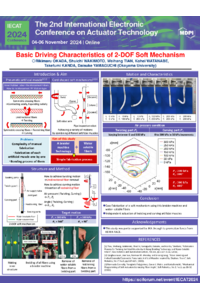
In recent years, cord-shaped soft mechanisms have been studied for medical and pipe-inspection applications due to their features such as safety and shape applicability. Some of these mechanisms use actuators based on McKibben-type artificial muscles [1][2]. The artificial muscle consists of a rubber tube and fibers forming a sleeve; half of the fibers are arranged spirally in a clockwise direction, and the other half in a counterclockwise direction. When air pressure is applied, the actuator expands and contracts in the axial direction. Additionally, by arranging a restraining material axially, a curved actuator is created, and by removing the fibers in either the clockwise or counterclockwise direction, a torsional actuator is fabricated. By combining these actuators with different motions in series, soft mechanisms with multiple degrees of freedom (DOF) can be realized. However, the manufacturing process is complex because each actuator is generally manufactured individually and then combined manually.
In this study, we propose a simple fabrication method of soft mechanisms that uses a braider machine. The braider machine has multiple bobbins with fibers set in them. Half of the bobbins rotate clockwise, and the other half rotate counterclockwise, crossing each other. In the center of the machine, the fibers are braided into a helical shape. Therefore, a McKibben-type artificial muscle is realized by setting a rubber tube in the center and driving the machine. The braider machine can also composite fibers in the axial direction, making it possible to realize a curved-type artificial muscle.
In this report, we fabricated a 2-DOF soft mechanism with combined twisting and curving motions. For realizing it, half of the fibers on bobbins are water-soluble fibers, and the other half of fibers are non-soluble fibers, and one plastic fiber is set for restricting material axially. By driving the braider, the rubber tube is covered with them. Twisting part can be realized by solving the water-soluble fibers by soaking them in water and removing the plastic fiber. On the other hand, for the curving part, no procedure needs.
The fabricated soft mechanism has a diameter of 5 mm and a total length of 105 mm, with 33.7 mm dedicated to a twisting part and 71.3 mm to a curving part. Basic experiments have shown that the developed soft mechanism enables independent movement of each part. The maximum twisting and curving angles are 350°and 100°at 300kPa of pneumatic pressure.
We realized the simple fabrication process of cord-shaped soft mechanisms by using the braider, and 2 DOF soft mechanism with twisting motion and curving motion was fabricated. We have plan to apply the mechanism to the medical endoscope in the future.
[1] Guan, Q.; Sun, J.; Liu, Y.; Wereley, N.M.; Leng, J. Novel Bending and Helical Extensile/Contractile Pneumatic Artificial Muscles Inspired by Elephant Trunk. Soft Robot. 2020, 7, 597–614.
[2] Polygerinos, P.; Wang, Z.; Galloway, K. C.; Wood, R. J.; Walsh, C. J. Soft Robotic Glove for Combined Assistance and At-Home Rehabilitation. Robot. Auton. Syst. 2015, 73, 135–143.
Acknowledgments
This study was partly supported by JKA through its promotion funds from KEIRIN RACE.
Keywords
Soft robot
McKibben artificial muscle
Soft mechanism
Poster
sciforum-100039 poster.pdf
A Multilayer Piezoelectric Thermo-Magnetic Film Generator
An electric linear actuator-based lysimeter soil retriever design: Performance optimization and performance loss measurement