Event submissions
Published
This submission belongs to the session Posters. Poster Session of the event 2nd Canadian Peptide and Protein Community Virtual Meeting
Published date
04 Nov, 2024
Academic Editor
'%3e%3cpath%20d='M12.6657%2010.9104C12.4185%2010.325%2012.0599%209.79327%2011.6097%209.34482C11.1609%208.89508%2010.6293%208.5365%2010.0442%208.28888C10.0389%208.28626%2010.0337%208.28495%2010.0285%208.28233C10.8446%207.69279%2011.3752%206.73249%2011.3752%205.64904C11.3752%203.8542%209.92103%202.39999%208.1262%202.39999C6.33136%202.39999%204.87715%203.8542%204.87715%205.64904C4.87715%206.73249%205.40774%207.69279%206.22393%208.28364C6.21869%208.28626%206.21345%208.28757%206.20821%208.29019C5.62129%208.5378%205.09463%208.89284%204.64265%209.34613C4.1929%209.79493%203.83432%2010.3266%203.58671%2010.9117C3.34345%2011.4845%203.21226%2012.0987%203.20023%2012.7209C3.19988%2012.7349%203.20233%2012.7488%203.20744%2012.7619C3.21255%2012.7749%203.22022%2012.7867%203.22998%2012.7968C3.23975%2012.8068%203.25142%2012.8147%203.26431%2012.8202C3.2772%2012.8256%203.29105%2012.8284%203.30504%2012.8284H4.09109C4.14874%2012.8284%204.19459%2012.7825%204.1959%2012.7262C4.2221%2011.7148%204.62823%2010.7676%205.34617%2010.0497C6.08899%209.30683%207.0755%208.89808%208.1262%208.89808C9.17689%208.89808%2010.1634%209.30683%2010.9062%2010.0497C11.6242%2010.7676%2012.0303%2011.7148%2012.0565%2012.7262C12.0578%2012.7838%2012.1037%2012.8284%2012.1613%2012.8284H12.9474C12.9613%2012.8284%2012.9752%2012.8256%2012.9881%2012.8202C13.001%2012.8147%2013.0126%2012.8068%2013.0224%2012.7968C13.0322%2012.7867%2013.0398%2012.7749%2013.0449%2012.7619C13.0501%2012.7488%2013.0525%2012.7349%2013.0522%2012.7209C13.0391%2012.0947%2012.9094%2011.4855%2012.6657%2010.9104ZM8.1262%207.9024C7.52486%207.9024%206.9589%207.6679%206.53312%207.24211C6.10733%206.81633%205.87283%206.25037%205.87283%205.64904C5.87283%205.0477%206.10733%204.48174%206.53312%204.05596C6.9589%203.63018%207.52486%203.39567%208.1262%203.39567C8.72753%203.39567%209.29349%203.63018%209.71927%204.05596C10.1451%204.48174%2010.3796%205.0477%2010.3796%205.64904C10.3796%206.25037%2010.1451%206.81633%209.71927%207.24211C9.29349%207.6679%208.72753%207.9024%208.1262%207.9024Z'%20fill='%235D1EE1'/%3e%3c/g%3e%3c/svg%3e) William D. Lubell
William D. LubellCitation
Rafaela Ansiliero, Leandra Oliveira Xavier Albiero, Eduarda Degani Araújo, Maria de Lourdes Borba Magalhães, Gustavo Felippe da Silva, Aniela Pinto Kempka, STUDY ON THE REDUCTION OF Β-CASOMORPHIN-7 IN A1 MILK THROUGH THE USE OF LACTIC ACID BACTERIA LACTICASEIBACILLUS CASEI AND LIMOSILACTOBACILLUS FERMENTUM, in Proceedings of 2nd Canadian Peptide and Protein Community Virtual Meeting, 16 December 2024, MDPI: Basel, Switzerland
Share
Email
Facebook
Twitter
LinkedIn
STUDY ON THE REDUCTION OF Β-CASOMORPHIN-7 IN A1 MILK THROUGH THE USE OF LACTIC ACID BACTERIA LACTICASEIBACILLUS CASEI AND LIMOSILACTOBACILLUS FERMENTUM

Rafaela Ansiliero 1
'%3e%3cpath%20d='M12.6647%2010.9104C12.4176%2010.325%2012.0589%209.7933%2011.6088%209.34485C11.16%208.89511%2010.6283%208.53653%2010.0432%208.28891C10.038%208.28629%2010.0327%208.28498%2010.0275%208.28236C10.8437%207.69282%2011.3743%206.73252%2011.3743%205.64907C11.3743%203.85423%209.92005%202.40002%208.12522%202.40002C6.33038%202.40002%204.87618%203.85423%204.87618%205.64907C4.87618%206.73252%205.40677%207.69282%206.22296%208.28367C6.21772%208.28629%206.21248%208.2876%206.20724%208.29022C5.62031%208.53783%205.09365%208.89287%204.64167%209.34616C4.19192%209.79496%203.83334%2010.3266%203.58573%2010.9117C3.34247%2011.4846%203.21128%2012.0987%203.19925%2012.721C3.1989%2012.735%203.20135%2012.7489%203.20646%2012.7619C3.21157%2012.7749%203.21924%2012.7868%203.22901%2012.7968C3.23877%2012.8068%203.25045%2012.8148%203.26334%2012.8202C3.27623%2012.8256%203.29007%2012.8284%203.30406%2012.8284H4.09012C4.14776%2012.8284%204.19362%2012.7825%204.19493%2012.7262C4.22113%2011.7148%204.62726%2010.7676%205.34519%2010.0497C6.08802%209.30686%207.07452%208.89811%208.12522%208.89811C9.17592%208.89811%2010.1624%209.30686%2010.9052%2010.0497C11.6232%2010.7676%2012.0293%2011.7148%2012.0555%2012.7262C12.0568%2012.7839%2012.1027%2012.8284%2012.1603%2012.8284H12.9464C12.9604%2012.8284%2012.9742%2012.8256%2012.9871%2012.8202C13%2012.8148%2013.0117%2012.8068%2013.0214%2012.7968C13.0312%2012.7868%2013.0389%2012.7749%2013.044%2012.7619C13.0491%2012.7489%2013.0515%2012.735%2013.0512%2012.721C13.0381%2012.0947%2012.9084%2011.4856%2012.6647%2010.9104ZM8.12522%207.90243C7.52388%207.90243%206.95792%207.66793%206.53214%207.24215C6.10636%206.81636%205.87185%206.2504%205.87185%205.64907C5.87185%205.04773%206.10636%204.48177%206.53214%204.05599C6.95792%203.63021%207.52388%203.3957%208.12522%203.3957C8.72655%203.3957%209.29252%203.63021%209.7183%204.05599C10.1441%204.48177%2010.3786%205.04773%2010.3786%205.64907C10.3786%206.2504%2010.1441%206.81636%209.7183%207.24215C9.29252%207.66793%208.72655%207.90243%208.12522%207.90243Z'%20fill='%235D1EE1'/%3e%3c/g%3e%3c/svg%3e)
Leandra Oliveira Xavier Albiero 1
Eduarda Degani Araújo 2
Maria de Lourdes Borba Magalhães 1
Gustavo Felippe da Silva 1

Aniela Pinto Kempka 2
1. Department of Animal Production and Food Science, Multicentric Graduate Program in Biochemistry and Molecular Biology, Santa Catarina State University, Lages, SC, Brazil
2. Department of Food Engineering and Chemical Engineering, Santa Catarina State University, Pinhalzinho, SC, Brazil
Abstract
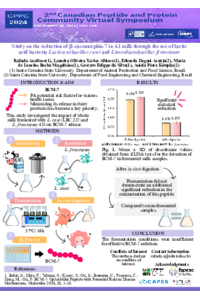
Beta-casomorphin-7 (BCM-7), released from β-casein A1 during digestion, has been identified as a potential risk factor for health issues, including chronic inflammation, gastrointestinal discomfort, and possible influences on neurological conditions. Reducing its release in dairy products has become a priority in the development of safer functional foods. This study investigated the impact of whole milk fermented with Lacticaseibacillus casei LBC 237 and Limosilactobacillus fermentum 433 on BCM-7 release. Fermentations were conducted separately at 37°C for 16 hours, followed by centrifugation and simulated digestion in the gastric and intestinal phases. ELISA tests indicated an initial absorbance of 0.196 and 0.210 in the fermented samples for L. casei and L. fermentum, respectively; these values dropped to 0.070 and 0.075 after digestion. Although in vitro digestion reduced the concentration of BCM-7 in fermented milk samples, fermentation with L. casei and L. fermentum did not demonstrate an additional significant reduction in the concentration of this peptide compared to non-fermented samples. The results suggest that fermentation conditions were insufficient for effective BCM-7 degradation. The study continues to explore the use of additional enzymes to improve BCM-7 degradation in dairy products.
Keywords
Lactic fermentation
L. casei
L. fermentum
β-casomorphin-7
Poster
Poster 2nd Canadian Peptide and Protein.pdf
Peptide Alkyl Thioester Synthesis from Advanced Thiols and Peptide Hydrazides
CONCEPTION OF COVALENTLY REVERSIBLE semi-PEPTIDIC INHIBITORS OF TMPRSS2 FOR SARS-COV-2 TREATMENT