Event submissions
Published
This submission belongs to the session Posters. Poster Session of the event 2nd Canadian Peptide and Protein Community Virtual Meeting
Published date
04 Nov, 2024
Academic Editor
'%3e%3cpath%20d='M12.6657%2010.9104C12.4185%2010.325%2012.0599%209.79327%2011.6097%209.34482C11.1609%208.89508%2010.6293%208.5365%2010.0442%208.28888C10.0389%208.28626%2010.0337%208.28495%2010.0285%208.28233C10.8446%207.69279%2011.3752%206.73249%2011.3752%205.64904C11.3752%203.8542%209.92103%202.39999%208.1262%202.39999C6.33136%202.39999%204.87715%203.8542%204.87715%205.64904C4.87715%206.73249%205.40774%207.69279%206.22393%208.28364C6.21869%208.28626%206.21345%208.28757%206.20821%208.29019C5.62129%208.5378%205.09463%208.89284%204.64265%209.34613C4.1929%209.79493%203.83432%2010.3266%203.58671%2010.9117C3.34345%2011.4845%203.21226%2012.0987%203.20023%2012.7209C3.19988%2012.7349%203.20233%2012.7488%203.20744%2012.7619C3.21255%2012.7749%203.22022%2012.7867%203.22998%2012.7968C3.23975%2012.8068%203.25142%2012.8147%203.26431%2012.8202C3.2772%2012.8256%203.29105%2012.8284%203.30504%2012.8284H4.09109C4.14874%2012.8284%204.19459%2012.7825%204.1959%2012.7262C4.2221%2011.7148%204.62823%2010.7676%205.34617%2010.0497C6.08899%209.30683%207.0755%208.89808%208.1262%208.89808C9.17689%208.89808%2010.1634%209.30683%2010.9062%2010.0497C11.6242%2010.7676%2012.0303%2011.7148%2012.0565%2012.7262C12.0578%2012.7838%2012.1037%2012.8284%2012.1613%2012.8284H12.9474C12.9613%2012.8284%2012.9752%2012.8256%2012.9881%2012.8202C13.001%2012.8147%2013.0126%2012.8068%2013.0224%2012.7968C13.0322%2012.7867%2013.0398%2012.7749%2013.0449%2012.7619C13.0501%2012.7488%2013.0525%2012.7349%2013.0522%2012.7209C13.0391%2012.0947%2012.9094%2011.4855%2012.6657%2010.9104ZM8.1262%207.9024C7.52486%207.9024%206.9589%207.6679%206.53312%207.24211C6.10733%206.81633%205.87283%206.25037%205.87283%205.64904C5.87283%205.0477%206.10733%204.48174%206.53312%204.05596C6.9589%203.63018%207.52486%203.39567%208.1262%203.39567C8.72753%203.39567%209.29349%203.63018%209.71927%204.05596C10.1451%204.48174%2010.3796%205.0477%2010.3796%205.64904C10.3796%206.25037%2010.1451%206.81633%209.71927%207.24211C9.29349%207.6679%208.72753%207.9024%208.1262%207.9024Z'%20fill='%235D1EE1'/%3e%3c/g%3e%3c/svg%3e) William D. Lubell
William D. LubellCitation
Sára Ferková, Antoine Désilets, Matthieu Lepage, Kevin Assouvie, Gabriel Lemieux, Ulrike Froehlich, Jules Vastra, Alice Gravel-Trudeau, Philippe Sarret, Richard Leduc, Pierre-Luc Boudreault, CONCEPTION OF COVALENTLY REVERSIBLE semi-PEPTIDIC INHIBITORS OF TMPRSS2 FOR SARS-COV-2 TREATMENT, in Proceedings of 2nd Canadian Peptide and Protein Community Virtual Meeting, 16 December 2024, MDPI: Basel, Switzerland
Share
Email
Facebook
Twitter
LinkedIn
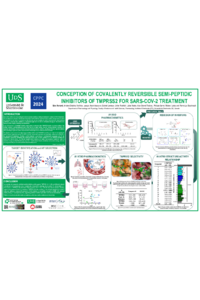
CONCEPTION OF COVALENTLY REVERSIBLE semi-PEPTIDIC INHIBITORS OF TMPRSS2 FOR SARS-COV-2 TREATMENT
'%3e%3cpath%20d='M12.6647%2010.9104C12.4176%2010.325%2012.0589%209.7933%2011.6088%209.34485C11.16%208.89511%2010.6283%208.53653%2010.0432%208.28891C10.038%208.28629%2010.0327%208.28498%2010.0275%208.28236C10.8437%207.69282%2011.3743%206.73252%2011.3743%205.64907C11.3743%203.85423%209.92005%202.40002%208.12522%202.40002C6.33038%202.40002%204.87618%203.85423%204.87618%205.64907C4.87618%206.73252%205.40677%207.69282%206.22296%208.28367C6.21772%208.28629%206.21248%208.2876%206.20724%208.29022C5.62031%208.53783%205.09365%208.89287%204.64167%209.34616C4.19192%209.79496%203.83334%2010.3266%203.58573%2010.9117C3.34247%2011.4846%203.21128%2012.0987%203.19925%2012.721C3.1989%2012.735%203.20135%2012.7489%203.20646%2012.7619C3.21157%2012.7749%203.21924%2012.7868%203.22901%2012.7968C3.23877%2012.8068%203.25045%2012.8148%203.26334%2012.8202C3.27623%2012.8256%203.29007%2012.8284%203.30406%2012.8284H4.09012C4.14776%2012.8284%204.19362%2012.7825%204.19493%2012.7262C4.22113%2011.7148%204.62726%2010.7676%205.34519%2010.0497C6.08802%209.30686%207.07452%208.89811%208.12522%208.89811C9.17592%208.89811%2010.1624%209.30686%2010.9052%2010.0497C11.6232%2010.7676%2012.0293%2011.7148%2012.0555%2012.7262C12.0568%2012.7839%2012.1027%2012.8284%2012.1603%2012.8284H12.9464C12.9604%2012.8284%2012.9742%2012.8256%2012.9871%2012.8202C13%2012.8148%2013.0117%2012.8068%2013.0214%2012.7968C13.0312%2012.7868%2013.0389%2012.7749%2013.044%2012.7619C13.0491%2012.7489%2013.0515%2012.735%2013.0512%2012.721C13.0381%2012.0947%2012.9084%2011.4856%2012.6647%2010.9104ZM8.12522%207.90243C7.52388%207.90243%206.95792%207.66793%206.53214%207.24215C6.10636%206.81636%205.87185%206.2504%205.87185%205.64907C5.87185%205.04773%206.10636%204.48177%206.53214%204.05599C6.95792%203.63021%207.52388%203.3957%208.12522%203.3957C8.72655%203.3957%209.29252%203.63021%209.7183%204.05599C10.1441%204.48177%2010.3786%205.04773%2010.3786%205.64907C10.3786%206.2504%2010.1441%206.81636%209.7183%207.24215C9.29252%207.66793%208.72655%207.90243%208.12522%207.90243Z'%20fill='%235D1EE1'/%3e%3c/g%3e%3c/svg%3e)
Sára Ferková 1
Antoine Désilets 1
Matthieu Lepage 1
Kevin Assouvie 1
Gabriel Lemieux 1
Ulrike Froehlich 1
Jules Vastra 1
Alice Gravel-Trudeau 1
Philippe Sarret 1
Richard Leduc 1
Pierre-Luc Boudreault 1
1. Université de Sherbrooke, Département de pharmacologie et de physiologie, Faculté de Médecine et des Sciences de la Santé, , 3001 12e Avenue Nord, Sherbrooke QC, J1H 5N4, Canada
Abstract
COVID-19, an infectious respiratory disease caused by Severe Acute Respiratory Syndrome Coronavirus 2 (SARS-CoV-2), has led to a global pandemic with profound public health implications and significant economic impacts worldwide. The Type-II transmembrane serine protease (TMPRSS2) has been identified as the proteolytic driver of SARS-CoV-2 activation and replication, making the dysregulation of TMPRSS2 activity a highly effective host-directed therapeutic strategy.
The previously reported TMPRSS2 inhibitor N-0385 exhibits unfavorable pharmacokinetic properties, including excessively high bioavailability (99%). To address the issue of significant systemic exposure, we designed a small library of peptidomimetic compounds with P3 site modifications by substituting proteinogenic amino acids and further evaluated their potency, in vitro efficacy, and pharmacokinetic profiles.
Exceptionally, compound 9, with Asp at the P3 position, resulted in a 2-fold increase in TMPRSS2 sub-nanomolar inhibitory potency (Ki of 13 ± 0.03 nM), while achieving >700-fold selectivity over Factor Xa and a superior selectivity profile against other proteases (matriptase, TMPRSS6, thrombin, and furin). An in vitro air-liquid interface (ALI) model of pulmonary epithelium revealed that compound 9 demonstrated a 1.5-fold decrease in permeability compared to N-0385, with sustained lung (11 h) and plasma (13 h) stability, suggesting its potential for daily prophylactic or therapeutic intranasal administration.
Keywords
SARS-CoV-2
TMPRSS2
Peptidomimetic
Covalent inhibitor,
Poster
POSTER_Square_Sara FERKOVA_2nd CPPC 2024.pdf
STUDY ON THE REDUCTION OF Β-CASOMORPHIN-7 IN A1 MILK THROUGH THE USE OF LACTIC ACID BACTERIA LACTICASEIBACILLUS CASEI AND LIMOSILACTOBACILLUS FERMENTUM
New Sulphonamide-peptide Hybrid Molecules as Potential PBP 2a Ligands and Methicillin Resistant Staphylococcus aureus Actives