Event submissions
Published
This submission belongs to the session Posters. Poster Session of the event 2nd Canadian Peptide and Protein Community Virtual Meeting
Published date
04 Nov, 2024
Academic Editor
'%3e%3cpath%20d='M12.6657%2010.9104C12.4185%2010.325%2012.0599%209.79327%2011.6097%209.34482C11.1609%208.89508%2010.6293%208.5365%2010.0442%208.28888C10.0389%208.28626%2010.0337%208.28495%2010.0285%208.28233C10.8446%207.69279%2011.3752%206.73249%2011.3752%205.64904C11.3752%203.8542%209.92103%202.39999%208.1262%202.39999C6.33136%202.39999%204.87715%203.8542%204.87715%205.64904C4.87715%206.73249%205.40774%207.69279%206.22393%208.28364C6.21869%208.28626%206.21345%208.28757%206.20821%208.29019C5.62129%208.5378%205.09463%208.89284%204.64265%209.34613C4.1929%209.79493%203.83432%2010.3266%203.58671%2010.9117C3.34345%2011.4845%203.21226%2012.0987%203.20023%2012.7209C3.19988%2012.7349%203.20233%2012.7488%203.20744%2012.7619C3.21255%2012.7749%203.22022%2012.7867%203.22998%2012.7968C3.23975%2012.8068%203.25142%2012.8147%203.26431%2012.8202C3.2772%2012.8256%203.29105%2012.8284%203.30504%2012.8284H4.09109C4.14874%2012.8284%204.19459%2012.7825%204.1959%2012.7262C4.2221%2011.7148%204.62823%2010.7676%205.34617%2010.0497C6.08899%209.30683%207.0755%208.89808%208.1262%208.89808C9.17689%208.89808%2010.1634%209.30683%2010.9062%2010.0497C11.6242%2010.7676%2012.0303%2011.7148%2012.0565%2012.7262C12.0578%2012.7838%2012.1037%2012.8284%2012.1613%2012.8284H12.9474C12.9613%2012.8284%2012.9752%2012.8256%2012.9881%2012.8202C13.001%2012.8147%2013.0126%2012.8068%2013.0224%2012.7968C13.0322%2012.7867%2013.0398%2012.7749%2013.0449%2012.7619C13.0501%2012.7488%2013.0525%2012.7349%2013.0522%2012.7209C13.0391%2012.0947%2012.9094%2011.4855%2012.6657%2010.9104ZM8.1262%207.9024C7.52486%207.9024%206.9589%207.6679%206.53312%207.24211C6.10733%206.81633%205.87283%206.25037%205.87283%205.64904C5.87283%205.0477%206.10733%204.48174%206.53312%204.05596C6.9589%203.63018%207.52486%203.39567%208.1262%203.39567C8.72753%203.39567%209.29349%203.63018%209.71927%204.05596C10.1451%204.48174%2010.3796%205.0477%2010.3796%205.64904C10.3796%206.25037%2010.1451%206.81633%209.71927%207.24211C9.29349%207.6679%208.72753%207.9024%208.1262%207.9024Z'%20fill='%235D1EE1'/%3e%3c/g%3e%3c/svg%3e) William D. Lubell
William D. LubellCitation
Fouad Damiri, Ahmed Fatimi, Mapping the innovation landscape of peptide and protein hydrogels through patent analysis, in Proceedings of 2nd Canadian Peptide and Protein Community Virtual Meeting, 16 December 2024, MDPI: Basel, Switzerland
Share
Email
Facebook
Twitter
LinkedIn
Mapping the innovation landscape of peptide and protein hydrogels through patent analysis

Fouad Damiri 1

Ahmed Fatimi 2
1. Department of Chemistry, Laboratory of Biomolecules and Organic Synthesis (BIOSYNTHO), Faculty of Sciences Ben M'Sick, University Hassan II of Casablanca, Casablanca 20000, Morocco
2. Chemical Science and Engineering Research Team (ERSIC), Department of Chemistry, Polydisciplinary Faculty of Beni Mellal (FPBM), Sultan Moulay Slimane University (USMS), Mghila, Beni Mellal 23000, Morocco
Abstract
Peptide and protein hydrogels are innovative biomaterials that have garnered significant attention in biomedical applications. Both types of these hydrogels exhibit unique biological properties that make them suitable for various applications, particularly in tissue engineering and 3D bioprinting. Despite their advantages, issues such as stability, reproducibility, and clinical translation remain significant hurdles for the development and application of such hydrogels. Patent analysis can provide valuable insights into emerging technologies, trends, and opportunities for innovation in the field of development and application of hydrogels based on peptides and proteins. By examining patent data, researchers can identify white spaces and gain inspiration for novel solutions that address evolving hydrogel challenges. In this study, a patent analysis has been carried out to highlight the distribution of patent filings and technologies involved hydrogels. A comparison of data between peptide and protein hydrogels was then realized. With 2,608 peptide hydrogel patents, this field shows rapid growth in bioengineering and regenerative medicine, with significant international interest through the PCT system. Protein hydrogels, totaling 2,326 patents, focus on traditional biomedical applications, mainly in the US. The data reveals a higher diversity in patent types and classifications for hydrogels, underscoring their dynamic and innovative trajectory in hydrogel technology.
Keywords
peptide
protein
hydrogels
biomedical applications
innovation trends
patent analysis
Poster
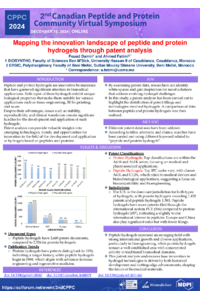
Poster_CPPC2024_Damiri.pdf
Evaluation of in vitro activity of C. neoformans isolated from hospital samples with synthetic peptides
Facilitating the access to repeat proteins by a novel water-compatible oligomerization process