Event submissions
Published
This submission belongs to the session Posters. Poster Session of the event 2nd Canadian Peptide and Protein Community Virtual Meeting
Published date
04 Nov, 2024
Academic Editor
'%3e%3cpath%20d='M12.6657%2010.9104C12.4185%2010.325%2012.0599%209.79327%2011.6097%209.34482C11.1609%208.89508%2010.6293%208.5365%2010.0442%208.28888C10.0389%208.28626%2010.0337%208.28495%2010.0285%208.28233C10.8446%207.69279%2011.3752%206.73249%2011.3752%205.64904C11.3752%203.8542%209.92103%202.39999%208.1262%202.39999C6.33136%202.39999%204.87715%203.8542%204.87715%205.64904C4.87715%206.73249%205.40774%207.69279%206.22393%208.28364C6.21869%208.28626%206.21345%208.28757%206.20821%208.29019C5.62129%208.5378%205.09463%208.89284%204.64265%209.34613C4.1929%209.79493%203.83432%2010.3266%203.58671%2010.9117C3.34345%2011.4845%203.21226%2012.0987%203.20023%2012.7209C3.19988%2012.7349%203.20233%2012.7488%203.20744%2012.7619C3.21255%2012.7749%203.22022%2012.7867%203.22998%2012.7968C3.23975%2012.8068%203.25142%2012.8147%203.26431%2012.8202C3.2772%2012.8256%203.29105%2012.8284%203.30504%2012.8284H4.09109C4.14874%2012.8284%204.19459%2012.7825%204.1959%2012.7262C4.2221%2011.7148%204.62823%2010.7676%205.34617%2010.0497C6.08899%209.30683%207.0755%208.89808%208.1262%208.89808C9.17689%208.89808%2010.1634%209.30683%2010.9062%2010.0497C11.6242%2010.7676%2012.0303%2011.7148%2012.0565%2012.7262C12.0578%2012.7838%2012.1037%2012.8284%2012.1613%2012.8284H12.9474C12.9613%2012.8284%2012.9752%2012.8256%2012.9881%2012.8202C13.001%2012.8147%2013.0126%2012.8068%2013.0224%2012.7968C13.0322%2012.7867%2013.0398%2012.7749%2013.0449%2012.7619C13.0501%2012.7488%2013.0525%2012.7349%2013.0522%2012.7209C13.0391%2012.0947%2012.9094%2011.4855%2012.6657%2010.9104ZM8.1262%207.9024C7.52486%207.9024%206.9589%207.6679%206.53312%207.24211C6.10733%206.81633%205.87283%206.25037%205.87283%205.64904C5.87283%205.0477%206.10733%204.48174%206.53312%204.05596C6.9589%203.63018%207.52486%203.39567%208.1262%203.39567C8.72753%203.39567%209.29349%203.63018%209.71927%204.05596C10.1451%204.48174%2010.3796%205.0477%2010.3796%205.64904C10.3796%206.25037%2010.1451%206.81633%209.71927%207.24211C9.29349%207.6679%208.72753%207.9024%208.1262%207.9024Z'%20fill='%235D1EE1'/%3e%3c/g%3e%3c/svg%3e) William D. Lubell
William D. LubellCitation
Alexis Lavallée, Ester Cassano, Marc-André Dansereau, Ulrike Froehlich, Alexandre Murza, Martyna Szpakowska, Andy Chevigné, Philippe Sarret, Pierre-Luc Boudreault, Characterization of LIH383, an Analgesic Peptide Targeting the Newly Identified Opioid Receptor ACKR3, in Proceedings of 2nd Canadian Peptide and Protein Community Virtual Meeting, 16 December 2024, MDPI: Basel, Switzerland
Share
Email
Facebook
Twitter
LinkedIn
Characterization of LIH383, an Analgesic Peptide Targeting the Newly Identified Opioid Receptor ACKR3
'%3e%3cpath%20d='M12.6647%2010.9104C12.4176%2010.325%2012.0589%209.7933%2011.6088%209.34485C11.16%208.89511%2010.6283%208.53653%2010.0432%208.28891C10.038%208.28629%2010.0327%208.28498%2010.0275%208.28236C10.8437%207.69282%2011.3743%206.73252%2011.3743%205.64907C11.3743%203.85423%209.92005%202.40002%208.12522%202.40002C6.33038%202.40002%204.87618%203.85423%204.87618%205.64907C4.87618%206.73252%205.40677%207.69282%206.22296%208.28367C6.21772%208.28629%206.21248%208.2876%206.20724%208.29022C5.62031%208.53783%205.09365%208.89287%204.64167%209.34616C4.19192%209.79496%203.83334%2010.3266%203.58573%2010.9117C3.34247%2011.4846%203.21128%2012.0987%203.19925%2012.721C3.1989%2012.735%203.20135%2012.7489%203.20646%2012.7619C3.21157%2012.7749%203.21924%2012.7868%203.22901%2012.7968C3.23877%2012.8068%203.25045%2012.8148%203.26334%2012.8202C3.27623%2012.8256%203.29007%2012.8284%203.30406%2012.8284H4.09012C4.14776%2012.8284%204.19362%2012.7825%204.19493%2012.7262C4.22113%2011.7148%204.62726%2010.7676%205.34519%2010.0497C6.08802%209.30686%207.07452%208.89811%208.12522%208.89811C9.17592%208.89811%2010.1624%209.30686%2010.9052%2010.0497C11.6232%2010.7676%2012.0293%2011.7148%2012.0555%2012.7262C12.0568%2012.7839%2012.1027%2012.8284%2012.1603%2012.8284H12.9464C12.9604%2012.8284%2012.9742%2012.8256%2012.9871%2012.8202C13%2012.8148%2013.0117%2012.8068%2013.0214%2012.7968C13.0312%2012.7868%2013.0389%2012.7749%2013.044%2012.7619C13.0491%2012.7489%2013.0515%2012.735%2013.0512%2012.721C13.0381%2012.0947%2012.9084%2011.4856%2012.6647%2010.9104ZM8.12522%207.90243C7.52388%207.90243%206.95792%207.66793%206.53214%207.24215C6.10636%206.81636%205.87185%206.2504%205.87185%205.64907C5.87185%205.04773%206.10636%204.48177%206.53214%204.05599C6.95792%203.63021%207.52388%203.3957%208.12522%203.3957C8.72655%203.3957%209.29252%203.63021%209.7183%204.05599C10.1441%204.48177%2010.3786%205.04773%2010.3786%205.64907C10.3786%206.2504%2010.1441%206.81636%209.7183%207.24215C9.29252%207.66793%208.72655%207.90243%208.12522%207.90243Z'%20fill='%235D1EE1'/%3e%3c/g%3e%3c/svg%3e)
Alexis Lavallée 1
Ester Cassano 2
Marc-André Dansereau 1
Ulrike Froehlich 1
Alexandre Murza 1
Martyna Szpakowska 2
Andy Chevigné 2
Philippe Sarret 1
Pierre-Luc Boudreault 1
1. Département de pharmacologie-physiologie, Université de Sherbrooke
2. Department of Infection and Immunity, Luxembourg Institute of Health
Abstract
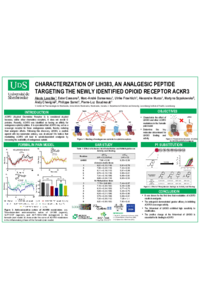
Opioids are currently the most prescribed analgesic compounds. Although they are effective against moderate to severe acute pain, they come with several side effects. Recently, ACKR3 (Atypical Chemokine Receptor 3) was identified as having an affinity for endogenous opioid peptides. It is speculated that ACKR3 may act as a scavenger receptor for endogenous opioids, thereby reducing their analgesic effects. Modulating this receptor could therefore increase the availability of opioid peptides and, consequently, enhance their effects.Following this discovery, LIH383, a peptide agonist with pM-level potency, was developed.
In this project, LIH383 showed significant analgesic effects in the formalin test, a model of tonic pain. Additionally, LIH383 analogs were synthesized to better understand the relevant binding interactions and crucial molecular determinants for activity. So far, our initial structure-activity relationship (SAR) studies have shown that the N-terminal part of LIH383 is particularly sensitive to chemical modifications. The proteolytic stability of LIH383 was also evaluated, revealing a half-life of less than two minutes in rat plasma. Specifically, the dibasic Arg-Arg motif at the C-terminus is rapidly targeted by proteases, making it a preferred target. An SAR study will therefore be conducted to increase stability and thus the therapeutic potential of these compounds.
Keywords
peptide
analgesic
opioid
chemokine receptor
ACKR3
Poster
CPPC_presentation_2024.pdf
Improved Sortase A-catalyzed transpeptidation by selective electrostatically-assisted aminolysis trapping.
Cyclic peptide-inorganic nanoparticles as co-assembled hydrogels for drug delivery