Event submissions
Published
This submission belongs to the session Posters. Poster Session of the event 2nd Canadian Peptide and Protein Community Virtual Meeting
Published date
05 Nov, 2024
Academic Editor
'%3e%3cpath%20d='M12.6657%2010.9104C12.4185%2010.325%2012.0599%209.79327%2011.6097%209.34482C11.1609%208.89508%2010.6293%208.5365%2010.0442%208.28888C10.0389%208.28626%2010.0337%208.28495%2010.0285%208.28233C10.8446%207.69279%2011.3752%206.73249%2011.3752%205.64904C11.3752%203.8542%209.92103%202.39999%208.1262%202.39999C6.33136%202.39999%204.87715%203.8542%204.87715%205.64904C4.87715%206.73249%205.40774%207.69279%206.22393%208.28364C6.21869%208.28626%206.21345%208.28757%206.20821%208.29019C5.62129%208.5378%205.09463%208.89284%204.64265%209.34613C4.1929%209.79493%203.83432%2010.3266%203.58671%2010.9117C3.34345%2011.4845%203.21226%2012.0987%203.20023%2012.7209C3.19988%2012.7349%203.20233%2012.7488%203.20744%2012.7619C3.21255%2012.7749%203.22022%2012.7867%203.22998%2012.7968C3.23975%2012.8068%203.25142%2012.8147%203.26431%2012.8202C3.2772%2012.8256%203.29105%2012.8284%203.30504%2012.8284H4.09109C4.14874%2012.8284%204.19459%2012.7825%204.1959%2012.7262C4.2221%2011.7148%204.62823%2010.7676%205.34617%2010.0497C6.08899%209.30683%207.0755%208.89808%208.1262%208.89808C9.17689%208.89808%2010.1634%209.30683%2010.9062%2010.0497C11.6242%2010.7676%2012.0303%2011.7148%2012.0565%2012.7262C12.0578%2012.7838%2012.1037%2012.8284%2012.1613%2012.8284H12.9474C12.9613%2012.8284%2012.9752%2012.8256%2012.9881%2012.8202C13.001%2012.8147%2013.0126%2012.8068%2013.0224%2012.7968C13.0322%2012.7867%2013.0398%2012.7749%2013.0449%2012.7619C13.0501%2012.7488%2013.0525%2012.7349%2013.0522%2012.7209C13.0391%2012.0947%2012.9094%2011.4855%2012.6657%2010.9104ZM8.1262%207.9024C7.52486%207.9024%206.9589%207.6679%206.53312%207.24211C6.10733%206.81633%205.87283%206.25037%205.87283%205.64904C5.87283%205.0477%206.10733%204.48174%206.53312%204.05596C6.9589%203.63018%207.52486%203.39567%208.1262%203.39567C8.72753%203.39567%209.29349%203.63018%209.71927%204.05596C10.1451%204.48174%2010.3796%205.0477%2010.3796%205.64904C10.3796%206.25037%2010.1451%206.81633%209.71927%207.24211C9.29349%207.6679%208.72753%207.9024%208.1262%207.9024Z'%20fill='%235D1EE1'/%3e%3c/g%3e%3c/svg%3e) William D. Lubell
William D. LubellCitation
Eduarda Degani de Araujo, Leandra Oliveira Xavier Albiero, Rafaela Ansiliero, Maria de Lourdes Borba Magalhães, Gustavo Felippe da Silva, Aniela Pinto Kempka, Impact of in vitro fermentation, enzymatic hydrolysis, and digestion on the degradation of B-casomorphin-7 in milk using Lacticaseibacillus casei and Limosilactobacillus fermentum, in Proceedings of 2nd Canadian Peptide and Protein Community Virtual Meeting, 16 December 2024, MDPI: Basel, Switzerland
Share
Email
Facebook
Twitter
LinkedIn
Impact of in vitro fermentation, enzymatic hydrolysis, and digestion on the degradation of B-casomorphin-7 in milk using Lacticaseibacillus casei and Limosilactobacillus fermentum
'%3e%3cpath%20d='M12.6647%2010.9104C12.4176%2010.325%2012.0589%209.7933%2011.6088%209.34485C11.16%208.89511%2010.6283%208.53653%2010.0432%208.28891C10.038%208.28629%2010.0327%208.28498%2010.0275%208.28236C10.8437%207.69282%2011.3743%206.73252%2011.3743%205.64907C11.3743%203.85423%209.92005%202.40002%208.12522%202.40002C6.33038%202.40002%204.87618%203.85423%204.87618%205.64907C4.87618%206.73252%205.40677%207.69282%206.22296%208.28367C6.21772%208.28629%206.21248%208.2876%206.20724%208.29022C5.62031%208.53783%205.09365%208.89287%204.64167%209.34616C4.19192%209.79496%203.83334%2010.3266%203.58573%2010.9117C3.34247%2011.4846%203.21128%2012.0987%203.19925%2012.721C3.1989%2012.735%203.20135%2012.7489%203.20646%2012.7619C3.21157%2012.7749%203.21924%2012.7868%203.22901%2012.7968C3.23877%2012.8068%203.25045%2012.8148%203.26334%2012.8202C3.27623%2012.8256%203.29007%2012.8284%203.30406%2012.8284H4.09012C4.14776%2012.8284%204.19362%2012.7825%204.19493%2012.7262C4.22113%2011.7148%204.62726%2010.7676%205.34519%2010.0497C6.08802%209.30686%207.07452%208.89811%208.12522%208.89811C9.17592%208.89811%2010.1624%209.30686%2010.9052%2010.0497C11.6232%2010.7676%2012.0293%2011.7148%2012.0555%2012.7262C12.0568%2012.7839%2012.1027%2012.8284%2012.1603%2012.8284H12.9464C12.9604%2012.8284%2012.9742%2012.8256%2012.9871%2012.8202C13%2012.8148%2013.0117%2012.8068%2013.0214%2012.7968C13.0312%2012.7868%2013.0389%2012.7749%2013.044%2012.7619C13.0491%2012.7489%2013.0515%2012.735%2013.0512%2012.721C13.0381%2012.0947%2012.9084%2011.4856%2012.6647%2010.9104ZM8.12522%207.90243C7.52388%207.90243%206.95792%207.66793%206.53214%207.24215C6.10636%206.81636%205.87185%206.2504%205.87185%205.64907C5.87185%205.04773%206.10636%204.48177%206.53214%204.05599C6.95792%203.63021%207.52388%203.3957%208.12522%203.3957C8.72655%203.3957%209.29252%203.63021%209.7183%204.05599C10.1441%204.48177%2010.3786%205.04773%2010.3786%205.64907C10.3786%206.2504%2010.1441%206.81636%209.7183%207.24215C9.29252%207.66793%208.72655%207.90243%208.12522%207.90243Z'%20fill='%235D1EE1'/%3e%3c/g%3e%3c/svg%3e)
Eduarda Degani de Araujo 1
Leandra Oliveira Xavier Albiero 2

Rafaela Ansiliero 2
Maria de Lourdes Borba Magalhães 2
Gustavo Felippe da Silva 2

Aniela Pinto Kempka 1
1. Santa Catarina State University. Department of Food Engineering and Chemical Engineering, Pinhalzinho, SC, Brazil.
2. Santa Catarina State University. Department of Animal Production and Food Science, Multicentric Graduate Program in Biochemistry and Molecular Biology. Lages, SC, Brazil.
Abstract
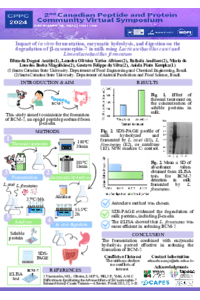
The objective of this study was to reduce the formation of β-casomorphin-7 (BCM-7), an opioid peptide derived from β-casein A1, associated with inflammation and gastrointestinal disorders. To achieve this, strategies involving thermal treatments and bacterial fermentation with Lacticaseibacillus casei and Limosilactobacillus fermentum, combined with enzymatic hydrolysis, were evaluated. The thermal treatment at β-casomorphin-7 100°C for 30 minutes increased the concentration of soluble proteins to 7.58 ± 0.07 mg/mL, while autoclaving at 105°C for 15 minutes had a lesser impact, resulting in 3.24 ± 0.05 mg/mL, this method was chosen as the standard to minimize protein degradation and prepare the milk for subsequent processes. Bacterial fermentation preserved the proteins during digestion, while the control showed a significant drop in soluble protein concentrations, from 5.32 ± 0.05 mg/mL to 0.19 ± 0.01 mg/mL. SDS-PAGE evidenced the degradation of milk proteins, including β-casein. The ELISA showed that L. fermentum was more efficient in reducing BCM-7, decreasing its concentration from 0.22 ± 0.01 to 0.08 ± 0.01. The combination of L. casei and L. fermentum did not result in any additional significant reduction. Thus, fermentation combined with enzymatic hydrolysis proved effective in reducing the formation of BCM-7.
Keywords
BCM-7
Fermentation
Enzymatic Hydrolysis.
Poster
DUDA - Poster 2nd Canadian Peptide and Protein-1.pdf
SEMI-SYNTHETIC K-RAS4B PROTEIN : A PLATFORM FOR INVESTIGATING THE BIOLOGICAL BEHAVIOR OF RAS PROTEIN
PSMA targeting agents that have been labeled with 18F-fluoride and enable radioplumbation