Event submissions
Published
This submission belongs to the session S6. Mental Health of the event The 2nd International Electronic Conference on Clinical Medicine
Published date
11 Nov, 2024
Academic Editor
'%3e%3cpath%20d='M12.6657%2010.9104C12.4185%2010.325%2012.0599%209.79327%2011.6097%209.34482C11.1609%208.89508%2010.6293%208.5365%2010.0442%208.28888C10.0389%208.28626%2010.0337%208.28495%2010.0285%208.28233C10.8446%207.69279%2011.3752%206.73249%2011.3752%205.64904C11.3752%203.8542%209.92103%202.39999%208.1262%202.39999C6.33136%202.39999%204.87715%203.8542%204.87715%205.64904C4.87715%206.73249%205.40774%207.69279%206.22393%208.28364C6.21869%208.28626%206.21345%208.28757%206.20821%208.29019C5.62129%208.5378%205.09463%208.89284%204.64265%209.34613C4.1929%209.79493%203.83432%2010.3266%203.58671%2010.9117C3.34345%2011.4845%203.21226%2012.0987%203.20023%2012.7209C3.19988%2012.7349%203.20233%2012.7488%203.20744%2012.7619C3.21255%2012.7749%203.22022%2012.7867%203.22998%2012.7968C3.23975%2012.8068%203.25142%2012.8147%203.26431%2012.8202C3.2772%2012.8256%203.29105%2012.8284%203.30504%2012.8284H4.09109C4.14874%2012.8284%204.19459%2012.7825%204.1959%2012.7262C4.2221%2011.7148%204.62823%2010.7676%205.34617%2010.0497C6.08899%209.30683%207.0755%208.89808%208.1262%208.89808C9.17689%208.89808%2010.1634%209.30683%2010.9062%2010.0497C11.6242%2010.7676%2012.0303%2011.7148%2012.0565%2012.7262C12.0578%2012.7838%2012.1037%2012.8284%2012.1613%2012.8284H12.9474C12.9613%2012.8284%2012.9752%2012.8256%2012.9881%2012.8202C13.001%2012.8147%2013.0126%2012.8068%2013.0224%2012.7968C13.0322%2012.7867%2013.0398%2012.7749%2013.0449%2012.7619C13.0501%2012.7488%2013.0525%2012.7349%2013.0522%2012.7209C13.0391%2012.0947%2012.9094%2011.4855%2012.6657%2010.9104ZM8.1262%207.9024C7.52486%207.9024%206.9589%207.6679%206.53312%207.24211C6.10733%206.81633%205.87283%206.25037%205.87283%205.64904C5.87283%205.0477%206.10733%204.48174%206.53312%204.05596C6.9589%203.63018%207.52486%203.39567%208.1262%203.39567C8.72753%203.39567%209.29349%203.63018%209.71927%204.05596C10.1451%204.48174%2010.3796%205.0477%2010.3796%205.64904C10.3796%206.25037%2010.1451%206.81633%209.71927%207.24211C9.29349%207.6679%208.72753%207.9024%208.1262%207.9024Z'%20fill='%235D1EE1'/%3e%3c/g%3e%3c/svg%3e) Michele Roccella
Michele RoccellaCitation
Fotini Tsoli, Ioanna Botsari, Agnes Tsianeli, Nefeli Menti, Panagiota Kountoudi, Maria Bakola, Eleni Jelastopulu, Vaios Peritogiannis, Effectiveness of Hybrid Assertive Community Treatment in Rural Greece: Improving Outcomes for Severe Mental Illness Patients, in Proceedings of The 2nd International Electronic Conference on Clinical Medicine, 13 November–15 November 2024, MDPI: Basel, Switzerland
Share
Email
Facebook
Twitter
LinkedIn
Effectiveness of Hybrid Assertive Community Treatment in Rural Greece: Improving Outcomes for Severe Mental Illness Patients
'%3e%3cpath%20d='M12.6647%2010.9104C12.4176%2010.325%2012.0589%209.7933%2011.6088%209.34485C11.16%208.89511%2010.6283%208.53653%2010.0432%208.28891C10.038%208.28629%2010.0327%208.28498%2010.0275%208.28236C10.8437%207.69282%2011.3743%206.73252%2011.3743%205.64907C11.3743%203.85423%209.92005%202.40002%208.12522%202.40002C6.33038%202.40002%204.87618%203.85423%204.87618%205.64907C4.87618%206.73252%205.40677%207.69282%206.22296%208.28367C6.21772%208.28629%206.21248%208.2876%206.20724%208.29022C5.62031%208.53783%205.09365%208.89287%204.64167%209.34616C4.19192%209.79496%203.83334%2010.3266%203.58573%2010.9117C3.34247%2011.4846%203.21128%2012.0987%203.19925%2012.721C3.1989%2012.735%203.20135%2012.7489%203.20646%2012.7619C3.21157%2012.7749%203.21924%2012.7868%203.22901%2012.7968C3.23877%2012.8068%203.25045%2012.8148%203.26334%2012.8202C3.27623%2012.8256%203.29007%2012.8284%203.30406%2012.8284H4.09012C4.14776%2012.8284%204.19362%2012.7825%204.19493%2012.7262C4.22113%2011.7148%204.62726%2010.7676%205.34519%2010.0497C6.08802%209.30686%207.07452%208.89811%208.12522%208.89811C9.17592%208.89811%2010.1624%209.30686%2010.9052%2010.0497C11.6232%2010.7676%2012.0293%2011.7148%2012.0555%2012.7262C12.0568%2012.7839%2012.1027%2012.8284%2012.1603%2012.8284H12.9464C12.9604%2012.8284%2012.9742%2012.8256%2012.9871%2012.8202C13%2012.8148%2013.0117%2012.8068%2013.0214%2012.7968C13.0312%2012.7868%2013.0389%2012.7749%2013.044%2012.7619C13.0491%2012.7489%2013.0515%2012.735%2013.0512%2012.721C13.0381%2012.0947%2012.9084%2011.4856%2012.6647%2010.9104ZM8.12522%207.90243C7.52388%207.90243%206.95792%207.66793%206.53214%207.24215C6.10636%206.81636%205.87185%206.2504%205.87185%205.64907C5.87185%205.04773%206.10636%204.48177%206.53214%204.05599C6.95792%203.63021%207.52388%203.3957%208.12522%203.3957C8.72655%203.3957%209.29252%203.63021%209.7183%204.05599C10.1441%204.48177%2010.3786%205.04773%2010.3786%205.64907C10.3786%206.2504%2010.1441%206.81636%209.7183%207.24215C9.29252%207.66793%208.72655%207.90243%208.12522%207.90243Z'%20fill='%235D1EE1'/%3e%3c/g%3e%3c/svg%3e)
Fotini Tsoli 1
Ioanna Botsari 2
Agnes Tsianeli 1
Nefeli Menti 1
Panagiota Kountoudi 1
Maria Bakola 3

Eleni Jelastopulu 3

Vaios Peritogiannis 1
1. Mobile Mental Health Unit of the Prefectures of Ioannina and Thesprotia, Society for the Promotion of Mental Health in Epirus, 45445 Ioannina, Greece
2. Early Intervention in Psychosis Unit, University Mental Health Research Institute, Athens, Greece
3. Department of Public Health, School of Medicine, University of Patras, Greece
Abstract
Introduction:
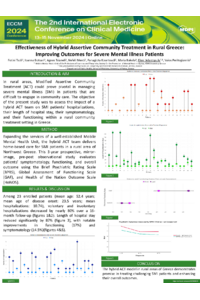
In rural areas, Modified Assertive Community Treatment (ACT) could prove pivotal in managing severe mental illness (SMI) in patients that are difficult to engage in community care. The objective of the present study was to assess the impact of a hybrid ACT team on SMI patients' hospitalizations, their length of hospital stay, their symptomatology, and their functioning within a rural community treatment setting in Greece.
Methods:
Expanding the services of a well-established Mobile Mental Health Unit, the hybrid ACT team delivers home-based care for SMI patients in a rural area of northwest Greece. This 3-year prospective, mirror-image, pre–post observational study evaluates patients' symptomatology, functioning, and overall outcome using three validated scales: the Brief Psychiatric Rating Scale (BPRS), the Global Assessment of Functioning Scale (GAF), and the Health of the Nation Outcome Scale (HοNOS).
Results:
Among the 23 enrolled patients (mean age: 52.4 years; mean age of disease onset: 23.5 years; mean hospitalizations: 10.74), voluntary and involuntary hospitalizations decreased by nearly 80% over a 16-month follow-up. Length of hospital stay was reduced significantly by 87%, with notable improvements in patients’ functioning (17%) and symptomatology (14.5%).
Conclusions:
This study highlights the efficacy of a hybrid Assertive Community Treatment model in rural Greece for patients with severe mental illness, demonstrating significant reductions in hospitalizations and length of stay and improvements in symptomatology and functioning, suggesting its potential to address the needs of difficult-to-engage SMI patients and enhance their overall outcomes.
Keywords
Assertive Community Treatment
severe mental illness
home-based care
hospitalizations
Poster
submissionID_093268_Eleni_Jelastopulu.pdf
Multidimensional Analysis Of Advanced-Stage Huntington's Disease From Neurocognitive And Psychofunctional Perspectives With Morphometric Correlations: Case Series
Aspergillosis in the course of childhood acute lymphoblastic leukaemia: an unexpected enemy