Event submissions
Published
This submission belongs to the session S2. Gastroenterology & Hepatopancreatobiliary Medicine of the event The 2nd International Electronic Conference on Clinical Medicine
Published date
11 Nov, 2024
Academic Editor
'%3e%3cpath%20d='M12.6657%2010.9104C12.4185%2010.325%2012.0599%209.79327%2011.6097%209.34482C11.1609%208.89508%2010.6293%208.5365%2010.0442%208.28888C10.0389%208.28626%2010.0337%208.28495%2010.0285%208.28233C10.8446%207.69279%2011.3752%206.73249%2011.3752%205.64904C11.3752%203.8542%209.92103%202.39999%208.1262%202.39999C6.33136%202.39999%204.87715%203.8542%204.87715%205.64904C4.87715%206.73249%205.40774%207.69279%206.22393%208.28364C6.21869%208.28626%206.21345%208.28757%206.20821%208.29019C5.62129%208.5378%205.09463%208.89284%204.64265%209.34613C4.1929%209.79493%203.83432%2010.3266%203.58671%2010.9117C3.34345%2011.4845%203.21226%2012.0987%203.20023%2012.7209C3.19988%2012.7349%203.20233%2012.7488%203.20744%2012.7619C3.21255%2012.7749%203.22022%2012.7867%203.22998%2012.7968C3.23975%2012.8068%203.25142%2012.8147%203.26431%2012.8202C3.2772%2012.8256%203.29105%2012.8284%203.30504%2012.8284H4.09109C4.14874%2012.8284%204.19459%2012.7825%204.1959%2012.7262C4.2221%2011.7148%204.62823%2010.7676%205.34617%2010.0497C6.08899%209.30683%207.0755%208.89808%208.1262%208.89808C9.17689%208.89808%2010.1634%209.30683%2010.9062%2010.0497C11.6242%2010.7676%2012.0303%2011.7148%2012.0565%2012.7262C12.0578%2012.7838%2012.1037%2012.8284%2012.1613%2012.8284H12.9474C12.9613%2012.8284%2012.9752%2012.8256%2012.9881%2012.8202C13.001%2012.8147%2013.0126%2012.8068%2013.0224%2012.7968C13.0322%2012.7867%2013.0398%2012.7749%2013.0449%2012.7619C13.0501%2012.7488%2013.0525%2012.7349%2013.0522%2012.7209C13.0391%2012.0947%2012.9094%2011.4855%2012.6657%2010.9104ZM8.1262%207.9024C7.52486%207.9024%206.9589%207.6679%206.53312%207.24211C6.10733%206.81633%205.87283%206.25037%205.87283%205.64904C5.87283%205.0477%206.10733%204.48174%206.53312%204.05596C6.9589%203.63018%207.52486%203.39567%208.1262%203.39567C8.72753%203.39567%209.29349%203.63018%209.71927%204.05596C10.1451%204.48174%2010.3796%205.0477%2010.3796%205.64904C10.3796%206.25037%2010.1451%206.81633%209.71927%207.24211C9.29349%207.6679%208.72753%207.9024%208.1262%207.9024Z'%20fill='%235D1EE1'/%3e%3c/g%3e%3c/svg%3e) Emmanuel Andrès
Emmanuel AndrèsCitation
Nahian Bari, Muhammad Hassan, Rachel Yim, Pedram Razavi, Reece Kimball, Aidan Telfer-Radzat, Lark Amoa, Early Detection of Pancreatic and Colorectal Cancers via Ultra-Sensitive Circulating Tumor DNA (ctDNA) Analysis, in Proceedings of The 2nd International Electronic Conference on Clinical Medicine, 13 November–15 November 2024, MDPI: Basel, Switzerland
Share
Email
Facebook
Twitter
LinkedIn
Early Detection of Pancreatic and Colorectal Cancers via Ultra-Sensitive Circulating Tumor DNA (ctDNA) Analysis
'%3e%3cpath%20d='M12.6647%2010.9104C12.4176%2010.325%2012.0589%209.7933%2011.6088%209.34485C11.16%208.89511%2010.6283%208.53653%2010.0432%208.28891C10.038%208.28629%2010.0327%208.28498%2010.0275%208.28236C10.8437%207.69282%2011.3743%206.73252%2011.3743%205.64907C11.3743%203.85423%209.92005%202.40002%208.12522%202.40002C6.33038%202.40002%204.87618%203.85423%204.87618%205.64907C4.87618%206.73252%205.40677%207.69282%206.22296%208.28367C6.21772%208.28629%206.21248%208.2876%206.20724%208.29022C5.62031%208.53783%205.09365%208.89287%204.64167%209.34616C4.19192%209.79496%203.83334%2010.3266%203.58573%2010.9117C3.34247%2011.4846%203.21128%2012.0987%203.19925%2012.721C3.1989%2012.735%203.20135%2012.7489%203.20646%2012.7619C3.21157%2012.7749%203.21924%2012.7868%203.22901%2012.7968C3.23877%2012.8068%203.25045%2012.8148%203.26334%2012.8202C3.27623%2012.8256%203.29007%2012.8284%203.30406%2012.8284H4.09012C4.14776%2012.8284%204.19362%2012.7825%204.19493%2012.7262C4.22113%2011.7148%204.62726%2010.7676%205.34519%2010.0497C6.08802%209.30686%207.07452%208.89811%208.12522%208.89811C9.17592%208.89811%2010.1624%209.30686%2010.9052%2010.0497C11.6232%2010.7676%2012.0293%2011.7148%2012.0555%2012.7262C12.0568%2012.7839%2012.1027%2012.8284%2012.1603%2012.8284H12.9464C12.9604%2012.8284%2012.9742%2012.8256%2012.9871%2012.8202C13%2012.8148%2013.0117%2012.8068%2013.0214%2012.7968C13.0312%2012.7868%2013.0389%2012.7749%2013.044%2012.7619C13.0491%2012.7489%2013.0515%2012.735%2013.0512%2012.721C13.0381%2012.0947%2012.9084%2011.4856%2012.6647%2010.9104ZM8.12522%207.90243C7.52388%207.90243%206.95792%207.66793%206.53214%207.24215C6.10636%206.81636%205.87185%206.2504%205.87185%205.64907C5.87185%205.04773%206.10636%204.48177%206.53214%204.05599C6.95792%203.63021%207.52388%203.3957%208.12522%203.3957C8.72655%203.3957%209.29252%203.63021%209.7183%204.05599C10.1441%204.48177%2010.3786%205.04773%2010.3786%205.64907C10.3786%206.2504%2010.1441%206.81636%209.7183%207.24215C9.29252%207.66793%208.72655%207.90243%208.12522%207.90243Z'%20fill='%235D1EE1'/%3e%3c/g%3e%3c/svg%3e)
Nahian Bari 1
Muhammad Hassan 2
Rachel Yim 1
Pedram Razavi 1
Reece Kimball 3
Aidan Telfer-Radzat 1
Lark Amoa 1
1. A.T Still University School of Osteopathic Medicine in Arizona, United States
2. Nuvance Health/Vassar Brothers Medical Center, United States
3. Medical College of Georgia, United States
Abstract
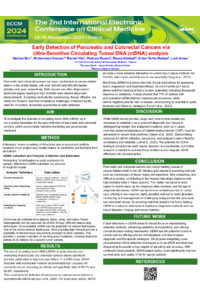
Pancreatic and colorectal cancers are often diagnosed at advanced stages, which limits therapeutic options and drastically reduces survival rates. To address this critical issue, we propose a novel, non-invasive early detection method that leverages the analysis of circulating tumor DNA (ctDNA) for identifying tumor-specific genetic mutations in plasma. ctDNA analysis offers a high-precision, dynamic approach to detecting molecular signatures of cancer at much earlier stages compared to traditional diagnostic tools such as endoscopy, imaging, or biopsy, which typically identify tumors when they are already advanced. This review analyzes current research pertaining to next-generation sequencing (NGS) and highly sensitive digital PCR to detect minimal amounts of ctDNA shed by cancer cells into the bloodstream. The novelty of this approach lies in its capacity for the continuous monitoring of ctDNA fluctuations, enabling not only early detection but also real-time assessment of tumor progression or response to therapy. This technology holds promise for significantly improving early diagnosis, particularly for high-risk populations with a genetic predisposition to these cancers. However, further research is required to enhance the sensitivity and specificity of ctDNA detection, especially in distinguishing between benign and malignant alterations, and to evaluate its effectiveness in larger, more diverse cohorts. Ultimately, ctDNA-based early detection could revolutionize cancer screening and patient management, providing a personalized, molecular-level approach to identifying and monitoring these deadly cancers.
Keywords
Circulating tumor DNA (ctDNA)
Next Generation Sequencing (NGS)
pancreatic cancer
colorectal cancer
early detection
precision medicine
Poster
105070_NahianBaripdf.pdf
Elucidating the Intricacies of Cytokine Release Syndrome (CRS) in Hematological Malignancies and the Associated Risk Factors: A National Study
Analyzing Neurological and Cardiological Signals: Original vs. Bessel Activated — Exploring Correlation and Anomalies