Event submissions
Published
This submission belongs to the session S1. Cardiology of the event The 2nd International Electronic Conference on Clinical Medicine
Published date
11 Nov, 2024
Academic Editor
'%3e%3cpath%20d='M12.6657%2010.9104C12.4185%2010.325%2012.0599%209.79327%2011.6097%209.34482C11.1609%208.89508%2010.6293%208.5365%2010.0442%208.28888C10.0389%208.28626%2010.0337%208.28495%2010.0285%208.28233C10.8446%207.69279%2011.3752%206.73249%2011.3752%205.64904C11.3752%203.8542%209.92103%202.39999%208.1262%202.39999C6.33136%202.39999%204.87715%203.8542%204.87715%205.64904C4.87715%206.73249%205.40774%207.69279%206.22393%208.28364C6.21869%208.28626%206.21345%208.28757%206.20821%208.29019C5.62129%208.5378%205.09463%208.89284%204.64265%209.34613C4.1929%209.79493%203.83432%2010.3266%203.58671%2010.9117C3.34345%2011.4845%203.21226%2012.0987%203.20023%2012.7209C3.19988%2012.7349%203.20233%2012.7488%203.20744%2012.7619C3.21255%2012.7749%203.22022%2012.7867%203.22998%2012.7968C3.23975%2012.8068%203.25142%2012.8147%203.26431%2012.8202C3.2772%2012.8256%203.29105%2012.8284%203.30504%2012.8284H4.09109C4.14874%2012.8284%204.19459%2012.7825%204.1959%2012.7262C4.2221%2011.7148%204.62823%2010.7676%205.34617%2010.0497C6.08899%209.30683%207.0755%208.89808%208.1262%208.89808C9.17689%208.89808%2010.1634%209.30683%2010.9062%2010.0497C11.6242%2010.7676%2012.0303%2011.7148%2012.0565%2012.7262C12.0578%2012.7838%2012.1037%2012.8284%2012.1613%2012.8284H12.9474C12.9613%2012.8284%2012.9752%2012.8256%2012.9881%2012.8202C13.001%2012.8147%2013.0126%2012.8068%2013.0224%2012.7968C13.0322%2012.7867%2013.0398%2012.7749%2013.0449%2012.7619C13.0501%2012.7488%2013.0525%2012.7349%2013.0522%2012.7209C13.0391%2012.0947%2012.9094%2011.4855%2012.6657%2010.9104ZM8.1262%207.9024C7.52486%207.9024%206.9589%207.6679%206.53312%207.24211C6.10733%206.81633%205.87283%206.25037%205.87283%205.64904C5.87283%205.0477%206.10733%204.48174%206.53312%204.05596C6.9589%203.63018%207.52486%203.39567%208.1262%203.39567C8.72753%203.39567%209.29349%203.63018%209.71927%204.05596C10.1451%204.48174%2010.3796%205.0477%2010.3796%205.64904C10.3796%206.25037%2010.1451%206.81633%209.71927%207.24211C9.29349%207.6679%208.72753%207.9024%208.1262%207.9024Z'%20fill='%235D1EE1'/%3e%3c/g%3e%3c/svg%3e) Emmanuel Andrès
Emmanuel AndrèsCitation
Asfa Mughal, Amaar Obaid Hassan, Rosa Moreno Lopez, Deirdre A Lane, Gregory Y H Lip, Rebecca V Harris, Corina Weir, Screening of Atrial Fibrillation in Dental Practices: a qualitative feasibility study, in Proceedings of The 2nd International Electronic Conference on Clinical Medicine, 13 November–15 November 2024, MDPI: Basel, Switzerland
Share
Email
Facebook
Twitter
LinkedIn
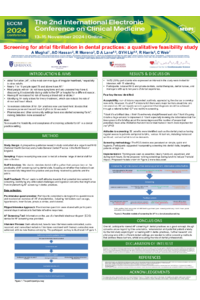
Screening of Atrial Fibrillation in Dental Practices: a qualitative feasibility study
'%3e%3cpath%20d='M12.6647%2010.9104C12.4176%2010.325%2012.0589%209.7933%2011.6088%209.34485C11.16%208.89511%2010.6283%208.53653%2010.0432%208.28891C10.038%208.28629%2010.0327%208.28498%2010.0275%208.28236C10.8437%207.69282%2011.3743%206.73252%2011.3743%205.64907C11.3743%203.85423%209.92005%202.40002%208.12522%202.40002C6.33038%202.40002%204.87618%203.85423%204.87618%205.64907C4.87618%206.73252%205.40677%207.69282%206.22296%208.28367C6.21772%208.28629%206.21248%208.2876%206.20724%208.29022C5.62031%208.53783%205.09365%208.89287%204.64167%209.34616C4.19192%209.79496%203.83334%2010.3266%203.58573%2010.9117C3.34247%2011.4846%203.21128%2012.0987%203.19925%2012.721C3.1989%2012.735%203.20135%2012.7489%203.20646%2012.7619C3.21157%2012.7749%203.21924%2012.7868%203.22901%2012.7968C3.23877%2012.8068%203.25045%2012.8148%203.26334%2012.8202C3.27623%2012.8256%203.29007%2012.8284%203.30406%2012.8284H4.09012C4.14776%2012.8284%204.19362%2012.7825%204.19493%2012.7262C4.22113%2011.7148%204.62726%2010.7676%205.34519%2010.0497C6.08802%209.30686%207.07452%208.89811%208.12522%208.89811C9.17592%208.89811%2010.1624%209.30686%2010.9052%2010.0497C11.6232%2010.7676%2012.0293%2011.7148%2012.0555%2012.7262C12.0568%2012.7839%2012.1027%2012.8284%2012.1603%2012.8284H12.9464C12.9604%2012.8284%2012.9742%2012.8256%2012.9871%2012.8202C13%2012.8148%2013.0117%2012.8068%2013.0214%2012.7968C13.0312%2012.7868%2013.0389%2012.7749%2013.044%2012.7619C13.0491%2012.7489%2013.0515%2012.735%2013.0512%2012.721C13.0381%2012.0947%2012.9084%2011.4856%2012.6647%2010.9104ZM8.12522%207.90243C7.52388%207.90243%206.95792%207.66793%206.53214%207.24215C6.10636%206.81636%205.87185%206.2504%205.87185%205.64907C5.87185%205.04773%206.10636%204.48177%206.53214%204.05599C6.95792%203.63021%207.52388%203.3957%208.12522%203.3957C8.72655%203.3957%209.29252%203.63021%209.7183%204.05599C10.1441%204.48177%2010.3786%205.04773%2010.3786%205.64907C10.3786%206.2504%2010.1441%206.81636%209.7183%207.24215C9.29252%207.66793%208.72655%207.90243%208.12522%207.90243Z'%20fill='%235D1EE1'/%3e%3c/g%3e%3c/svg%3e)
Asfa Mughal 1
Amaar Obaid Hassan 2
Rosa Moreno Lopez 3

Deirdre A Lane 4

Gregory Y H Lip 4,5
Rebecca V Harris 6
Corina Weir 7
1. General Dental Practitioner, Aesthetique Dental Care, Leeds, United Kingdom.
2. Department of Orthodontics, Liverpool University Hospitals NHS Foundation Trust, United Kingdom
3. Institute of Dentistry, University of Aberdeen, United Kingdom.
4. Liverpool Centre for Cardiovascular Science at University of Liverpool, Liverpool John Moores University and Liverpool Heart & Chest Hospital, Liverpool, United Kingdom.
5. Danish Center for Clinical Health Services Research, Department of Clinical Medicine, Aalborg University, Aalborg, Denmark.
6. Department of Public Health, Policy and Systems, Institute of Population Health, University of Liverpool, United Kingdom.
7. Institute of Applied Health Sciences, University of Aberdeen, United Kingdom.
Abstract
Introduction:
Atrial Fibrillation (AF) is an abnormal, rapid, and irregular cardiac arrhythmia.1 AF is associated with a five-fold increase in stroke risk, but anticoagulation given to eligible patients can reduce this risk by 65%.2 Dental practices are increasingly seen as an appropriate healthcare environment in which to undertake healthcare prevention.
This qualitative study aimed to explore perceptions of and barriers faced by dental staff in screening for Atrial Fibrillation using a hand-held electronic device in a primary dental care setting.
Methods:
Purposive sampling was used to recruit participants from a large mixed NHS (National Health Service) and private dental practice. Interviews were semi-structured, face-to-face, audio-recorded, and transcribed verbatim amongst dental professionals within the practice. Interviews continued until no new themes or patterns emerged from the data and thematic saturation had been achieved.
Results:
Eleven participants were interviewed. Overall, the responses were positive. Four out of seven clinicians expressed concerns about time and remuneration. They felt screening would be well received but could heighten anxiety among patients. Seven out of eleven participants stressed their preference to refer the patients to their GP (General Practitioner) for confirmation after the initial screening. Encouraging feedback regarding the simplicity of the portable screening device was given. Participants also proposed models of screening, such as using private screening booths.
Conclusions:
Overall, the AF screening was deemed to be a good concept amongst participants, but concerns were expressed about time, remuneration, and heightening anxiety among patients. A need for further research is indicated whilst evaluating the role of dental care professionals.
Keywords
Atrial fibrillation
cardiovascular disease
dentistry
general dental practice
primary dental care
qualitative
screening.
Poster
Sciforum-104942_AsfaMughal_final.pdf
Patients With Plaque Psoriasis: MTHFR Genetic Polymorphism At Can Tho Dermato-venereology Hospital
Influence of circadian rhythmicity in development and course of Substance Use Disorders, Major Depression, and their comorbidities