Event submissions
Published
This submission belongs to the session S1. Cardiology of the event The 2nd International Electronic Conference on Clinical Medicine
Published date
11 Nov, 2024
Academic Editor
'%3e%3cpath%20d='M12.6657%2010.9104C12.4185%2010.325%2012.0599%209.79327%2011.6097%209.34482C11.1609%208.89508%2010.6293%208.5365%2010.0442%208.28888C10.0389%208.28626%2010.0337%208.28495%2010.0285%208.28233C10.8446%207.69279%2011.3752%206.73249%2011.3752%205.64904C11.3752%203.8542%209.92103%202.39999%208.1262%202.39999C6.33136%202.39999%204.87715%203.8542%204.87715%205.64904C4.87715%206.73249%205.40774%207.69279%206.22393%208.28364C6.21869%208.28626%206.21345%208.28757%206.20821%208.29019C5.62129%208.5378%205.09463%208.89284%204.64265%209.34613C4.1929%209.79493%203.83432%2010.3266%203.58671%2010.9117C3.34345%2011.4845%203.21226%2012.0987%203.20023%2012.7209C3.19988%2012.7349%203.20233%2012.7488%203.20744%2012.7619C3.21255%2012.7749%203.22022%2012.7867%203.22998%2012.7968C3.23975%2012.8068%203.25142%2012.8147%203.26431%2012.8202C3.2772%2012.8256%203.29105%2012.8284%203.30504%2012.8284H4.09109C4.14874%2012.8284%204.19459%2012.7825%204.1959%2012.7262C4.2221%2011.7148%204.62823%2010.7676%205.34617%2010.0497C6.08899%209.30683%207.0755%208.89808%208.1262%208.89808C9.17689%208.89808%2010.1634%209.30683%2010.9062%2010.0497C11.6242%2010.7676%2012.0303%2011.7148%2012.0565%2012.7262C12.0578%2012.7838%2012.1037%2012.8284%2012.1613%2012.8284H12.9474C12.9613%2012.8284%2012.9752%2012.8256%2012.9881%2012.8202C13.001%2012.8147%2013.0126%2012.8068%2013.0224%2012.7968C13.0322%2012.7867%2013.0398%2012.7749%2013.0449%2012.7619C13.0501%2012.7488%2013.0525%2012.7349%2013.0522%2012.7209C13.0391%2012.0947%2012.9094%2011.4855%2012.6657%2010.9104ZM8.1262%207.9024C7.52486%207.9024%206.9589%207.6679%206.53312%207.24211C6.10733%206.81633%205.87283%206.25037%205.87283%205.64904C5.87283%205.0477%206.10733%204.48174%206.53312%204.05596C6.9589%203.63018%207.52486%203.39567%208.1262%203.39567C8.72753%203.39567%209.29349%203.63018%209.71927%204.05596C10.1451%204.48174%2010.3796%205.0477%2010.3796%205.64904C10.3796%206.25037%2010.1451%206.81633%209.71927%207.24211C9.29349%207.6679%208.72753%207.9024%208.1262%207.9024Z'%20fill='%235D1EE1'/%3e%3c/g%3e%3c/svg%3e) Emmanuel Andrès
Emmanuel AndrèsCitation
Shadab Ahamad, Prachi Kukshal, Ajay Kumar, Anagha Tulsi, Amita Sharma, Paramvir Singh, Hematological profile of congenital heart disease patients undergoing surgical correction: A case--control observational study from North India, in Proceedings of The 2nd International Electronic Conference on Clinical Medicine, 13 November–15 November 2024, MDPI: Basel, Switzerland
Share
Email
Facebook
Twitter
LinkedIn
Hematological profile of congenital heart disease patients undergoing surgical correction: A case--control observational study from North India
'%3e%3cpath%20d='M12.6647%2010.9104C12.4176%2010.325%2012.0589%209.7933%2011.6088%209.34485C11.16%208.89511%2010.6283%208.53653%2010.0432%208.28891C10.038%208.28629%2010.0327%208.28498%2010.0275%208.28236C10.8437%207.69282%2011.3743%206.73252%2011.3743%205.64907C11.3743%203.85423%209.92005%202.40002%208.12522%202.40002C6.33038%202.40002%204.87618%203.85423%204.87618%205.64907C4.87618%206.73252%205.40677%207.69282%206.22296%208.28367C6.21772%208.28629%206.21248%208.2876%206.20724%208.29022C5.62031%208.53783%205.09365%208.89287%204.64167%209.34616C4.19192%209.79496%203.83334%2010.3266%203.58573%2010.9117C3.34247%2011.4846%203.21128%2012.0987%203.19925%2012.721C3.1989%2012.735%203.20135%2012.7489%203.20646%2012.7619C3.21157%2012.7749%203.21924%2012.7868%203.22901%2012.7968C3.23877%2012.8068%203.25045%2012.8148%203.26334%2012.8202C3.27623%2012.8256%203.29007%2012.8284%203.30406%2012.8284H4.09012C4.14776%2012.8284%204.19362%2012.7825%204.19493%2012.7262C4.22113%2011.7148%204.62726%2010.7676%205.34519%2010.0497C6.08802%209.30686%207.07452%208.89811%208.12522%208.89811C9.17592%208.89811%2010.1624%209.30686%2010.9052%2010.0497C11.6232%2010.7676%2012.0293%2011.7148%2012.0555%2012.7262C12.0568%2012.7839%2012.1027%2012.8284%2012.1603%2012.8284H12.9464C12.9604%2012.8284%2012.9742%2012.8256%2012.9871%2012.8202C13%2012.8148%2013.0117%2012.8068%2013.0214%2012.7968C13.0312%2012.7868%2013.0389%2012.7749%2013.044%2012.7619C13.0491%2012.7489%2013.0515%2012.735%2013.0512%2012.721C13.0381%2012.0947%2012.9084%2011.4856%2012.6647%2010.9104ZM8.12522%207.90243C7.52388%207.90243%206.95792%207.66793%206.53214%207.24215C6.10636%206.81636%205.87185%206.2504%205.87185%205.64907C5.87185%205.04773%206.10636%204.48177%206.53214%204.05599C6.95792%203.63021%207.52388%203.3957%208.12522%203.3957C8.72655%203.3957%209.29252%203.63021%209.7183%204.05599C10.1441%204.48177%2010.3786%205.04773%2010.3786%205.64907C10.3786%206.2504%2010.1441%206.81636%209.7183%207.24215C9.29252%207.66793%208.72655%207.90243%208.12522%207.90243Z'%20fill='%235D1EE1'/%3e%3c/g%3e%3c/svg%3e)
Shadab Ahamad 1
Prachi Kukshal 1
Ajay Kumar 1
Anagha Tulsi 2
Amita Sharma 2
Paramvir Singh 2
1. Sri Sathya Sai Sanjeevani Research Foundation, Palwal, Haryana, India-121102
2. Sri Sathya Sai Sanjeevani International Centre for Child Heart Care & Research, Palwal-121102, Haryana, India
Abstract
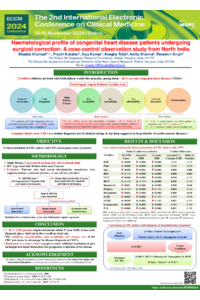
Background: Congenital heart disease (CHD) is a cardiac condition present from birth, contributing to ~28 % of all birth defects, and causing higher fetal and neonatal mortality worldwide. Complete blood count (CBC) is a routine diagnostic tool in clinical settings and has been suggested to be predictive of cardiovascular diseases and other metabolic disorders. This study investigates the correlation between CBC indices and CHD.
Methods: We analyzed pre-operative CBC data from 238 CHD patients and 50 healthy controls. Statistical analyses, including the Student’s t-test, chi-square test, and multivariate logistic regression, were employed to identify significant deviations and correlations.
Results: Our findings revealed that ~ 79% (11 out of 14) of CBC parameters differed significantly from those of healthy controls. Notably, lymphocytosis and a reduced platelet-to-lymphocyte ratio (PLR) were observed consistently across all CHD cases (p = 0.000). Cyanotic patients exhibited erythrocytosis and higher hemoglobin levels despite their tendency towards anemia (p = 0.000). Multivariate regression analysis demonstrated robust correlations: hematocrit was strongly associated with both hemoglobin (r = 0.92) and SpO2 (r = -0.76), while red blood cell (RBC) counts correlated closely with hematocrit (r = 0.88), hemoglobin (r = 0.83), and SpO2 (r = -0.78). Elevated pulse rates, platelet counts, and lymphocyte levels, coupled with lower body mass index (BMI), mean corpuscular volume (MCV), hemoglobin, and mean corpuscular hemoglobin (MCH), could facilitate early CHD diagnosis (p < 0.05). Additionally, reduced mean corpuscular hemoglobin concentration (MCHC) levels were linked to shorter ventilation times (p = 0.0004).
Conclusion: Our study underlines the significant associations between CBC indices and CHD in a North Indian cohort, highlighting the potential of CBC parameters for the early diagnosis and management of CHD. Our findings suggest that specific CBC alterations are closely linked to the severity and type of CHD, offering valuable insights for improving patient care and outcomes.
Keywords
Congenital heart disease
hematology
association
north India
Poster
Sciforum-104788_Shadab Ahamad.pdf
Early diagnostic markers of nephropathy with hypertensive disease in patients with type 2 diabetes mellitus
Integrating Artificial Intelligence in Telemedicine: Predicting Lung Cancer Disease and Decision Making