Event submissions
Published
This submission belongs to the session S6. Mental Health of the event The 2nd International Electronic Conference on Clinical Medicine
Published date
11 Nov, 2024
Academic Editor
'%3e%3cpath%20d='M12.6657%2010.9104C12.4185%2010.325%2012.0599%209.79327%2011.6097%209.34482C11.1609%208.89508%2010.6293%208.5365%2010.0442%208.28888C10.0389%208.28626%2010.0337%208.28495%2010.0285%208.28233C10.8446%207.69279%2011.3752%206.73249%2011.3752%205.64904C11.3752%203.8542%209.92103%202.39999%208.1262%202.39999C6.33136%202.39999%204.87715%203.8542%204.87715%205.64904C4.87715%206.73249%205.40774%207.69279%206.22393%208.28364C6.21869%208.28626%206.21345%208.28757%206.20821%208.29019C5.62129%208.5378%205.09463%208.89284%204.64265%209.34613C4.1929%209.79493%203.83432%2010.3266%203.58671%2010.9117C3.34345%2011.4845%203.21226%2012.0987%203.20023%2012.7209C3.19988%2012.7349%203.20233%2012.7488%203.20744%2012.7619C3.21255%2012.7749%203.22022%2012.7867%203.22998%2012.7968C3.23975%2012.8068%203.25142%2012.8147%203.26431%2012.8202C3.2772%2012.8256%203.29105%2012.8284%203.30504%2012.8284H4.09109C4.14874%2012.8284%204.19459%2012.7825%204.1959%2012.7262C4.2221%2011.7148%204.62823%2010.7676%205.34617%2010.0497C6.08899%209.30683%207.0755%208.89808%208.1262%208.89808C9.17689%208.89808%2010.1634%209.30683%2010.9062%2010.0497C11.6242%2010.7676%2012.0303%2011.7148%2012.0565%2012.7262C12.0578%2012.7838%2012.1037%2012.8284%2012.1613%2012.8284H12.9474C12.9613%2012.8284%2012.9752%2012.8256%2012.9881%2012.8202C13.001%2012.8147%2013.0126%2012.8068%2013.0224%2012.7968C13.0322%2012.7867%2013.0398%2012.7749%2013.0449%2012.7619C13.0501%2012.7488%2013.0525%2012.7349%2013.0522%2012.7209C13.0391%2012.0947%2012.9094%2011.4855%2012.6657%2010.9104ZM8.1262%207.9024C7.52486%207.9024%206.9589%207.6679%206.53312%207.24211C6.10733%206.81633%205.87283%206.25037%205.87283%205.64904C5.87283%205.0477%206.10733%204.48174%206.53312%204.05596C6.9589%203.63018%207.52486%203.39567%208.1262%203.39567C8.72753%203.39567%209.29349%203.63018%209.71927%204.05596C10.1451%204.48174%2010.3796%205.0477%2010.3796%205.64904C10.3796%206.25037%2010.1451%206.81633%209.71927%207.24211C9.29349%207.6679%208.72753%207.9024%208.1262%207.9024Z'%20fill='%235D1EE1'/%3e%3c/g%3e%3c/svg%3e) Michele Roccella
Michele RoccellaCitation
Sergio Martinez-Vazquez, JUAN MIGUEL MARTÍNEZ GALIANO, ROCIO ADRIANA PEINADO MOLINA, ANTONIO HERNÁNDEZ MARTÍNEZ, “Magnitude of suicidal ideation and perinatal suicide risk in Spanish women. What are the factors involved?”, in Proceedings of The 2nd International Electronic Conference on Clinical Medicine, 13 November–15 November 2024, MDPI: Basel, Switzerland
Share
Email
Facebook
Twitter
LinkedIn
“Magnitude of suicidal ideation and perinatal suicide risk in Spanish women. What are the factors involved?”
'%3e%3cpath%20d='M12.6647%2010.9104C12.4176%2010.325%2012.0589%209.7933%2011.6088%209.34485C11.16%208.89511%2010.6283%208.53653%2010.0432%208.28891C10.038%208.28629%2010.0327%208.28498%2010.0275%208.28236C10.8437%207.69282%2011.3743%206.73252%2011.3743%205.64907C11.3743%203.85423%209.92005%202.40002%208.12522%202.40002C6.33038%202.40002%204.87618%203.85423%204.87618%205.64907C4.87618%206.73252%205.40677%207.69282%206.22296%208.28367C6.21772%208.28629%206.21248%208.2876%206.20724%208.29022C5.62031%208.53783%205.09365%208.89287%204.64167%209.34616C4.19192%209.79496%203.83334%2010.3266%203.58573%2010.9117C3.34247%2011.4846%203.21128%2012.0987%203.19925%2012.721C3.1989%2012.735%203.20135%2012.7489%203.20646%2012.7619C3.21157%2012.7749%203.21924%2012.7868%203.22901%2012.7968C3.23877%2012.8068%203.25045%2012.8148%203.26334%2012.8202C3.27623%2012.8256%203.29007%2012.8284%203.30406%2012.8284H4.09012C4.14776%2012.8284%204.19362%2012.7825%204.19493%2012.7262C4.22113%2011.7148%204.62726%2010.7676%205.34519%2010.0497C6.08802%209.30686%207.07452%208.89811%208.12522%208.89811C9.17592%208.89811%2010.1624%209.30686%2010.9052%2010.0497C11.6232%2010.7676%2012.0293%2011.7148%2012.0555%2012.7262C12.0568%2012.7839%2012.1027%2012.8284%2012.1603%2012.8284H12.9464C12.9604%2012.8284%2012.9742%2012.8256%2012.9871%2012.8202C13%2012.8148%2013.0117%2012.8068%2013.0214%2012.7968C13.0312%2012.7868%2013.0389%2012.7749%2013.044%2012.7619C13.0491%2012.7489%2013.0515%2012.735%2013.0512%2012.721C13.0381%2012.0947%2012.9084%2011.4856%2012.6647%2010.9104ZM8.12522%207.90243C7.52388%207.90243%206.95792%207.66793%206.53214%207.24215C6.10636%206.81636%205.87185%206.2504%205.87185%205.64907C5.87185%205.04773%206.10636%204.48177%206.53214%204.05599C6.95792%203.63021%207.52388%203.3957%208.12522%203.3957C8.72655%203.3957%209.29252%203.63021%209.7183%204.05599C10.1441%204.48177%2010.3786%205.04773%2010.3786%205.64907C10.3786%206.2504%2010.1441%206.81636%209.7183%207.24215C9.29252%207.66793%208.72655%207.90243%208.12522%207.90243Z'%20fill='%235D1EE1'/%3e%3c/g%3e%3c/svg%3e)
Sergio Martinez-Vazquez 1

JUAN MIGUEL MARTÍNEZ GALIANO 1
ROCIO ADRIANA PEINADO MOLINA 1
ANTONIO HERNÁNDEZ MARTÍNEZ 2
1. University of Jaén, Spain
2. University of Castilla-La Mancha, Spain
Abstract
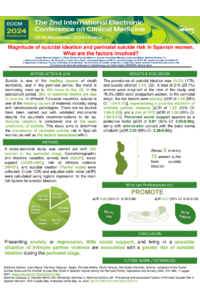
Background: Suicide is one of the leading causes of death worldwide, and in the perinatal period, this trend is increasing, even up to 100 times in the US. In the postpartum period, 36% of maternal deaths are due to suicide. In different European countries, suicide is one of the leading causes of maternal mortality, along with cardiovascular pathologies. The perinatal phase is a critical period where mental health challenges can arise. Understanding risk factors and protective elements is essential for improving maternal well-being.
Objective: To identify key risk factors associated with enhanced suicidal ideation during the perinatal period and to highlight potential protective factors.
Methods: An analysis of various psychosocial variables was conducted, yielding the following risk associations and protective factors:
Results: Risk factors:
Anxiety: Adjusted Odds Ratio (aOR) of 1.08 (95% Confidence Interval: 1.04-1.31);
Intimate partner violence during perinatal period: aOR of 1.59 (95% CI: 1.04-2.43);
Postpartum Depression (PPD): aOR of 3.00 (95% CI: 1.86-4.81);
Protective Factors:
Perceived social support during perinatal period: aOR of 0.97 (95% CI: 0.95-0.99);
Skin-to-skin contact during delivery: aOR of 0.50 (95% CI: 0.28-0.88);
Conclusion: Anxiety, depression, insufficient social support, and exposure to intimate partner violence are significantly linked to an elevated risk of suicidal thoughts in the perinatal phase. Conversely, perceived social support and skin-to-skin contact with the infant serve as critical protective factors. Addressing these elements may enhance maternal mental health outcomes during this vulnerable period.
Implications for practice: Enhancing social support systems and promoting skin-to-skin practices could significantly reduce mental health risks among perinatal women. Further research is warranted to explore intervention strategies targeting these factors.
Keywords
pregnancy
suicidal ideation
postpartum
suicidal risk
magnitude
associated factors.
Poster
submission103806_SergioMartinezVazquez.pdf
Divergent Roles of Emotional Intelligence Models in Technology-Related Behavioural Addictions: A Systematic Literature Review
Transformative Impact of Telemedicine on Healthcare in South Korea: A Systematic Review