Event submissions
Published
This submission belongs to the session S6. Mental Health of the event The 2nd International Electronic Conference on Clinical Medicine
Published date
11 Nov, 2024
Academic Editor
'%3e%3cpath%20d='M12.6657%2010.9104C12.4185%2010.325%2012.0599%209.79327%2011.6097%209.34482C11.1609%208.89508%2010.6293%208.5365%2010.0442%208.28888C10.0389%208.28626%2010.0337%208.28495%2010.0285%208.28233C10.8446%207.69279%2011.3752%206.73249%2011.3752%205.64904C11.3752%203.8542%209.92103%202.39999%208.1262%202.39999C6.33136%202.39999%204.87715%203.8542%204.87715%205.64904C4.87715%206.73249%205.40774%207.69279%206.22393%208.28364C6.21869%208.28626%206.21345%208.28757%206.20821%208.29019C5.62129%208.5378%205.09463%208.89284%204.64265%209.34613C4.1929%209.79493%203.83432%2010.3266%203.58671%2010.9117C3.34345%2011.4845%203.21226%2012.0987%203.20023%2012.7209C3.19988%2012.7349%203.20233%2012.7488%203.20744%2012.7619C3.21255%2012.7749%203.22022%2012.7867%203.22998%2012.7968C3.23975%2012.8068%203.25142%2012.8147%203.26431%2012.8202C3.2772%2012.8256%203.29105%2012.8284%203.30504%2012.8284H4.09109C4.14874%2012.8284%204.19459%2012.7825%204.1959%2012.7262C4.2221%2011.7148%204.62823%2010.7676%205.34617%2010.0497C6.08899%209.30683%207.0755%208.89808%208.1262%208.89808C9.17689%208.89808%2010.1634%209.30683%2010.9062%2010.0497C11.6242%2010.7676%2012.0303%2011.7148%2012.0565%2012.7262C12.0578%2012.7838%2012.1037%2012.8284%2012.1613%2012.8284H12.9474C12.9613%2012.8284%2012.9752%2012.8256%2012.9881%2012.8202C13.001%2012.8147%2013.0126%2012.8068%2013.0224%2012.7968C13.0322%2012.7867%2013.0398%2012.7749%2013.0449%2012.7619C13.0501%2012.7488%2013.0525%2012.7349%2013.0522%2012.7209C13.0391%2012.0947%2012.9094%2011.4855%2012.6657%2010.9104ZM8.1262%207.9024C7.52486%207.9024%206.9589%207.6679%206.53312%207.24211C6.10733%206.81633%205.87283%206.25037%205.87283%205.64904C5.87283%205.0477%206.10733%204.48174%206.53312%204.05596C6.9589%203.63018%207.52486%203.39567%208.1262%203.39567C8.72753%203.39567%209.29349%203.63018%209.71927%204.05596C10.1451%204.48174%2010.3796%205.0477%2010.3796%205.64904C10.3796%206.25037%2010.1451%206.81633%209.71927%207.24211C9.29349%207.6679%208.72753%207.9024%208.1262%207.9024Z'%20fill='%235D1EE1'/%3e%3c/g%3e%3c/svg%3e) Michele Roccella
Michele RoccellaCitation
Adriana Goñi-Sarriés, Leire Leache Alegría, Leticia Morata-Sampaio, Marta Gutiérrez-Valencia, Luis Carlos Saiz Fernández, Almudena Sánchez-Villegas, Systematic review on the impact of lifestyle habits and problem behavior on non-suicidal self-injury in adolescents, in Proceedings of The 2nd International Electronic Conference on Clinical Medicine, 13 November–15 November 2024, MDPI: Basel, Switzerland
Share
Email
Facebook
Twitter
LinkedIn
Systematic review on the impact of lifestyle habits and problem behavior on non-suicidal self-injury in adolescents
'%3e%3cpath%20d='M12.6647%2010.9104C12.4176%2010.325%2012.0589%209.7933%2011.6088%209.34485C11.16%208.89511%2010.6283%208.53653%2010.0432%208.28891C10.038%208.28629%2010.0327%208.28498%2010.0275%208.28236C10.8437%207.69282%2011.3743%206.73252%2011.3743%205.64907C11.3743%203.85423%209.92005%202.40002%208.12522%202.40002C6.33038%202.40002%204.87618%203.85423%204.87618%205.64907C4.87618%206.73252%205.40677%207.69282%206.22296%208.28367C6.21772%208.28629%206.21248%208.2876%206.20724%208.29022C5.62031%208.53783%205.09365%208.89287%204.64167%209.34616C4.19192%209.79496%203.83334%2010.3266%203.58573%2010.9117C3.34247%2011.4846%203.21128%2012.0987%203.19925%2012.721C3.1989%2012.735%203.20135%2012.7489%203.20646%2012.7619C3.21157%2012.7749%203.21924%2012.7868%203.22901%2012.7968C3.23877%2012.8068%203.25045%2012.8148%203.26334%2012.8202C3.27623%2012.8256%203.29007%2012.8284%203.30406%2012.8284H4.09012C4.14776%2012.8284%204.19362%2012.7825%204.19493%2012.7262C4.22113%2011.7148%204.62726%2010.7676%205.34519%2010.0497C6.08802%209.30686%207.07452%208.89811%208.12522%208.89811C9.17592%208.89811%2010.1624%209.30686%2010.9052%2010.0497C11.6232%2010.7676%2012.0293%2011.7148%2012.0555%2012.7262C12.0568%2012.7839%2012.1027%2012.8284%2012.1603%2012.8284H12.9464C12.9604%2012.8284%2012.9742%2012.8256%2012.9871%2012.8202C13%2012.8148%2013.0117%2012.8068%2013.0214%2012.7968C13.0312%2012.7868%2013.0389%2012.7749%2013.044%2012.7619C13.0491%2012.7489%2013.0515%2012.735%2013.0512%2012.721C13.0381%2012.0947%2012.9084%2011.4856%2012.6647%2010.9104ZM8.12522%207.90243C7.52388%207.90243%206.95792%207.66793%206.53214%207.24215C6.10636%206.81636%205.87185%206.2504%205.87185%205.64907C5.87185%205.04773%206.10636%204.48177%206.53214%204.05599C6.95792%203.63021%207.52388%203.3957%208.12522%203.3957C8.72655%203.3957%209.29252%203.63021%209.7183%204.05599C10.1441%204.48177%2010.3786%205.04773%2010.3786%205.64907C10.3786%206.2504%2010.1441%206.81636%209.7183%207.24215C9.29252%207.66793%208.72655%207.90243%208.12522%207.90243Z'%20fill='%235D1EE1'/%3e%3c/g%3e%3c/svg%3e)
Adriana Goñi-Sarriés 1
Leire Leache Alegría 2
Leticia Morata-Sampaio 3
Marta Gutiérrez-Valencia 2
Luis Carlos Saiz Fernández 2
Almudena Sánchez-Villegas 4
1. Navarre Health Service - Osasunbidea
2. Servicio Navarro de Salud-Osasunbidea
3. Universidad Las Palmas de Gran Canaria
4. Universidad Pública de Navarra
Abstract
Introduction:
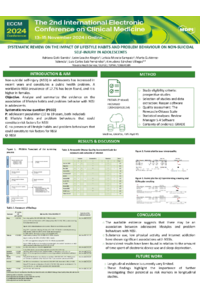
Non-suicidal self-injury (NSSI) in adolescents has increased in recent years and constitutes a public health problem. A worldwide NSSI prevalence of 17.7% has been found, and it is higher in females. The objective of this review is to analyze and summarize the evidence on the association of lifestyle habits and problem behavior with NSSI in adolescents.
Methods:
We searched cohort and case–control studies in Medline, Embase and APA PsycInfo with no date or language restrictions. The study protocol was registered in PROSPERO (CRD42024501154). People aged 10 to 19 years with established exposure factors (sleeping habits, physical activity, eating habits, toxic habits or problematic use of technology devices) were compared to those with no exposure factors. The main outcome was the proportion of patients with NSSI. Meta-analyses were carried out following the Cochrane methodology.
Results:
Out of 5295 identified records, a total of 13 cohort studies were included (43% of moderate quality, 36% of poor quality and 21% of high quality). The results showed a statistically significant increase in the risk of NSSI with regular smoking (OR 2.89; IC 95% 1.42-5.90; I2 58%; two studies), alcohol (two studies), early cannabis use (aOR 1.42; IC 95% 1.13-1.75; one study), and poor physical activity (OR 0.49; 0.41-0.58; one study). No significant association was found between NSSI and substance use in one study. Inconsistent results were found for the use of technology devices and sleep quality.
Conclusions:
The results of this review show that regular smoking, alcohol use, early cannabis use and poor physical activity could increase the risk of NSSI in adolescents. The role of other factors like sleeping habits or use of technology devices is still uncertain. More longitudinal studies with longer follow-up are needed to extract firm conclusions.
Keywords
Non-suicidal self-injury
NSSI
adolescent
problem behaviour
lifestyle
Poster
ID_104872_Adriana Goñi-Sarriés.pdf
The effects of multitask cognitive training on EEG changes and neurovascular unit markers in cardiac surgery patients
The Combination Therapy of Transarterial Chemoembolization and Microwave Ablation Leads to Better Survival for Liver Metastases from Colorectal Cancer: A Comparative Study