Event submissions
Published
This submission belongs to the session S7. Oncology & Hematology of the event The 2nd International Electronic Conference on Clinical Medicine
Published date
11 Nov, 2024
Academic Editor
'%3e%3cpath%20d='M12.6657%2010.9104C12.4185%2010.325%2012.0599%209.79327%2011.6097%209.34482C11.1609%208.89508%2010.6293%208.5365%2010.0442%208.28888C10.0389%208.28626%2010.0337%208.28495%2010.0285%208.28233C10.8446%207.69279%2011.3752%206.73249%2011.3752%205.64904C11.3752%203.8542%209.92103%202.39999%208.1262%202.39999C6.33136%202.39999%204.87715%203.8542%204.87715%205.64904C4.87715%206.73249%205.40774%207.69279%206.22393%208.28364C6.21869%208.28626%206.21345%208.28757%206.20821%208.29019C5.62129%208.5378%205.09463%208.89284%204.64265%209.34613C4.1929%209.79493%203.83432%2010.3266%203.58671%2010.9117C3.34345%2011.4845%203.21226%2012.0987%203.20023%2012.7209C3.19988%2012.7349%203.20233%2012.7488%203.20744%2012.7619C3.21255%2012.7749%203.22022%2012.7867%203.22998%2012.7968C3.23975%2012.8068%203.25142%2012.8147%203.26431%2012.8202C3.2772%2012.8256%203.29105%2012.8284%203.30504%2012.8284H4.09109C4.14874%2012.8284%204.19459%2012.7825%204.1959%2012.7262C4.2221%2011.7148%204.62823%2010.7676%205.34617%2010.0497C6.08899%209.30683%207.0755%208.89808%208.1262%208.89808C9.17689%208.89808%2010.1634%209.30683%2010.9062%2010.0497C11.6242%2010.7676%2012.0303%2011.7148%2012.0565%2012.7262C12.0578%2012.7838%2012.1037%2012.8284%2012.1613%2012.8284H12.9474C12.9613%2012.8284%2012.9752%2012.8256%2012.9881%2012.8202C13.001%2012.8147%2013.0126%2012.8068%2013.0224%2012.7968C13.0322%2012.7867%2013.0398%2012.7749%2013.0449%2012.7619C13.0501%2012.7488%2013.0525%2012.7349%2013.0522%2012.7209C13.0391%2012.0947%2012.9094%2011.4855%2012.6657%2010.9104ZM8.1262%207.9024C7.52486%207.9024%206.9589%207.6679%206.53312%207.24211C6.10733%206.81633%205.87283%206.25037%205.87283%205.64904C5.87283%205.0477%206.10733%204.48174%206.53312%204.05596C6.9589%203.63018%207.52486%203.39567%208.1262%203.39567C8.72753%203.39567%209.29349%203.63018%209.71927%204.05596C10.1451%204.48174%2010.3796%205.0477%2010.3796%205.64904C10.3796%206.25037%2010.1451%206.81633%209.71927%207.24211C9.29349%207.6679%208.72753%207.9024%208.1262%207.9024Z'%20fill='%235D1EE1'/%3e%3c/g%3e%3c/svg%3e) Alex C Spyropoulos
Alex C SpyropoulosCitation
Kezia Yaa Awortwe, Kwadjo Fosu, Lily Paemka, Molecular analysis of Rett syndrome gene expression in solid tumors: a bioinformatics view on the inverse relationship of Rett syndrome and solid tumors, in Proceedings of The 2nd International Electronic Conference on Clinical Medicine, 13 November–15 November 2024, MDPI: Basel, Switzerland
Share
Email
Facebook
Twitter
LinkedIn
Molecular analysis of Rett syndrome gene expression in solid tumors: a bioinformatics view on the inverse relationship of Rett syndrome and solid tumors
'%3e%3cpath%20d='M12.6647%2010.9104C12.4176%2010.325%2012.0589%209.7933%2011.6088%209.34485C11.16%208.89511%2010.6283%208.53653%2010.0432%208.28891C10.038%208.28629%2010.0327%208.28498%2010.0275%208.28236C10.8437%207.69282%2011.3743%206.73252%2011.3743%205.64907C11.3743%203.85423%209.92005%202.40002%208.12522%202.40002C6.33038%202.40002%204.87618%203.85423%204.87618%205.64907C4.87618%206.73252%205.40677%207.69282%206.22296%208.28367C6.21772%208.28629%206.21248%208.2876%206.20724%208.29022C5.62031%208.53783%205.09365%208.89287%204.64167%209.34616C4.19192%209.79496%203.83334%2010.3266%203.58573%2010.9117C3.34247%2011.4846%203.21128%2012.0987%203.19925%2012.721C3.1989%2012.735%203.20135%2012.7489%203.20646%2012.7619C3.21157%2012.7749%203.21924%2012.7868%203.22901%2012.7968C3.23877%2012.8068%203.25045%2012.8148%203.26334%2012.8202C3.27623%2012.8256%203.29007%2012.8284%203.30406%2012.8284H4.09012C4.14776%2012.8284%204.19362%2012.7825%204.19493%2012.7262C4.22113%2011.7148%204.62726%2010.7676%205.34519%2010.0497C6.08802%209.30686%207.07452%208.89811%208.12522%208.89811C9.17592%208.89811%2010.1624%209.30686%2010.9052%2010.0497C11.6232%2010.7676%2012.0293%2011.7148%2012.0555%2012.7262C12.0568%2012.7839%2012.1027%2012.8284%2012.1603%2012.8284H12.9464C12.9604%2012.8284%2012.9742%2012.8256%2012.9871%2012.8202C13%2012.8148%2013.0117%2012.8068%2013.0214%2012.7968C13.0312%2012.7868%2013.0389%2012.7749%2013.044%2012.7619C13.0491%2012.7489%2013.0515%2012.735%2013.0512%2012.721C13.0381%2012.0947%2012.9084%2011.4856%2012.6647%2010.9104ZM8.12522%207.90243C7.52388%207.90243%206.95792%207.66793%206.53214%207.24215C6.10636%206.81636%205.87185%206.2504%205.87185%205.64907C5.87185%205.04773%206.10636%204.48177%206.53214%204.05599C6.95792%203.63021%207.52388%203.3957%208.12522%203.3957C8.72655%203.3957%209.29252%203.63021%209.7183%204.05599C10.1441%204.48177%2010.3786%205.04773%2010.3786%205.64907C10.3786%206.2504%2010.1441%206.81636%209.7183%207.24215C9.29252%207.66793%208.72655%207.90243%208.12522%207.90243Z'%20fill='%235D1EE1'/%3e%3c/g%3e%3c/svg%3e)
Kezia Yaa Awortwe 1
Kwadjo Fosu 1,2
Lily Paemka 1,2,3
1. West African Centre for Cell Biology of Infectious Pathogens, Ghana
2. University of Ghana, Ghana
3. West African Genetic Medicine Centre, Ghana
Abstract
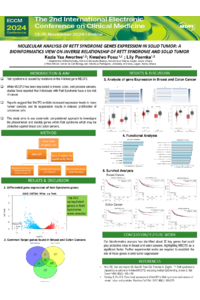
Background: Rett syndrome is caused by mutations in the X-linked gene MECP2. While MECP2 has been implicated in breast, colon, and prostate cancers, studies have reported that individuals with Rett syndrome have a low risk of cancer. Due to this, there is a need to investigate the molecular mechanism that contributes to the inverse relationship between Rett syndrome and cancers. This study therefore aims to use a systematic computational approach to identify genes within Rett syndrome which may be protective against breast, ovarian, and cervical cancers. This finding could have clinical implications for developing targeted therapies or diagnostic markers for these cancers.
Method: Publicly available transcriptomics data on Rett syndrome were analyzed with GEOR2.Venny 2.0, which was used to identify overlapping genes between Rett syndrome and breast, cervical, and ovarian cancers. We further analyzed their expression pattern using GEPIA2. ShinyGo and KM Plotter were used to perform functional analysis and survival analysis, respectively.
Results: A total of 250 overlapping genes were identified between Rett syndrome and breast, cervical, and ovarian cancers. NTRK3, EphA3, TFPI2, and WWC1 were upregulated in Rett syndrome but were significantly downregulated in the cancers, suggesting they may act as tumor suppressors. NTRK3, EphA3, TFPI2, and WWC1 significantly increased the survival probability of breast cancer cohorts, but they did not have the same effect on the other cancers. However, functional analysis revealed these genes may play a role in tumor suppression.
Conclusion: The NTRK3, EphA3, TFPI2, and WWC1 genes, which are upregulated in Rett syndrome but downregulated in breast, ovarian, and cervical cancers, may play a role in their inverse relationship.
Keywords
Solid tumors
Rett Syndrome
Bioinformatics
Poster
sciforum-100236- Kezia Yaa Awortwe.pdf
Prevalence and Impact of Skin Disorders in Palliative Care: A Systematic Review
Long-Term Survival Trends in Paediatric Patients with Solid Tumours in the State of São Paulo, Brazil (2000-2022): An Analytical Descriptive Epidemiological Study