Event submissions
Published

This submission belongs to the session S2. Chemistry of Bioorganic, Medicinal and Natural Products of the event The 28th International Electronic Conference on Synthetic Organic Chemistry
Published date
14 Nov, 2024
Academic Editor
'%3e%3cpath%20d='M12.6657%2010.9104C12.4185%2010.325%2012.0599%209.79327%2011.6097%209.34482C11.1609%208.89508%2010.6293%208.5365%2010.0442%208.28888C10.0389%208.28626%2010.0337%208.28495%2010.0285%208.28233C10.8446%207.69279%2011.3752%206.73249%2011.3752%205.64904C11.3752%203.8542%209.92103%202.39999%208.1262%202.39999C6.33136%202.39999%204.87715%203.8542%204.87715%205.64904C4.87715%206.73249%205.40774%207.69279%206.22393%208.28364C6.21869%208.28626%206.21345%208.28757%206.20821%208.29019C5.62129%208.5378%205.09463%208.89284%204.64265%209.34613C4.1929%209.79493%203.83432%2010.3266%203.58671%2010.9117C3.34345%2011.4845%203.21226%2012.0987%203.20023%2012.7209C3.19988%2012.7349%203.20233%2012.7488%203.20744%2012.7619C3.21255%2012.7749%203.22022%2012.7867%203.22998%2012.7968C3.23975%2012.8068%203.25142%2012.8147%203.26431%2012.8202C3.2772%2012.8256%203.29105%2012.8284%203.30504%2012.8284H4.09109C4.14874%2012.8284%204.19459%2012.7825%204.1959%2012.7262C4.2221%2011.7148%204.62823%2010.7676%205.34617%2010.0497C6.08899%209.30683%207.0755%208.89808%208.1262%208.89808C9.17689%208.89808%2010.1634%209.30683%2010.9062%2010.0497C11.6242%2010.7676%2012.0303%2011.7148%2012.0565%2012.7262C12.0578%2012.7838%2012.1037%2012.8284%2012.1613%2012.8284H12.9474C12.9613%2012.8284%2012.9752%2012.8256%2012.9881%2012.8202C13.001%2012.8147%2013.0126%2012.8068%2013.0224%2012.7968C13.0322%2012.7867%2013.0398%2012.7749%2013.0449%2012.7619C13.0501%2012.7488%2013.0525%2012.7349%2013.0522%2012.7209C13.0391%2012.0947%2012.9094%2011.4855%2012.6657%2010.9104ZM8.1262%207.9024C7.52486%207.9024%206.9589%207.6679%206.53312%207.24211C6.10733%206.81633%205.87283%206.25037%205.87283%205.64904C5.87283%205.0477%206.10733%204.48174%206.53312%204.05596C6.9589%203.63018%207.52486%203.39567%208.1262%203.39567C8.72753%203.39567%209.29349%203.63018%209.71927%204.05596C10.1451%204.48174%2010.3796%205.0477%2010.3796%205.64904C10.3796%206.25037%2010.1451%206.81633%209.71927%207.24211C9.29349%207.6679%208.72753%207.9024%208.1262%207.9024Z'%20fill='%235D1EE1'/%3e%3c/g%3e%3c/svg%3e) Julio A. Seijas
Julio A. SeijasCitation
Jorge M. S. Faria, Gonçalo Pereira, Activity of Satureja montana allelochemical volatiles against the pinewood nematode, in Proceedings of The 28th International Electronic Conference on Synthetic Organic Chemistry, 15 November–30 November 2024, MDPI: Basel, Switzerland, doi: 10.3390/ecsoc-28-20154
Share
Email
Facebook
Twitter
LinkedIn
Activity of Satureja montana allelochemical volatiles against the pinewood nematode

Jorge M. S. Faria 1
'%3e%3cpath%20d='M12.6647%2010.9104C12.4176%2010.325%2012.0589%209.7933%2011.6088%209.34485C11.16%208.89511%2010.6283%208.53653%2010.0432%208.28891C10.038%208.28629%2010.0327%208.28498%2010.0275%208.28236C10.8437%207.69282%2011.3743%206.73252%2011.3743%205.64907C11.3743%203.85423%209.92005%202.40002%208.12522%202.40002C6.33038%202.40002%204.87618%203.85423%204.87618%205.64907C4.87618%206.73252%205.40677%207.69282%206.22296%208.28367C6.21772%208.28629%206.21248%208.2876%206.20724%208.29022C5.62031%208.53783%205.09365%208.89287%204.64167%209.34616C4.19192%209.79496%203.83334%2010.3266%203.58573%2010.9117C3.34247%2011.4846%203.21128%2012.0987%203.19925%2012.721C3.1989%2012.735%203.20135%2012.7489%203.20646%2012.7619C3.21157%2012.7749%203.21924%2012.7868%203.22901%2012.7968C3.23877%2012.8068%203.25045%2012.8148%203.26334%2012.8202C3.27623%2012.8256%203.29007%2012.8284%203.30406%2012.8284H4.09012C4.14776%2012.8284%204.19362%2012.7825%204.19493%2012.7262C4.22113%2011.7148%204.62726%2010.7676%205.34519%2010.0497C6.08802%209.30686%207.07452%208.89811%208.12522%208.89811C9.17592%208.89811%2010.1624%209.30686%2010.9052%2010.0497C11.6232%2010.7676%2012.0293%2011.7148%2012.0555%2012.7262C12.0568%2012.7839%2012.1027%2012.8284%2012.1603%2012.8284H12.9464C12.9604%2012.8284%2012.9742%2012.8256%2012.9871%2012.8202C13%2012.8148%2013.0117%2012.8068%2013.0214%2012.7968C13.0312%2012.7868%2013.0389%2012.7749%2013.044%2012.7619C13.0491%2012.7489%2013.0515%2012.735%2013.0512%2012.721C13.0381%2012.0947%2012.9084%2011.4856%2012.6647%2010.9104ZM8.12522%207.90243C7.52388%207.90243%206.95792%207.66793%206.53214%207.24215C6.10636%206.81636%205.87185%206.2504%205.87185%205.64907C5.87185%205.04773%206.10636%204.48177%206.53214%204.05599C6.95792%203.63021%207.52388%203.3957%208.12522%203.3957C8.72655%203.3957%209.29252%203.63021%209.7183%204.05599C10.1441%204.48177%2010.3786%205.04773%2010.3786%205.64907C10.3786%206.2504%2010.1441%206.81636%209.7183%207.24215C9.29252%207.66793%208.72655%207.90243%208.12522%207.90243Z'%20fill='%235D1EE1'/%3e%3c/g%3e%3c/svg%3e)
Gonçalo Pereira 2
1. INIAV, I.P., National Institute for Agrarian and Veterinarian Research, Quinta do Marquês, 2780-159 Oeiras, Portugal
2. INIAV, Instituto Nacional de Investigação Agrária e Veterinária, Quinta do Marquês, 2780-159 Oeiras, Portugal
Abstract
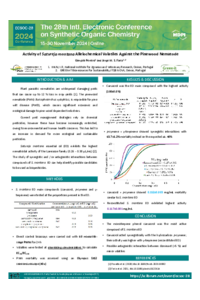
Essential oils (EOs) are complex mixtures of terpenic and phenolic volatiles, although other groups of compounds can be present in high proportions. Due to their strong biological activities, EOs have been increasingly screened for nematicidal activity against plant parasitic nematodes of crops and forest species. Direct-contact bioassays can provide important data on the properties of anti-nematodal chemical structures. In previous studies, the EO of Satureja montana, winter savory, revealed a high nematicidal activity against the pinewood nematode (PWN), a dangerous phytoparasite that attacks pine trees and causes pine wilt disease in susceptible trees. The bioactivity of S. montana EO was attributed to its oxygen-containing molecules, while the hydrocarbon molecules showed only a weak activity. However, the interactions between EO compounds was not ascertained. In the present study, the main compounds of winter savory EO, i.e., the phenol carvacrol (64%), and the hydrocarbons γ-terpinene (18%) and p-cymene (8%) were tested solely to pinpoint the main responsible for the nematicidal strength of the EO; and in binary combinations to assess synergistic or antagonistic interactions. Direct-contact bioassays were performed for the compounds and their binary combinations at the proportions they presented in the original EO. Carvacrol, induced the strongest response, inducing complete PWN mortality at a concentration as low as 0.5 mg/mL, however, γ-terpinene and p-cymene appear to influence its activity, even though they induced a low PWN mortality at 1 mg/mL. Uncovering the interactions between the components of nematicidal EOs can provide clues to formulate more effective sustainable alternatives to traditional pesticides.
Keywords
Bursaphelenchus xylophilus
carvacrol
essential oil
nematicide
toxicity
volatiles
winter savory
Manuscript
chemproc-sciforum_097705_S2_original_2024_Pereira_et_al-done.pdf
Poster
2024 Pereira et al Poster.pdf
The Bingel-Hirsch reaction is a universal key to the synthesis of hybrid molecules based on C60 fullerene and 5Z,9Z-dienoic acids - potential antitumor drugs.
Synthesis of a hybrid molecule based on 5Z,9Z-eicosa-5,9-dienoic acid and 1-aminoadamantane and study of cytotoxic activity.