Event submissions
Published

This submission belongs to the session S2. Chemistry of Bioorganic, Medicinal and Natural Products of the event The 28th International Electronic Conference on Synthetic Organic Chemistry
Published date
14 Nov, 2024
Academic Editor
'%3e%3cpath%20d='M12.6657%2010.9104C12.4185%2010.325%2012.0599%209.79327%2011.6097%209.34482C11.1609%208.89508%2010.6293%208.5365%2010.0442%208.28888C10.0389%208.28626%2010.0337%208.28495%2010.0285%208.28233C10.8446%207.69279%2011.3752%206.73249%2011.3752%205.64904C11.3752%203.8542%209.92103%202.39999%208.1262%202.39999C6.33136%202.39999%204.87715%203.8542%204.87715%205.64904C4.87715%206.73249%205.40774%207.69279%206.22393%208.28364C6.21869%208.28626%206.21345%208.28757%206.20821%208.29019C5.62129%208.5378%205.09463%208.89284%204.64265%209.34613C4.1929%209.79493%203.83432%2010.3266%203.58671%2010.9117C3.34345%2011.4845%203.21226%2012.0987%203.20023%2012.7209C3.19988%2012.7349%203.20233%2012.7488%203.20744%2012.7619C3.21255%2012.7749%203.22022%2012.7867%203.22998%2012.7968C3.23975%2012.8068%203.25142%2012.8147%203.26431%2012.8202C3.2772%2012.8256%203.29105%2012.8284%203.30504%2012.8284H4.09109C4.14874%2012.8284%204.19459%2012.7825%204.1959%2012.7262C4.2221%2011.7148%204.62823%2010.7676%205.34617%2010.0497C6.08899%209.30683%207.0755%208.89808%208.1262%208.89808C9.17689%208.89808%2010.1634%209.30683%2010.9062%2010.0497C11.6242%2010.7676%2012.0303%2011.7148%2012.0565%2012.7262C12.0578%2012.7838%2012.1037%2012.8284%2012.1613%2012.8284H12.9474C12.9613%2012.8284%2012.9752%2012.8256%2012.9881%2012.8202C13.001%2012.8147%2013.0126%2012.8068%2013.0224%2012.7968C13.0322%2012.7867%2013.0398%2012.7749%2013.0449%2012.7619C13.0501%2012.7488%2013.0525%2012.7349%2013.0522%2012.7209C13.0391%2012.0947%2012.9094%2011.4855%2012.6657%2010.9104ZM8.1262%207.9024C7.52486%207.9024%206.9589%207.6679%206.53312%207.24211C6.10733%206.81633%205.87283%206.25037%205.87283%205.64904C5.87283%205.0477%206.10733%204.48174%206.53312%204.05596C6.9589%203.63018%207.52486%203.39567%208.1262%203.39567C8.72753%203.39567%209.29349%203.63018%209.71927%204.05596C10.1451%204.48174%2010.3796%205.0477%2010.3796%205.64904C10.3796%206.25037%2010.1451%206.81633%209.71927%207.24211C9.29349%207.6679%208.72753%207.9024%208.1262%207.9024Z'%20fill='%235D1EE1'/%3e%3c/g%3e%3c/svg%3e) Julio A. Seijas
Julio A. SeijasCitation
ENAS BSHENA, Abdalrahem Shtawa, Sarra A Takita, Magdi Hassn Mussa, A Case Study on Utilizing Soy and Whey Protein Polymers: Advances in Enteric Coatings for Improved Delayed-Release Pharmaceuticals, in Proceedings of The 28th International Electronic Conference on Synthetic Organic Chemistry, 15 November–30 November 2024, MDPI: Basel, Switzerland, doi: 10.3390/ecsoc-28-20156
Share
Email
Facebook
Twitter
LinkedIn
A Case Study on Utilizing Soy and Whey Protein Polymers: Advances in Enteric Coatings for Improved Delayed-Release Pharmaceuticals
'%3e%3cpath%20d='M12.6647%2010.9104C12.4176%2010.325%2012.0589%209.7933%2011.6088%209.34485C11.16%208.89511%2010.6283%208.53653%2010.0432%208.28891C10.038%208.28629%2010.0327%208.28498%2010.0275%208.28236C10.8437%207.69282%2011.3743%206.73252%2011.3743%205.64907C11.3743%203.85423%209.92005%202.40002%208.12522%202.40002C6.33038%202.40002%204.87618%203.85423%204.87618%205.64907C4.87618%206.73252%205.40677%207.69282%206.22296%208.28367C6.21772%208.28629%206.21248%208.2876%206.20724%208.29022C5.62031%208.53783%205.09365%208.89287%204.64167%209.34616C4.19192%209.79496%203.83334%2010.3266%203.58573%2010.9117C3.34247%2011.4846%203.21128%2012.0987%203.19925%2012.721C3.1989%2012.735%203.20135%2012.7489%203.20646%2012.7619C3.21157%2012.7749%203.21924%2012.7868%203.22901%2012.7968C3.23877%2012.8068%203.25045%2012.8148%203.26334%2012.8202C3.27623%2012.8256%203.29007%2012.8284%203.30406%2012.8284H4.09012C4.14776%2012.8284%204.19362%2012.7825%204.19493%2012.7262C4.22113%2011.7148%204.62726%2010.7676%205.34519%2010.0497C6.08802%209.30686%207.07452%208.89811%208.12522%208.89811C9.17592%208.89811%2010.1624%209.30686%2010.9052%2010.0497C11.6232%2010.7676%2012.0293%2011.7148%2012.0555%2012.7262C12.0568%2012.7839%2012.1027%2012.8284%2012.1603%2012.8284H12.9464C12.9604%2012.8284%2012.9742%2012.8256%2012.9871%2012.8202C13%2012.8148%2013.0117%2012.8068%2013.0214%2012.7968C13.0312%2012.7868%2013.0389%2012.7749%2013.044%2012.7619C13.0491%2012.7489%2013.0515%2012.735%2013.0512%2012.721C13.0381%2012.0947%2012.9084%2011.4856%2012.6647%2010.9104ZM8.12522%207.90243C7.52388%207.90243%206.95792%207.66793%206.53214%207.24215C6.10636%206.81636%205.87185%206.2504%205.87185%205.64907C5.87185%205.04773%206.10636%204.48177%206.53214%204.05599C6.95792%203.63021%207.52388%203.3957%208.12522%203.3957C8.72655%203.3957%209.29252%203.63021%209.7183%204.05599C10.1441%204.48177%2010.3786%205.04773%2010.3786%205.64907C10.3786%206.2504%2010.1441%206.81636%209.7183%207.24215C9.29252%207.66793%208.72655%207.90243%208.12522%207.90243Z'%20fill='%235D1EE1'/%3e%3c/g%3e%3c/svg%3e)
ENAS BSHENA 1,2
Abdalrahem Shtawa 2,3
Sarra A Takita 3,4
Magdi Hassn Mussa 5,6,7
1. Huddersfield University, Queensgate, Huddersfield HD1 3DH, UK
2. Medical Research Center Zawia, Libyan Authority for Scientific Research, Zawia, P.O. Box 80045, Libya
3. Materials and Engineering Research Institute MERI, Sheffield Hallam University, Howard Street, Sheffield, S1 1WB, UK
4. Biomedical Research Centre(BMRC), Sheffield Hallam University, UK
5. The Institute of Marine Engineering, Science and Technology (IMarEST), London, UK
6. Sheffield Hallam university, Materials and Engineering Research Institute, UK
7. The Northern College, Wentworth Castle, Barnsley S75 3ET, UK
Abstract
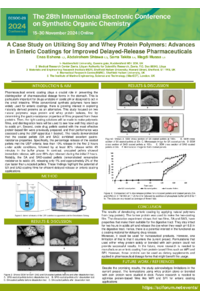
Enteric coating plays a crucial role in preventing the disintegration of pharmaceutical dosage forms in the stomach. This is particularly important for drugs that are unstable at an acidic pH or are designed to act in the small intestine. While conventional synthetic polymers have been widely used for enteric coatings, there is growing interest in exploring naturally derived proteins as an alternative. This study focused on two natural polymers: soya protein and whey protein isolates, first by determining the gastro-resistance properties of films prepared from these proteins. Then, appropriate casting solutions will be developed to create polymeric films, and their resistance to acidic pH will be evaluated using disintegration tests. Second, crate drug pellets coated with the most effective protein-based film were previously prepared, and their performance was assessed using the USP apparatus I (basket). The results demonstrated that the coated pellets (SA and SAG) exhibited excellent gastro-resistance properties. Specifically, the percentage release of the coated pellets met the USP criteria: less than 10% release in the first 2 hours under acidic conditions, followed by at least 80% release within 45 minutes in the buffer phase. In contrast, uncoated pellets showed immediate release, with over 69% of the dye released during the initial 2 hours. Notably, the SA and SAG-coated pellets demonstrated remarkable resistance to acidic pH, releasing only 1% and approximately 2% of the dye faster than uncoated pellets. These findings highlight the potential of SA and SAG coating films for efficient delayed release or enteric coating applications.
Keywords
biodegradable materials
blended protein
delayed-release
enteric coating
dissolution
Manuscript
chemproc-sciforum_098404_S2_original_A_Case_Study_on_Utilising_Soy_and_Whey_Protein_Polymers_Advances_in_Enteric_Coatings_for_Improved_Delayed_Release_Pharmaceuticals-done.pdf
Poster
poster presentation .pdf
Synthesis of a hybrid molecule based on 5Z,9Z-eicosa-5,9-dienoic acid and 1-aminoadamantane and study of cytotoxic activity.
Ti-catalyzed homo- and cross-cyclomagnesiation in the synthesis of 1Z,5Z-dienes containing a biologically active 3,4-dimethoxyphenyl fragment in their structure